Biography
Beatus of Liébana
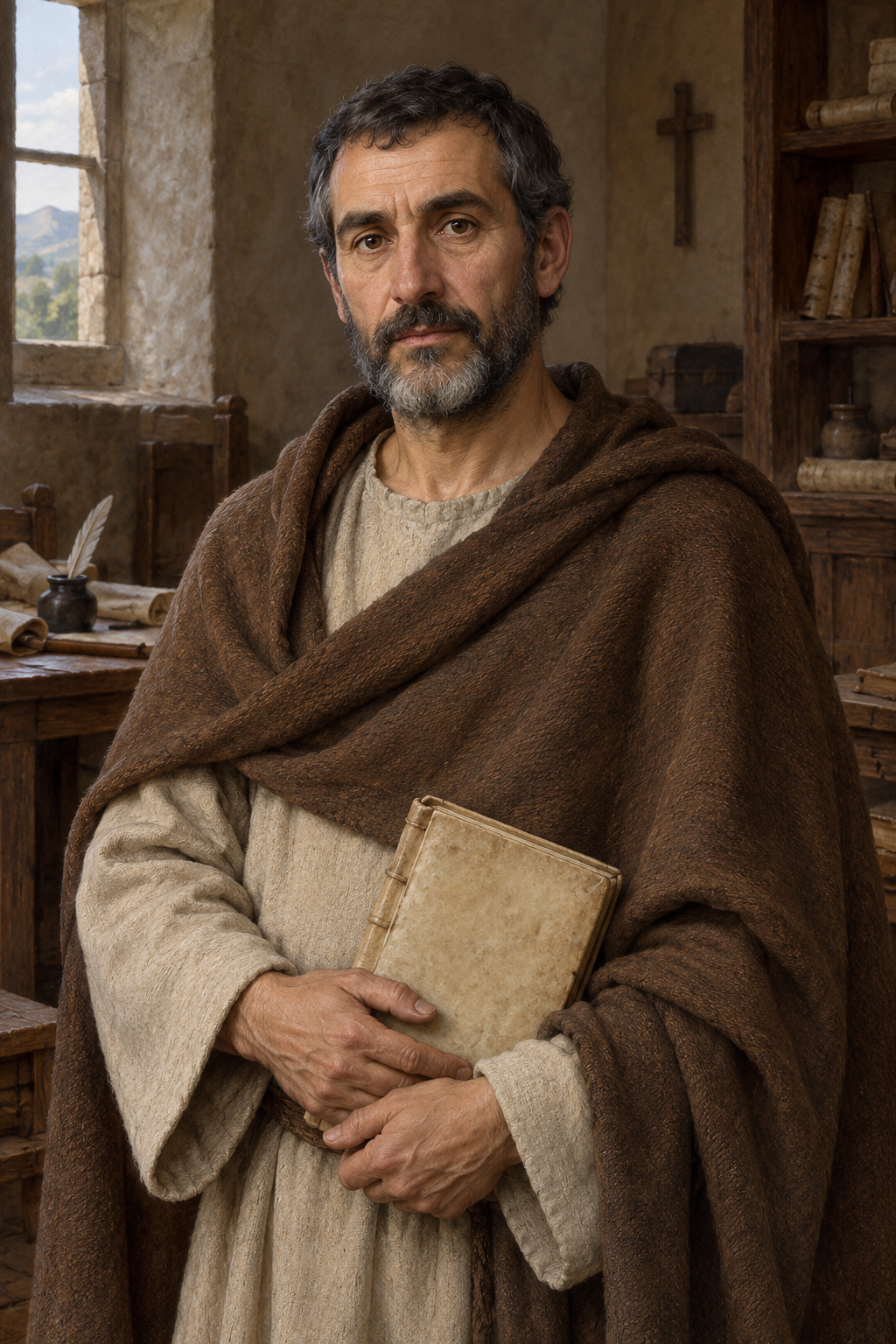
About Beatus of Liébana
Beatus of Liébana was a Christian priest and writer active in the later eighth century. His name is closely associated with the Commentary on the Apocalypse and with his opposition to the teaching of Elipandus of Toledo. Yet the details of his personal life are scarce. The National Library of Spain distinguishes his well-attested priesthood from less certain claims about his being a monk or abbot, and notes that his birthplace cannot be established securely.
He worked with Etherius, bishop of Osma, on a reply to Elipandus. The opening of their letter explains that they learned of a writing addressed to the abbot Fidel, which had been circulated against them and their faith. Their response presents the controversy through the image of a boat disturbed by a storm. Scripture supplies the language through which the authors describe both the dispute and their hope of remaining united in faith. It is a polemical work written to defend a conviction, rather than a detached history of the disagreement.
The argument concerns the identity of Christ. In the opening sections, Beatus and Etherius insist that the one born of Mary is truly God and truly human. They resist language that treats Christ as an adopted son in his humanity. Their reasoning turns to Peter’s confession of Christ, the testimony of the Gospel and the relation between belief and understanding. These passages make the religious purpose of their work visible: they considered the dispute a question about the faith confessed by the Church, not merely a choice between competing expressions.
José Antonio Fernández Flórez sets Beatus’s writing within the book culture of Liébana. His study points to evidence of manuscripts circulating in the region and to Beatus’s capacity to compose works of different kinds. It also distinguishes the roles of Beatus and Etherius in their literary partnership. The reply to Elipandus is the work most securely associated with Beatus; its language and themes help scholars assess the attribution of the Commentary and of a hymn traditionally connected with him. Those connections are conclusions of textual scholarship, rather than a surviving autobiographical account.
The Commentary draws extensively on earlier Christian interpreters. J. Williams describes it as a compilation using writers including Augustine, Jerome, Gregory and Tyconius. Biblical passages are followed by explanations, arranged within twelve books. The work therefore carries older traditions of interpretation into a new setting. Williams also cautions that no copy contemporary with Beatus survives. The manuscript evidence belongs to the history of its transmission, and the author’s precise purposes cannot be recovered simply by treating later copies as his own original book.
The Commentary’s dedication gives a more personal glimpse of the work he hoped to do. Addressing Etherius, Beatus says that he has undertaken it at his request for the benefit of the brethren. He presents the book as a gathering of explanations from Scripture and earlier Christian teachers, made easier to approach through a shorter presentation and plain language. He also asks forgiveness if his effort has offended anyone. In the preface’s closing image, the Apocalypse becomes a key to the biblical collection. These passages present a writer trying to make a difficult text useful within a religious community, rather than an artist describing his own pictures.
Fernández Flórez cautions against reducing the Commentary to a prediction of catastrophe or a campaign against Islam. Much of its language comes from earlier interpreters, and references to persecution cannot automatically be read as descriptions of Beatus’s own surroundings. He also distinguishes its purpose from the later reply to Elipandus. The two works belong to the same writer’s legacy, but their arguments and occasions should not be collapsed into one controversy.
The richly illustrated manuscripts called Beatos preserve that later history. Williams traces changes in their images and decorative organization across generations of copying. They do not prove that Beatus personally painted the surviving scenes. Different versions added material and developed new ways to present the text. The relationship between commentary and pictures became a distinctive achievement of medieval bookmaking, but the hands of later scribes and artists remain part of the story. A manuscript bearing the work’s name may be centuries later than the writer who helped give it that name.
One such witness is the National Library of Spain’s codex associated with Fernando I and Sancha. The library’s 2023 exhibition dossier follows its changing value, ownership and preservation. During the Spanish Civil War, it was among the volumes removed from Madrid for protection; it returned to the library after the war. The dossier also describes how facsimiles and digitization have widened access while the original remains carefully conserved. This is the history of a treasured copy and of those who cared for it, not evidence for Beatus’s own travels or belongings.
The monastery of Santo Toribio keeps his Catholic commemoration on February 19. His birth, death year and burial place remain uncertain. His surviving literary legacy includes interpreting Scripture and defending the faith he professed.
Wondering how to weigh the stories and sources? Learn how to read a saint biography.