Biography
Benedict the Moor
About Benedict the Moor
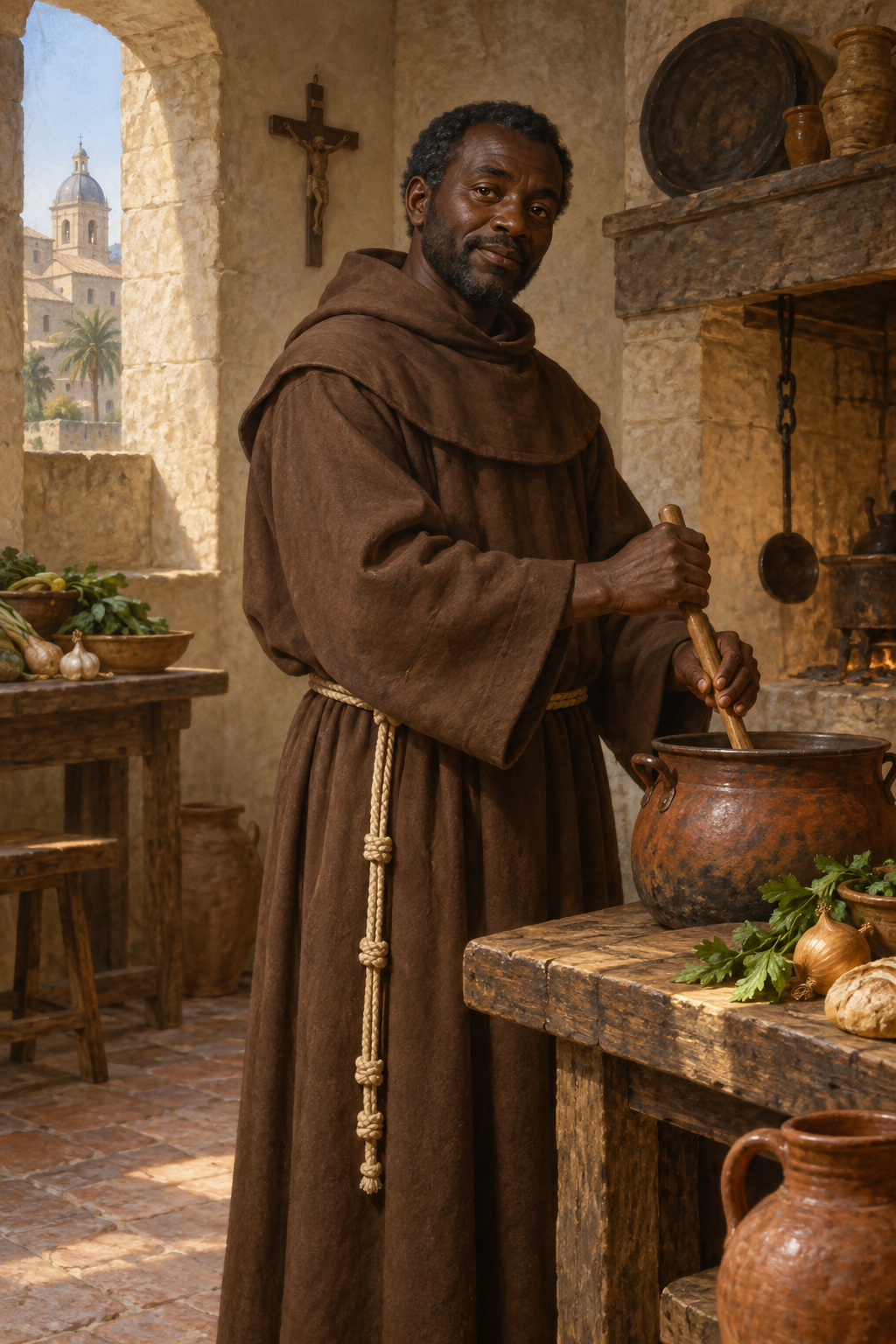
Benedict Manassari was born at San Fratello, Sicily, in 1526. The Dicastery says his parents descended from enslaved Africans. The 1907 Catholic Encyclopedia describes them as enslaved Christians from Ethiopia. An account published by the Franciscan General Curia says the family had been promised freedom for their firstborn. That OFM account gives 1524 as the birth year, while the Dicastery and Catholic Encyclopedia give 1526; the profile follows the latter concordant date. The OFM narrative also says Benedict tended livestock for the family’s enslaver and faced mockery over his complexion and family status. It recounts that at twenty-one he met the hermit Girolamo Lanza, sold his oxen, gave the proceeds to the poor and joined the hermitage.
The Dicastery places his entry into a hermit community at about twenty-one and locates the community on Monte Pellegrino. The Catholic Encyclopedia records that he joined a newly formed hermit association and entered the Franciscan Order when Pope Pius IV dissolved it. Franciscan Media places the hermits around Palermo and says Benedict was eventually recognized as their leader. A separate OFM account describes Santa Domenica and a rigorous communal rule of fasting, solitude and prayer. The sources do not yield one fully consistent hermit chronology, so the profile preserves only the common transition from hermit life to Franciscan life.
The Dicastery says Benedict spent twenty-four years at Santa Maria di Gesù in Palermo and lists his sequence of work: cook, superior, novice master and cook again. The Catholic Encyclopedia says he was made superior three years after joining, though he was a lay brother, and credits him with reforming the monastery. The OFM General Curia dates his appointment as guardian to 1578 and says priests and friars sought his counsel about Scripture, faith and the Franciscan Rule. Franciscan Media also names him novice master and guardian, positions it calls unusual for a lay brother, and says he returned to kitchen work when his term ended. Franciscan Media recounts that he once asked a novice’s pardon after discovering that he had assigned penance to the wrong person. The same source describes later traditions about his prayer, fasting, simplicity and reputation for holiness. The OFM account reports healings attributed to Benedict in the canonization proceedings; these are recorded here as claims in his devotional history, not independently established events.
Benedict died in Palermo on 4 April 1589 and was beatified in 1743 and canonized in 1807. The Dicastery lists April 4 as his liturgical memorial and names him co-patron of Palermo with Saint Rosalia. Fiume’s study notes that images and hagiographies were collected during the long canonization process and that production began after his death. It records the transfer of Benedict’s body to a wooden coffin by the altar of Santa Maria di Gesù in 1611. Fiume traces the cult from Sicily through Spain and Portugal to the Americas, with image production increasing after the 1743 beatification. Her analysis argues that Franciscan image-making shaped how Benedict’s sanctity was represented in seventeenth-century Sicily. Sean Wyer’s study of contemporary Palermo rhetoric shows politicians invoking Benedict as a symbol of coexistence, while warning that this selective civic story can obscure his parents’ enslavement and Sicily’s own role in slavery.
Sean Wyer’s study of contemporary Palermo rhetoric shows politicians invoking Benedict as a symbol of coexistence, while warning that this selective civic story can obscure his parents’ enslavement and Sicily’s own role in slavery. Fiume argues that seventeenth-century images first presented Benedict as a model of Franciscan reform and lay religious life, then connected him with the evangelization of enslaved Africans. Franciscan Media says he referred to the things he used as “ours” rather than “mine,” presenting this as a sign of his simplicity and communal life. It also reports that he followed Francis’s example by keeping seven forty-day fasts each year and sleeping only a few hours a night; these remain devotional biographical traditions.
Wondering how to weigh the stories and sources? Learn how to read a saint biography.