Biography
Bernardino Realino
About Bernardino Realino
Bernardino Realino was born at Carpi, Modena, on December 1, 1530. The existing catalog stores that birth date and place, and this draft preserves both fields.
The catalog slug is `bernardino-realino`. This packet preserves the slug and filenames so the importer, artwork, and review paths all match the existing runtime row.
Realino's early life included serious study and civil responsibility. Sources remember his legal training and public offices before his entrance into the Society of Jesus.
That pre-Jesuit background matters. The page should not make him appear to have stepped directly from childhood into priesthood; his conversion and vocation came after education, public work, and worldly prospects.
It also helps explain the tone of his later ministry. Realino could understand public responsibility, civic conflict, and ordinary human ambitions from the inside, not only as an outside preacher.
The Society of Jesus source helps frame that shift. Realino left a career of status and responsibility for religious life, priesthood, and pastoral service.
The catalog classifies him as `Priest / Deacon` and `Monk / Nun`. This draft preserves those fields, using the second class as the catalog's broad religious life vocabulary for a Jesuit.
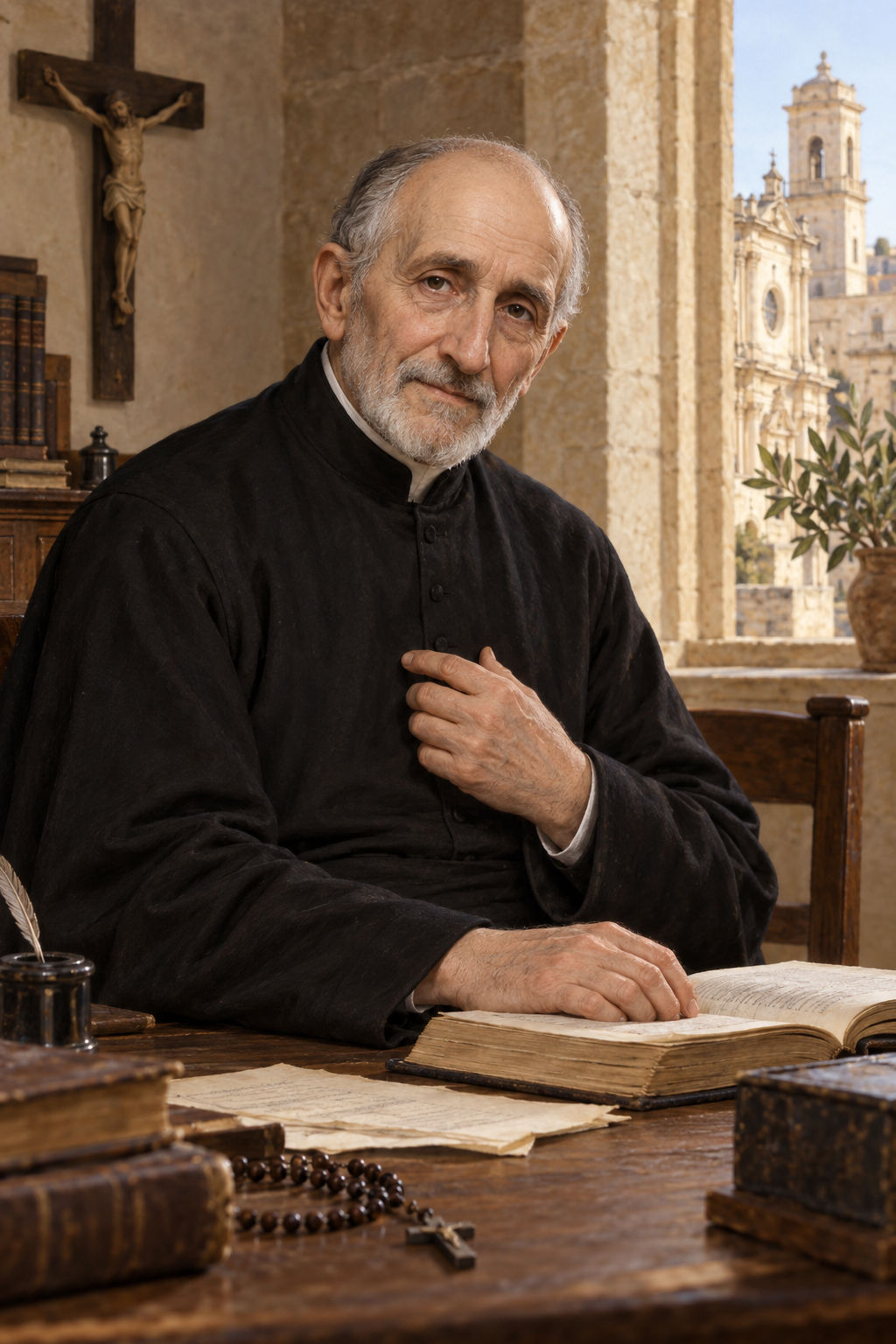
His visual identity should therefore be a Jesuit priest in a simple black cassock, with book, papers, rosary, and crucifix. He should not be shown as a bishop, friar, or monk in ornate robes.
Realino's mature ministry was centered in Lecce. The city is not only his death place; it is the place where his pastoral identity became deeply remembered.
The sources emphasize preaching, confession, counsel, and care for vulnerable people. The page can name prisoners and the sick without turning them into visual scenery or creating dramatic prison and hospital tableaux.
Confession and counsel are especially important because they show patient, personal ministry. Realino's holiness was not only public preaching; it was also the slow work of listening, discerning, correcting, and encouraging.
His ministry should be shown through ordinary pastoral signs: a desk, book, rosary, confessional care, and warm Lecce stone. Those cues carry the story without crowding the image.
The Dicastery profile names care for prisoners and the sick alongside ministry of the word and penance. That combination gives the public article a strong shape: speech, sacrament, counsel, and mercy.
Those themes also keep the prose from becoming a list of offices. The biography should show a priest whose learning and age made him available to people at many kinds of need.
Treccani adds useful historical context for the Jesuit presence and Lecce memory. It should be used as context, not as a reason to overload the biography with institutional or architectural detail.
Realino's relationship with Lecce is unusually strong in the tradition. Sources remember him as associated with the city's affection and later patronage, but the page should avoid turning the profile into a civic ceremony.
The affection of a city can be named, but it should remain secondary to the pastoral reasons for that affection: years of availability, preaching, counsel, and care for people in need.
This restraint matters for artwork too. The background can suggest Lecce, but the portrait should focus on the Jesuit priest and his pastoral work rather than on public honors.
Realino died in Lecce on July 2, 1616. The catalog already stores the full death date, death place, and July 2 feast, and this draft preserves them.
He was beatified in 1896 and canonized in 1947. Those recognitions belong in the article, but the center should remain his long Jesuit ministry rather than the ceremonial history of the cause.
The cause history should therefore stay concise. Realino's public significance does not depend on a long approval chronology; it rests on a life remembered for pastoral presence and charity in Lecce.
The page should avoid late miracle or relic traditions unless each claim is separately sourced and clearly categorized. A compact profile does not need extraordinary stories to make Realino's holiness legible.
His witness is especially clear for people whose earlier skills are converted into service. Legal training, administrative discipline, and intelligence became tools for pastoral counsel and care.
That conversion of gifts is the thread that can hold the article together. The young jurist did not disappear; his disciplined mind became part of the older Jesuit's service to souls.
The final page should leave readers with an elderly Jesuit pastor in Lecce: wise, approachable, disciplined, attentive to confession and counsel, and remembered for charity that did not need spectacle.
Artwork should show an elderly Italian Jesuit priest in black cassock, in a simple Lecce room with crucifix, book, papers, and rosary. Avoid bishop vestments, civic ceremony, prison or hospital drama, ornate baroque excess, rendered text, halos, and exact-likeness claims.
The badge crop should keep Realino's face, cassock, hand, book, and pastoral room visible. It should read as Jesuit priestly care before it reads as a generic elderly cleric.
Wondering how to weigh the stories and sources? Learn how to read a saint biography.