Biography
Boethius
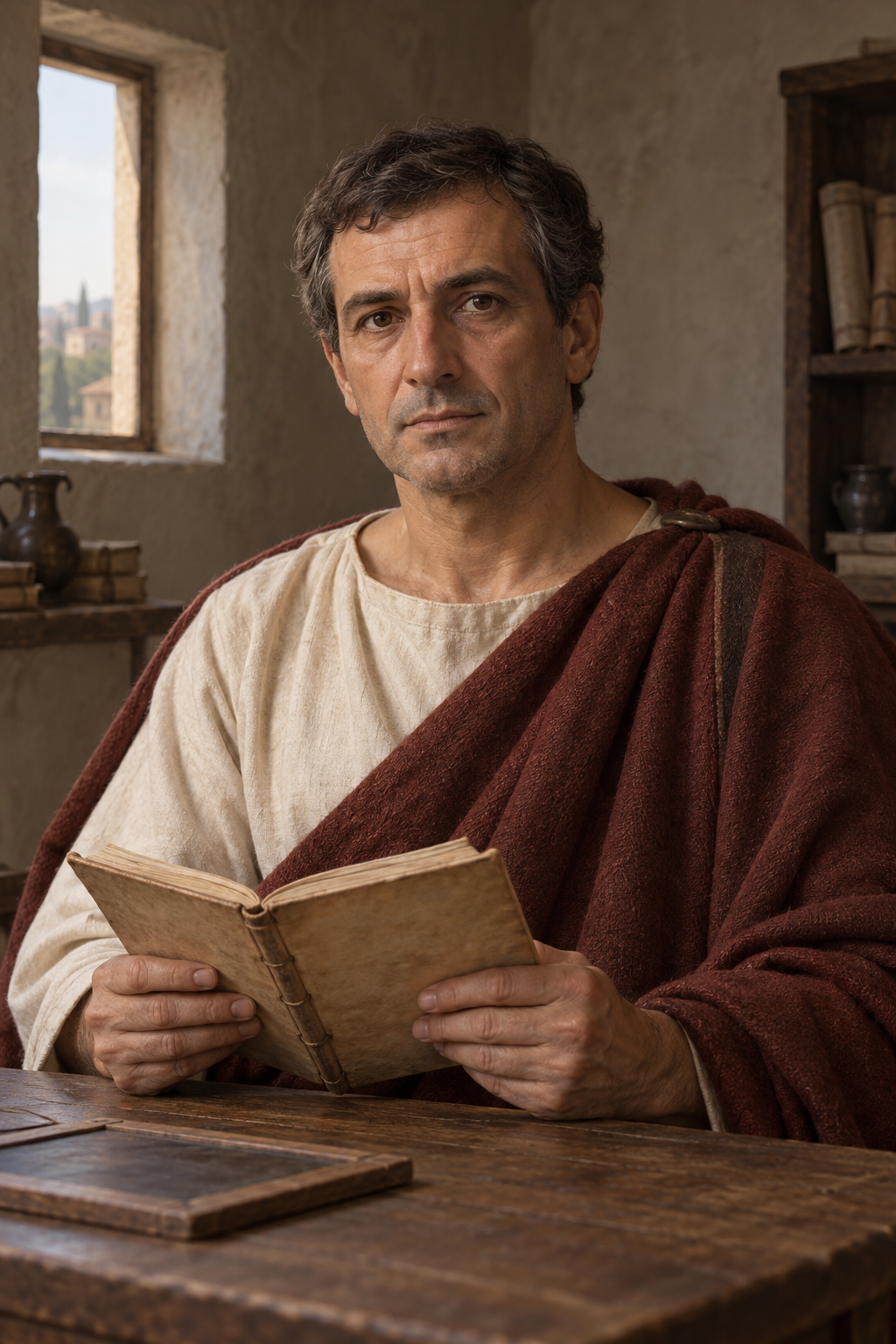
About Boethius
Boethius grew up in the Roman aristocracy and combined a life of learning with public responsibility. After his father’s death, he entered the household of Symmachus and married Symmachus’s daughter Rusticiana. He became consul and later served Theodoric as master of offices. His career placed him within the difficult relationship between Roman senatorial families and the Ostrogothic monarchy.
His intellectual work reached beyond the needs of office. John Marenbon’s account describes a sustained engagement with Aristotle’s logic and with Porphyry’s explanations of it. Boethius translated, commented and wrote textbooks that helped Latin readers work through questions of classification and argument. He also brought these methods into discussions of Christian doctrine. The significance lay in more than preserving titles from an older culture. His choices shaped how later students encountered those texts, while his own reasoning gave the inherited material a particular direction.
The opening of his treatise on the Trinity reveals the seriousness with which he approached that task. Addressing Symmachus, he submits an argument for examination and acknowledges the limits of human understanding. He asks whether ideas drawn from Augustine have borne fruit in his own thinking. The dedication also makes clear that he is writing for a demanding reader, rather than seeking easy approval from a large audience. The discussion then begins with the Christian confession of one God in three persons and examines the ways in which things can be called the same or different. He distinguishes agreement in genus, species and number rather than treating sameness as one relation. Here philosophical distinctions serve a religious question. This is a different kind of writing from a simple devotional tribute: it asks how the language used in belief can be understood without turning divine unity into a collection of separate gods.
His political position did not protect him. The accusation against the senator Albinus drew Boethius into a treason case, and he was imprisoned near Pavia. The surviving accounts differ in emphasis, and scholars continue to distinguish the political and religious pressures behind the proceedings. His execution is certain, while its exact chronology is debated. The later tradition gives 524, whereas a scholarly reconstruction places it in 526. That uncertainty does not diminish the abrupt change from high office to captivity.
The Consolation of Philosophy begins within that changed world. Its narrator is writing in sorrow when a commanding woman appears. She is Philosophy, presented as the teacher he has known since youth. The scene belongs to an imagined dialogue, not a report of a supernatural visitor. She challenges the poetry that keeps his distress alive and begins to recover his capacity for thought. As he recognises her, the conversation places his suffering beside the experiences of earlier philosophers who met hostility or unjust death. The opening does not hurry past grief. It gives the prisoner a voice, then answers him through a figure able to question the conclusions he has drawn from his misfortune. Boethius turns philosophical instruction into a scene of encounter, allowing the movement from confusion towards understanding to become part of the book’s form.
Benedict XVI returned to this work in a 2008 audience. He interpreted its concern with fortune and providence as a response to the experience of injustice, rather than an invitation to passive resignation. His reading stressed friendship that survives the loss of outward advantages, the possibility of prayer and hope, and the difference between apparent prosperity and lasting good. He also connected Boethius’s story with people imprisoned or tortured because of their convictions. This is a modern Christian reception of the work, distinct from a reconstruction of every detail of the ancient trial. It helps explain why a book written in the shadow of execution can still be read as a search for wisdom.
Pavia preserves another part of that reception in worship. A 2025 diocesan homily for his local commemoration describes Boethius as a martyr and recalls papal recognition of the city’s longstanding cult. The celebration took place at San Pietro in Ciel d’Oro. Its prayers and readings linked the search for wisdom with conduct in prosperity and adversity. The homily gave that connection a practical emphasis: understanding should help form an upright life, including the exercise of public responsibility. Such observance is evidence of an enduring local religious memory. It does not, by itself, settle every historical question about the motives for his execution or the date of a formal canonization.
His wider influence was equally durable. Marenbon traces the role of his translations and commentaries in medieval learning and the readership of the Consolation beyond specialist schools. The work was translated into vernacular languages and inspired further literary writing. Boethius remains important both for the tools he supplied to later thinkers and for the form he gave to the problem of seeking understanding when public success has collapsed.
Wondering how to weigh the stories and sources? Learn how to read a saint biography.