Biography
Teacher Eleazar
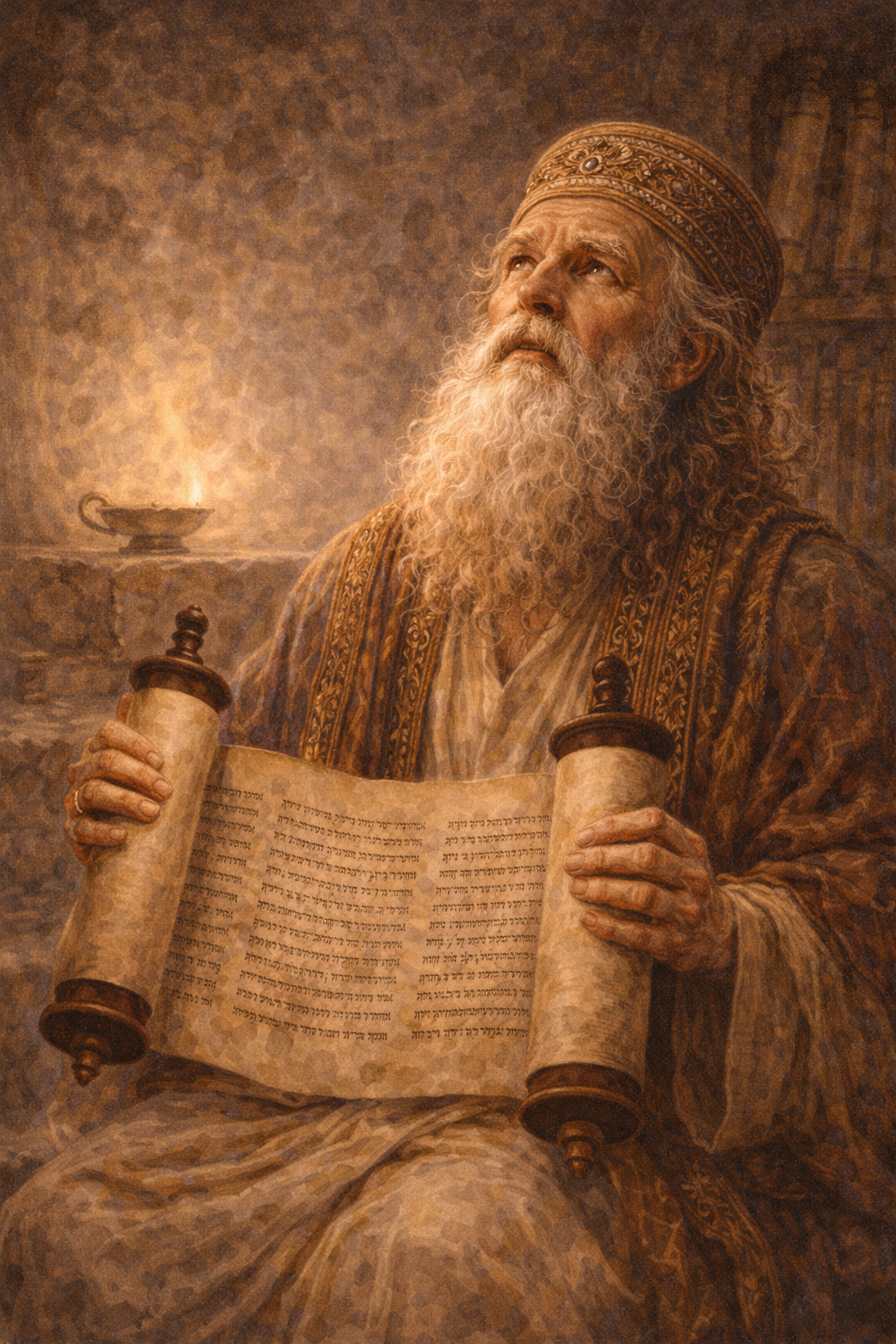
About Teacher Eleazar
Eleazar is the elderly Jewish scribe whose martyrdom opens the paired persecution narratives in 2 Maccabees 6–7. The text calls him one of the foremost scribes, about ninety years old, noble in appearance, and admirable in conduct from childhood. It does not give his family, birthplace, career chronology, or an exact date. The chapter belongs to a work describing Seleucid efforts under Antiochus IV Epiphanes to suppress Jewish law and worship. Its note identifies Eleazar’s story and the following account of a mother and seven sons as early models of martyrology, composed to encourage a persecuted people. His narrated witness is traditional; the text and its later reception are documented.
The setting is organized coercion, not a private disagreement about food. The preceding verses describe decrees forbidding sabbath observance and traditional feasts, compelling participation in sacrifices, and executing people who refused Greek customs. Eleazar is forced to open his mouth to eat pork, food prohibited by the law he follows. He spits it out and goes toward the instrument of torture. The narrative praises that choice, but it should not be turned into contempt for bodies or ordinary measures taken to preserve life. His decision arises under state violence designed to erase a community’s religious identity; responsibility for the killing belongs to the persecutors who remove any safe freedom of conscience.
Officials who have known Eleazar for a long time take him aside and propose an escape. He could provide food lawful for him to eat and merely pretend that he consumed the king’s sacrificial meat. Their offer shows that the crisis is partly public performance: authorities want visible compliance whether or not the forbidden food is actually swallowed. Friendship makes the proposal less brutal than immediate force, yet it still asks him to cooperate with a lie sustaining persecution. Eleazar considers not only his own survival but what observers will infer. The episode therefore turns on integrity under coercion, where a seemingly small deception may teach others that conviction can be traded for safety.
Eleazar refuses the staged meal because younger people might believe that a ninety-year-old teacher had abandoned his ancestral religion. He says that gaining a short extension of life through pretense would bring dishonor and lead the young astray. This is the clearest basis for the later title “Teacher Eleazar”: in the biblical passage he teaches through public example, although 2 Maccabees does not explicitly call him the instructor of the seven brothers. His reasoning also deserves careful limits. The text commends truthful witness in this particular persecution; it does not make every disputed practice a cause for death, authorize coercion by religious communities, or excuse leaders from protecting vulnerable lives whenever protection is genuinely possible.
After speaking, Eleazar is taken immediately to the instrument of torture. Those who had shown goodwill become hostile because they judge his refusal foolish. The chapter says that he dies under blows and reports both severe bodily pain and inward devotion. Its theological voice presents his death as a noble example for young people and the nation. The violence must remain visible: an aged prisoner is beaten to death because he will not perform religious conformity. Yet the narrative need not be expanded with invented injuries, last gestures, or a precise execution site. It supplies no independent witness list and no coordinates, and its crafted speech belongs to ancient historiography and exhortation rather than a modern transcript.
Chapter 7 then introduces seven brothers and their unnamed mother in a separate scene. The biblical text does not state that Eleazar taught them, that they watched his death, or that the two trials occurred at one location. Their shared placement creates a literary sequence: an elder’s example is followed by younger people and a mother who resist the same forced meal. Later Orthodox tradition explicitly calls the brothers Eleazar’s disciples and names their mother Solomonia. That relationship is meaningful within the tradition but should not be retrojected into chapter 6 as documented biography. Likewise, the title “Maccabee” is liturgical usage for these martyrs, not evidence that Eleazar belonged genealogically to the Hasmonean family.
The Orthodox Church in America remembers the group on August 1 and calls Eleazar a scribe and teacher of the Law. Its account assigns his suffering to 166 BC and Jerusalem. These details provide an authoritative witness to Eastern Orthodox tradition, not independent contemporary documentation. The date is therefore retained only in the feast narrative, not entered as an exact death date; the former catalog birth and death values implied knowledge the sources do not support. Jerusalem may be displayed as a traditional association without a pin claiming the place of imprisonment or execution. The OCA’s liturgical Menaion also names Eleazar with Solomonia and the seven, showing that their joined remembrance is embedded in worship.
Eleazar’s virtues appear in actions rather than flawless labels. He rejects a false performance when it could mislead people under his care. He considers the young before his own reputation, and he endures the consequences without disguising physical pain. His short speech makes influence a moral responsibility: age and public standing can either shelter expediency or offer truthful guidance. At the same time, readers should resist praising torture as spiritually useful. The persecutors’ cruelty is evil, and Eleazar’s courage does not lessen the duty to oppose systems that manufacture such choices. His witness asks how integrity can protect a community while preserving compassion for people whose fear leads them to different decisions.
The surviving evidence supports a focused portrait rather than a complete life. Nothing reliable establishes Eleazar’s parents, education, students by name, travels, daily teaching, or burial. Even his age is part of the narrated account rather than an independently verified civil record. What can be said is substantial but bounded: 2 Maccabees presents a respected elder subjected to religious coercion, offered deceptive escape, concerned about the effect of his conduct, and killed after refusing. Orthodox tradition receives him as teacher and martyr alongside Solomonia and seven sons. Remembered responsibly, he is neither a symbol detached from Jewish persecution nor a pretext for romanticizing death, but a witness to integrity, responsibility, and freedom of conscience under violent rule.
Wondering how to weigh the stories and sources? Learn how to read a saint biography.