Biography
Bruno Lemarchand
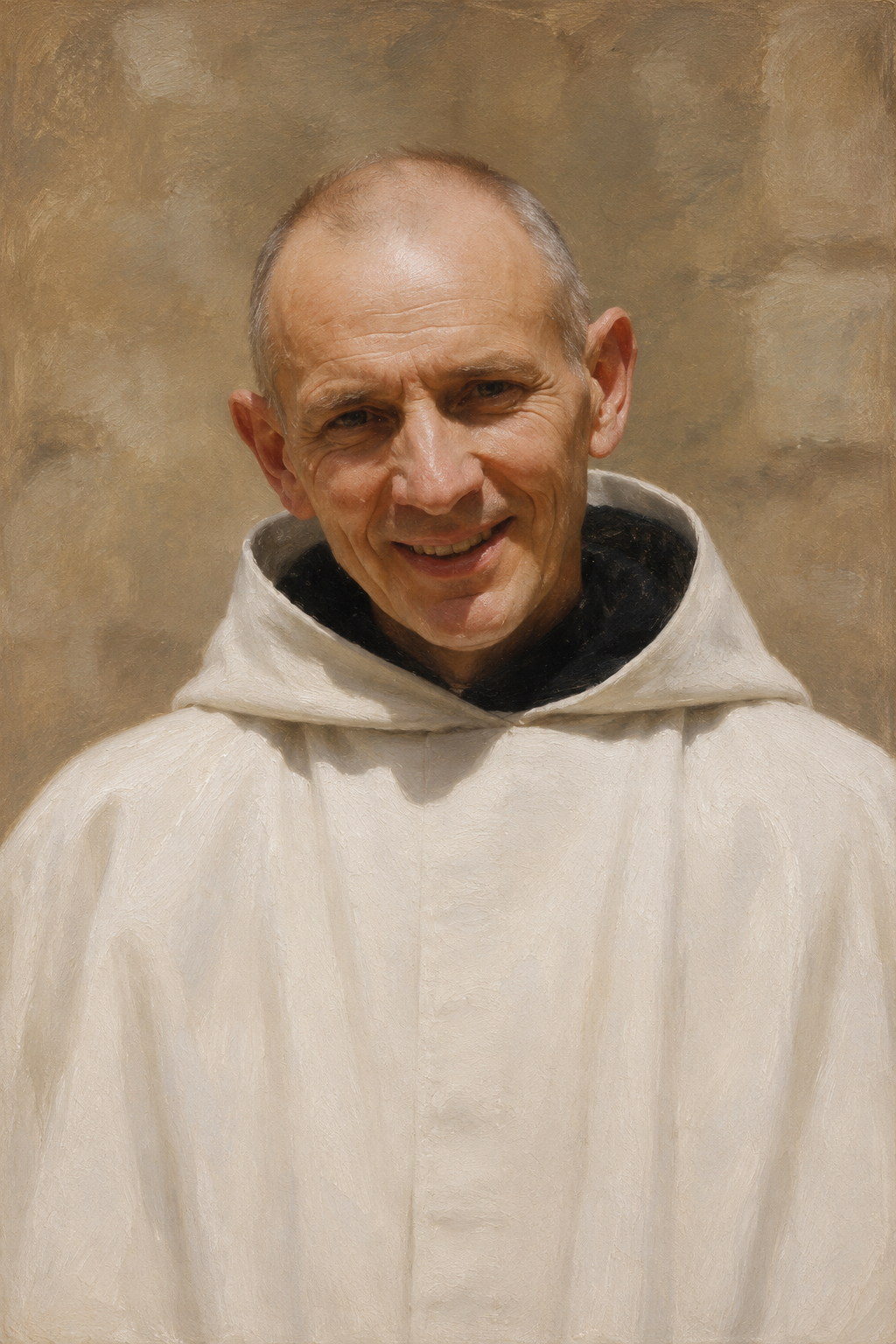
About Bruno Lemarchand
Bruno Lemarchand was born Christian Lemarchand at Saint-Maixent on 1 March 1930. His father’s military career took the family to Syria, Tonkin and Algeria. In a later account of his vocation, he remembered relatives whose prayers supported him and a childhood religious formation that stayed with him. A desire for monastic life emerged while he was still young.
An earlier attempt at monastic life at Ligugé in 1961 had ended painfully.
He entered the major seminary at Poitiers after secondary school and performed military service in Algeria between 1951 and 1953. Ordained on 2 April 1956, he spent the following decades teaching at Saint-Charles in Thouars, where he also became the school’s superior. In 1981 he entered the Trappist monastery of Bellefontaine. Notes from that year present silence, prayer, work and cheerful service as parts of the same calling. He looked to the hidden life of Jesus at Nazareth as a pattern for his own.
The move required adjustment. Reporting from Bellefontaine after his death, Eric Fottorino described Bruno as deliberate and conscientious, a capable speaker who preferred quiet. He could seem rather stiff, and unexpected changes unsettled him. Yet the same account emphasizes his readiness to listen. These recollections preserve a recognizable temperament, with limitations as well as strengths, rather than portraying his vocation as effortless.
His novice master, Etienne Baudry, remembered a decisive conversation on 6 April 1984. Bruno calmly but firmly told him that he felt called to Tibhirine. Michel Fleury and Célestin Ringeard had independently expressed the same desire that week. Baudry believed the three requests were authentic and understood their departure as a sacrifice asked of Bellefontaine. This is the novice master’s recollection and religious interpretation of their decisions.
Bruno reached Tibhirine in August 1984 but struggled to adapt and returned to Bellefontaine. He asked to try again in 1988, received a welcoming reply from Christian de Chergé and returned in April 1989. He made his solemn profession on 21 March 1990. That October he moved to the community’s Moroccan house at Fès, becoming its superior in 1991.
The Moroccan foundation had a place within the community’s wider commitment. Armand Veilleux visited Fès in November 1995 and Tibhirine in January 1996. His written report explained that the house had been established in response to an invitation from the Church in Morocco. It extended a Christian monastic presence into another Muslim country. Veilleux regarded the two houses as one community living in different circumstances, united by their Cistercian calling and relationships with Muslim neighbors. He also recognized the practical difficulty: maintaining Fès divided already limited resources and could weaken Tibhirine if the balance were neglected. The Moroccan house offered a possible refuge if violence forced the brothers to leave Algeria. Its meaning, however, was wider than emergency shelter. Veilleux saw its gradual integration into Moroccan society and the local Church as part of a developing vocation. His assessment places Bruno’s responsibility within both the spiritual aims and material pressures of a small community.
Bruno’s own letter of 8 January 1996 speaks from within that quiet life at Fès. He expressed gratitude for being there and described his existence through the image of seed hidden in the ground. Growth would come in its own time. He connected his hope with God’s work throughout the world and acknowledged that new life could involve suffering. The surviving excerpt expresses faith and patience; it does not predict the circumstances of his death.
He returned to Tibhirine on 18 March 1996 for an election of the prior. Armed men abducted him with six brothers during the night of 26–27 March. They died that year; the communiqué naming 21 May does not establish an independently verified death date.
In December 1995 he again described his monastic life through Nazareth, expressing happiness that its demands were becoming simpler for him.
Bruno was beatified with the other martyrs of Algeria at Oran on 8 December 2018. The theologian Marie-Dominique Minassian places his return to Algeria within a personal history that included childhood, military service and a sister buried there. Her study interprets the monks’ commitments through sustained listening to Scripture, to one another and to their neighbors. It situates their religious decisions within relationships formed over time.
His earlier work in education also remained part of his memory. In November 2022, Saint-Charles announced a gathering with relatives, former pupils and staff, alongside researchers collecting the monks’ writings. Participants were invited to bring photographs, letters and other documents for digitization and to share memories of daily life with him. A photograph accompanying the report shows him among school staff in a garden he had arranged, where he liked to walk and reflect. The gathering’s purpose connected his later monastic vocation with the years during which pupils and colleagues had known him as Father Christian Lemarchand.
Wondering how to weigh the stories and sources? Learn how to read a saint biography.