Biography
César de Bus
About César de Bus
César de Bus was born at Cavaillon in Provence on February 3, 1544. The catalog stores Cavaillon, Provence, Papal States, as his birthplace, and this draft preserves that historically textured field.
His life began in a world shaped by Renaissance Provence, noble households, regional loyalties, and the religious tensions of sixteenth-century France. Those surroundings matter because César's later vocation was not abstract.
He is remembered as a priest and catechist, but the sources also describe a younger life drawn toward honor, culture, and public advancement. The page should mention that turn without using it as a moral caricature.
The most responsible way to tell the story is to show conversion as a long redirection. César did not become significant because his earlier life was colorful; he became significant because he placed learning, speech, and pastoral organization at the service of ordinary Christians.
The Catholic Encyclopedia and the official cause profile both help frame this movement toward priesthood and instruction. They should be used as supporting sources, not as a license to invent scenes of interior struggle.
In the Catholic reform era, catechesis was not a minor classroom accessory. It answered a pastoral need: many believers needed clear teaching in prayer, Scripture, sacraments, and the basic shape of Christian life.
César's work responded to that need by making instruction regular, public, and organized. He became a priest whose main contribution was the patient teaching of Christian doctrine.
The biography should keep his social setting visible, but it should not make the page mainly about politics or military service. His enduring witness lies in catechetical perseverance.
He gathered companions around that purpose. The Fathers of Christian Doctrine, often known through the Doctrinaires, developed as a community for teaching the faith clearly and forming people in Christian life.
That foundation should be central in the article. It shows that César did more than give occasional lessons; he built a form of shared ministry that could continue beyond one person's energy.
The page should describe the work concretely. A priest with books, notes, and a small teaching room is more accurate than a grand reformer posed above a crowd.
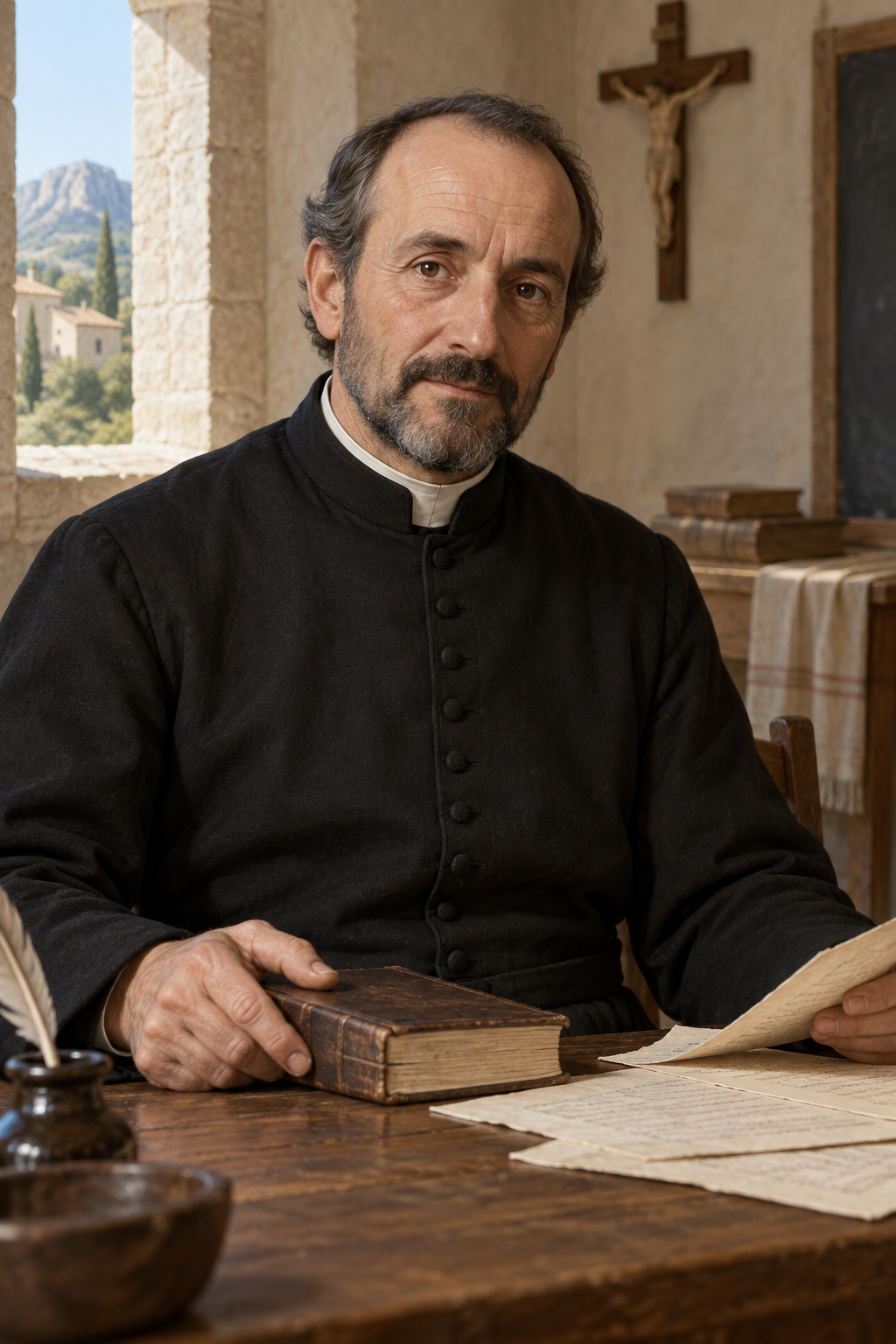
The artwork follows that interpretation. The generated portrait shows a mature French priest in a black cassock with catechism papers and books, in a quiet Provençal chapel or schoolroom.
That visual choice also avoids a common error. César was not a bishop; the catalog classifies him as `Priest / Deacon`, and this draft preserves that field without adding unsupported secondary classes.
His ministry took place in a Church working to renew preaching, discipline, and instruction. He fits that reform landscape because he chose a humble but foundational task: helping people understand what the Church taught.
Instruction can sound small when compared with dramatic travel or martyrdom. For César, it was the core of charity, because people cannot freely embrace a faith they have never been helped to understand.
The sources remember him as founder of a community devoted to Christian Doctrine. That title should not become a slogan; the biography should explain the practical meaning of doctrine as pastoral teaching.
He died at Avignon on April 15, 1607. The catalog already preserves that death date, death place, feast day, and priestly classification, and this packet keeps those values stable.
Later recognition came slowly. César was beatified by Paul VI in 1975 and canonized by Pope Francis on May 15, 2022.
The canonization note belongs near the end rather than at the center. His story is not the story of a modern ceremony; it is the story of a priest who built a teaching ministry in a time when careful instruction mattered deeply.
The article should avoid overstatement. It need not claim that César solved the religious crisis of France or that every later catechetical movement depends on him.
What can be said is strong enough: he made Christian teaching an organized vocation, gathered companions for it, and left behind a recognizable Catholic memory of priestly catechesis.
His witness remains useful wherever religious language is repeated without understanding. César de Bus points to teaching as an act of patience, humility, and pastoral love.
The final page should leave readers with a teacher-priest at a table, not a triumphal reformer. His holiness is found in the durable work of explaining the faith clearly, again and again, for the people in front of him.
That ordinary scale is not a weakness in the account. It is the reason César's memory still matters for families, teachers, catechists, and parish groups. The recorded facts point toward a man who chose the slow work of formation over public display, and the final profile should let that slower witness remain visible without apology.
Artwork should show a mature French priest in a simple cassock, with catechism book, loose papers, quill, crucifix, and Provençal chapel or schoolroom context. Avoid bishop's vesture, grand preaching crowds, political imagery, readable text, halo, modern classrooms, and exact-likeness claims.
The badge crop should keep the face, clerical collar, crucifix, book, and papers visible. It should read as catechist and priest before it reads as a generic clerical portrait.
Wondering how to weigh the stories and sources? Learn how to read a saint biography.