Biography
Christophe Lebreton
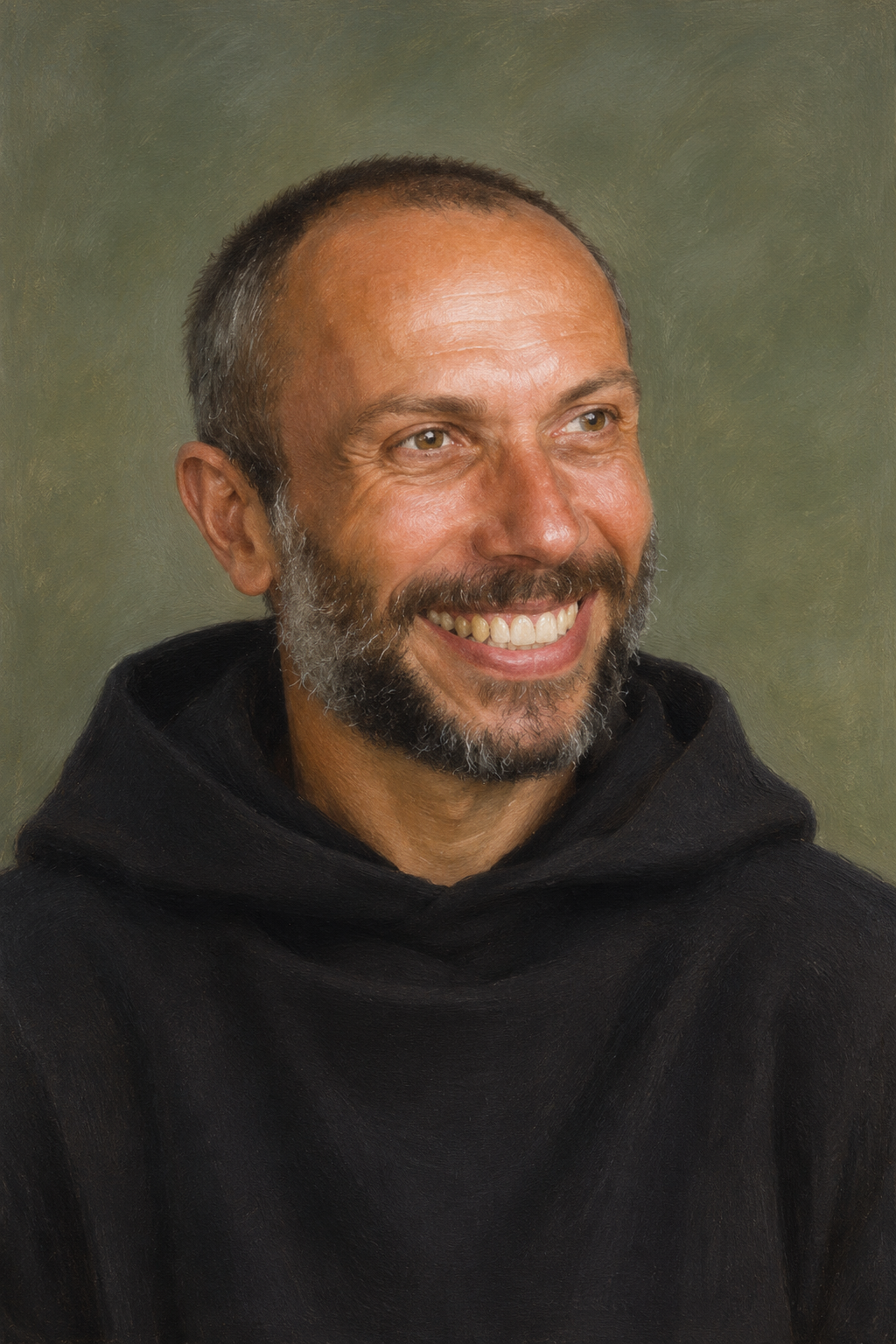
About Christophe Lebreton
Christophe Lebreton was born at Blois on 11 October 1950, the seventh of twelve children. In an account written during his early monastic years, he recalled an affectionate family and a Christian upbringing that allowed freedom. He entered the minor seminary as a boy, then chose a different direction after completing school in 1968.
He studied law at Tours and stopped practicing his faith, but work in Emmaüs camps kept him close to people experiencing poverty. The writings of Charles de Foucauld helped renew his religious commitment. He considered joining the Little Brothers of Jesus before completing his national service through educational work in Algeria. Encounters with the community at Tibhirine led him toward the Trappists. Because the small monastery could not provide a novitiate, he began his formation at Tamié.
He entered Tamié in November 1974, spent a period at Tibhirine during his formation and returned to France. After solemn profession in 1980, he trained as a carpenter in Troyes. He later helped at Notre-Dame des Dombes. In 1987 he returned to Tibhirine, where he shared responsibility for the garden and cared for the liturgy.
Michel Sol, who knew him at Tamié from 1981 to 1985, remembered a physically strong man with a definite character and a quiet manner when assigning work. Christophe consulted a small notebook, spoke softly and greeted each brother with a slight smile and nod. Sol also recalled his friendship with Jean-Bernard, a guest with multiple disabilities who regularly stayed inside the monastery. Several monks shared the tasks of helping him move, eat, wash and attend prayer; Christophe took part in that care. His taste for physical work appeared in farming, haymaking and clearing snow from the access road after the early morning office. These firsthand memories describe service through particular tasks rather than through an abstract reputation for generosity.
Friendship could also grow through acknowledged failures. Brother Didier remembered Christophe losing his temper with him and immediately asking forgiveness. They embraced, and the encounter became a lasting point of reference in their friendship. Before leaving for Algeria, Christophe carved a cross, divided it and gave Didier one half while keeping the other. Didier understood it as a sign that distance need not break their shared commitment. Years later Christophe told him that his own half had been lost while plowing at Tibhirine. Didier recalled the incident with emotion after his friend’s death. His testimony also describes opening the poems Christophe had entrusted to him when news of the killings arrived. Those earlier writings became a means of remembering his friend and sharing something of his faith with others.
Christophe was ordained a priest on 1 January 1990. His earlier wish to devote himself to manual work had made him reluctant to seek ordination, but experience receiving guests at the Dombes led him to consider a wider ministry. Minassian’s study describes this change as part of a developing vocation rather than an inevitable progression.
Didier also preserved Christophe’s last letter to him, which urged the importance of Gospel friendship and work for peace. Their relationship continued through correspondence after they ceased living in the same monastery.
His writings belong within that daily life. In a 2025 literary study, Jędrzej Pawlicki examines the connection between Christophe’s monastic work, his relationships with Muslim neighbors and his response to violence. Pawlicki emphasizes practical encounters in the garden, where agricultural tasks and conversation existed together. He interprets these exchanges as a space in which people could continue speaking to one another when public life was increasingly dominated by fear. In this reading, religious fidelity involved attention to ordinary relationships and resistance to being absorbed into a political camp. The argument is an interpretation of Christophe’s writings, not evidence that his community stood outside the pressures of its time.
In May 1992 he took responsibility for a novice’s formation. Family ties remained close: in October 1995 he was with his mother and relatives as his father lay dying. His letters continued to follow both joyful and painful events in their lives.
Christophe himself rejected an account of violence that placed it entirely on the Muslim side. In a letter discussed by Minassian, he turned attention toward the Christian’s own need for conversion and toward friendship with a Muslim coworker.
A diary passage from July 1995 describes the monks’ circumstances as a call to deeper conversion and a more stripped-down way of remaining. Christophe prayed to become a servant and to offer his life for peace. The words reveal his religious response to danger; they do not turn the violence that followed into something harmless or desirable.
He was abducted with six other monks during the night of 26–27 March 1996 and died in circumstances that remain uncertain.
He was beatified with the martyrs of Algeria at Oran on 8 December 2018.
Wondering how to weigh the stories and sources? Learn how to read a saint biography.