Biography
Claude La Colombière
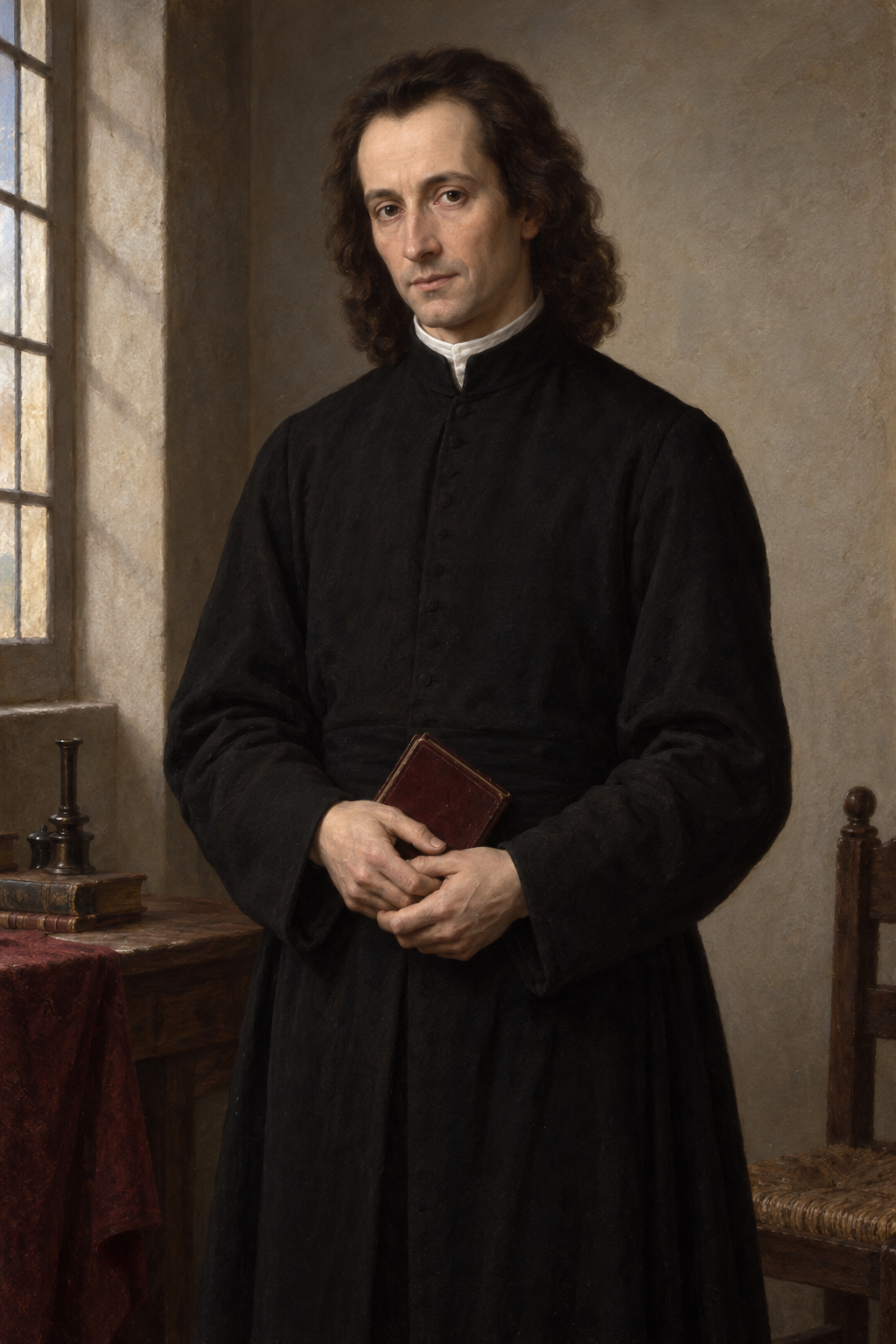
About Claude La Colombière
Claude La Colombière was a French Jesuit priest whose preaching and spiritual friendship helped spread devotion to the Sacred Heart of Jesus. He was born at Saint-Symphorien-d’Ozon on 2 February 1641, the son of a notary. His education took him through Vienne and Lyon. Drawn to literature and close personal friendships, he did not describe entry into religious life as an easy or untroubled choice. Nevertheless, he entered the Jesuit novitiate at Avignon at seventeen.
Years of formation combined study with teaching. He taught grammar and literature at Avignon, then went to Paris for theology in 1666. His superiors also entrusted him with tutoring the children of Jean-Baptiste Colbert, Louis XIV’s finance minister. After ordination he returned to Lyon, where teaching gave way to preaching and the direction of Marian congregations. The Vatican biography remembers sermons addressed to the real concerns of particular audiences, with an emphasis on confidence in God.
His further Jesuit formation culminated in final vows in February 1675, followed by appointment as superior at Paray-le-Monial. There he became acquainted with Margaret Mary Alacoque, a Visitation nun who reported visions of Christ’s heart. Jesuit historian Thomas McCoog carefully distinguishes Claude’s personal conviction from formal ecclesiastical recognition: Claude found her experiences convincing when they had not yet been authenticated by Church authorities. His willingness to listen and support her became a central part of his remembered ministry.
John Paul II later described their relationship as a spiritual fraternity. In the pope’s account, Claude’s preparation in the Spiritual Exercises helped him discern the meaning of Margaret Mary’s experience. The devotion called for a response to Christ’s love through Eucharistic communion, renewed fidelity and charity. At Claude’s canonization, the pope explained reparation as a return to God inspired by mercy, with each person’s offering directed toward the good of others. This interpretation gives the devotion a communal purpose as well as a personal one.
In 1676 Claude was sent to London as chaplain to Mary of Modena, Duchess of York. Political suspicion surrounding Catholicism made the assignment precarious. In 1678 Titus Oates’s fabricated allegations of a Catholic conspiracy provoked arrests and executions. Claude was imprisoned in the King’s Bench Prison that November, and the conditions aggravated his pulmonary illness. He was expelled to France in early 1679. The experience brought his English ministry to an end and left him seriously weakened.
His time abroad had not ended his correspondence with Margaret Mary. The Catholic Encyclopedia records that he continued to guide her by letter despite the difficulties of his English assignment. After returning to France he served as spiritual director to young Jesuits at Lyon and sought relief for his health at Paray. These final responsibilities kept him involved in the formation of others, even as illness narrowed the scope of his work.
Claude’s writings preserve a wider ministry than his association with one devotion might suggest. They include reflections, meditations on the Passion, retreat notes and spiritual letters, later gathered into collected editions. The Catholic Encyclopedia records nineteenth-century editions published at Avignon and Paris. Through these texts, readers could encounter both his counsel to others and the religious concerns that shaped his own life. His literary legacy therefore extends beyond the accounts of his conversations with Margaret Mary.
Theologian Timothy O’Malley draws attention to that breadth. In a 1678 letter discussed in his study, Claude advises a correspondent to serve God within her present responsibilities rather than assume that different circumstances would solve her distractions. O’Malley also examines his preaching on providence, where trust rests on God’s love rather than on a belief that human life can be made free of difficulty. These passages connect spiritual direction with the demands of ordinary work and the willingness to care for people already close at hand.
O’Malley also discusses a retreat passage in which Claude examines his love for his neighbours. The question is whether he recognizes Christ in each person or merely favours agreeable companions. His examination extends to his own brothers, making daily community life a practical test of the love professed in prayer.
Claude died at Paray-le-Monial on 15 February 1682. John Paul II canonized him on 31 May 1992.
His teaching continued to receive attention in later Catholic reflection. In the 2024 encyclical Dilexit nos, Pope Francis emphasized Claude’s insistence on confidence in Christ rather than satisfaction with personal sacrifices or achievements. Francis also recalled his meditation on Jesus facing betrayal without hatred. The emphasis falls on a heart transformed by trust and compassion, including compassion toward enemies. That reading preserves an important feature of Claude’s legacy: devotion is meant to change the way a person responds to others, not simply the intensity of private feeling. Francis places this teaching at the meeting of Margaret Mary’s spiritual experience and the concrete Gospel contemplation of the Ignatian Exercises.
Wondering how to weigh the stories and sources? Learn how to read a saint biography.