Biography
Cornelius Hill
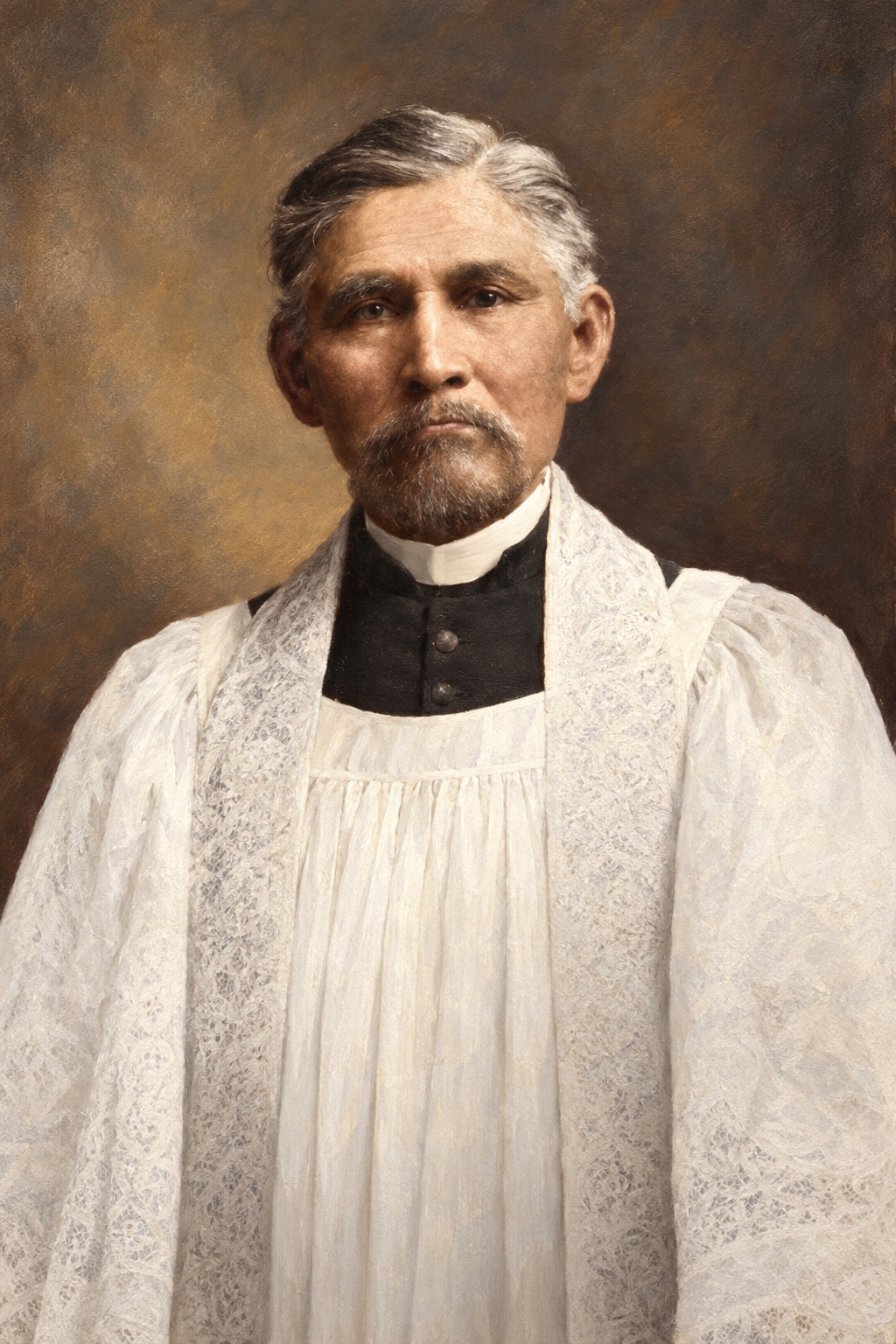
About Cornelius Hill
Cornelius Hill served the Wisconsin Oneida community as a leader, interpreter, musician, and eventually an Episcopal priest. Julia Keen Bloomfield’s early account places his birth in 1834 and describes his schooling at Nashotah. Its exact birth date conflicts with the age given in the same book’s obituary, so his birth year remains probable. He became a Bear clan chief while young. The account also records his work with census information and annuity payments, responsibilities that placed him within the practical affairs of his people.
Bloomfield preserves a statement attributed to Hill rejecting pressure to leave Oneida land. He refused to treat payment as a reason to surrender his people’s home. The passage connects his Christian convictions with his insistence on remaining where the community had settled. The original occasion is not established in the portion of the book inspected, and its surrounding missionary narrative cannot substitute for Hill’s own full account.
His defense of Oneida land took place amid growing commercial pressure. The Milwaukee Public Museum’s history describes how white pine on the reservation attracted lumber companies during the 1850s. Although families cultivated their own parcels, the land was held communally. Supporters of allotment wanted individual ownership, which would allow timber and land sales. Hill feared that the Oneida would lose their reservation lands to outsiders. The disagreement divided Oneida leaders as well as involving outside interests. Federal allotment followed in the 1890s. The museum’s account records that much of the land later passed into non-Oneida ownership, the danger that Hill and other opponents had feared.
A later history by Thelma Cornelius McLester, published in the Oneida newspaper Kalihwisaks, describes Hill traveling with other chiefs to council meetings from early adulthood. It also recalls several journeys to Washington with fellow Oneida leaders to defend their lands. His representative work extended to church affairs: he served as a delegate to Episcopal councils in Milwaukee. These journeys placed him in meetings beyond his home community, speaking on matters that affected its future. McLester’s account remembers his political leadership alongside his religious service, rather than treating ordination as the beginning of his public life.
The diary of John Archiquette offers glimpses of Hill’s activities beyond later tributes. The original manuscript was written in Oneida and later translated by Oscar Archiquette. In the surviving English translation, an October entry identifies him as a witness in a federal court case concerning allegedly illegal purchases of Oneida timber. Another entry records him supervising a log drive on Duck Creek in 1872. His opposition to losing tribal land did not mean withdrawal from the community’s timber economy. The diary also lists him among three delegates sent by the congregation to a meeting of ministers in Milwaukee that June, with money provided for their expenses.
Music appears in the same record: a band roster names Hill as a cornet player. In January 1874, the diary places him in a delegation traveling to Albany with other Oneida leaders and an interpreter. A later entry records a letter addressed to him there. These brief notices preserve particular journeys and responsibilities without supplying the contents of his speeches or proving the outcome of negotiations.
The memoir written by Solomon Burleson’s sons identifies Hill as Onan-gwat-go and records his ordination as a deacon on June 27, 1895. That year agrees with the recollection of his colleague F. W. Merrill. Hill’s clerical ministry thus followed many years of service in the community. Burleson encouraged the preparation of Oneida clergy, believing that a minister from the community could reach people in ways an outside missionary could not. His sons describe Hill’s ordination as a result of that effort.
Merrill remembered Hill interpreting, playing the organ, leading singers, and helping with the parish’s practical work. His tribute describes someone whose contribution extended beyond a formal church office. Parish labor and community consultation appear alongside music and worship in this colleague’s recollections. The tribute is admiring testimony from a missionary associate, whose perspective does not encompass every Oneida experience of the church.
Before Hill’s ordination to the priesthood, he and other Oneida speakers worked for more than a year on a translation of the Eucharistic liturgy. Merrill describes repeated preparation for its use. Hill celebrated the service the morning after his ordination, with elders hearing it in their own language. The same tribute remembers his visits to older and sick people to bring them Communion. These particular acts show the place of language and personal pastoral care in his ministry.
Hill was ordained priest on June 24, 1903, and died at Oneida on January 25, 1907.
Holy Apostles parish continues to remember him on June 27. Its commemorative notice recalls his vows in the Oneida language and his burial in the churchyard. His memory there joins Oneida community leadership with the ministry of a priest who served his own people.
Wondering how to weigh the stories and sources? Learn how to read a saint biography.