Biography
Cuthbert Mayne
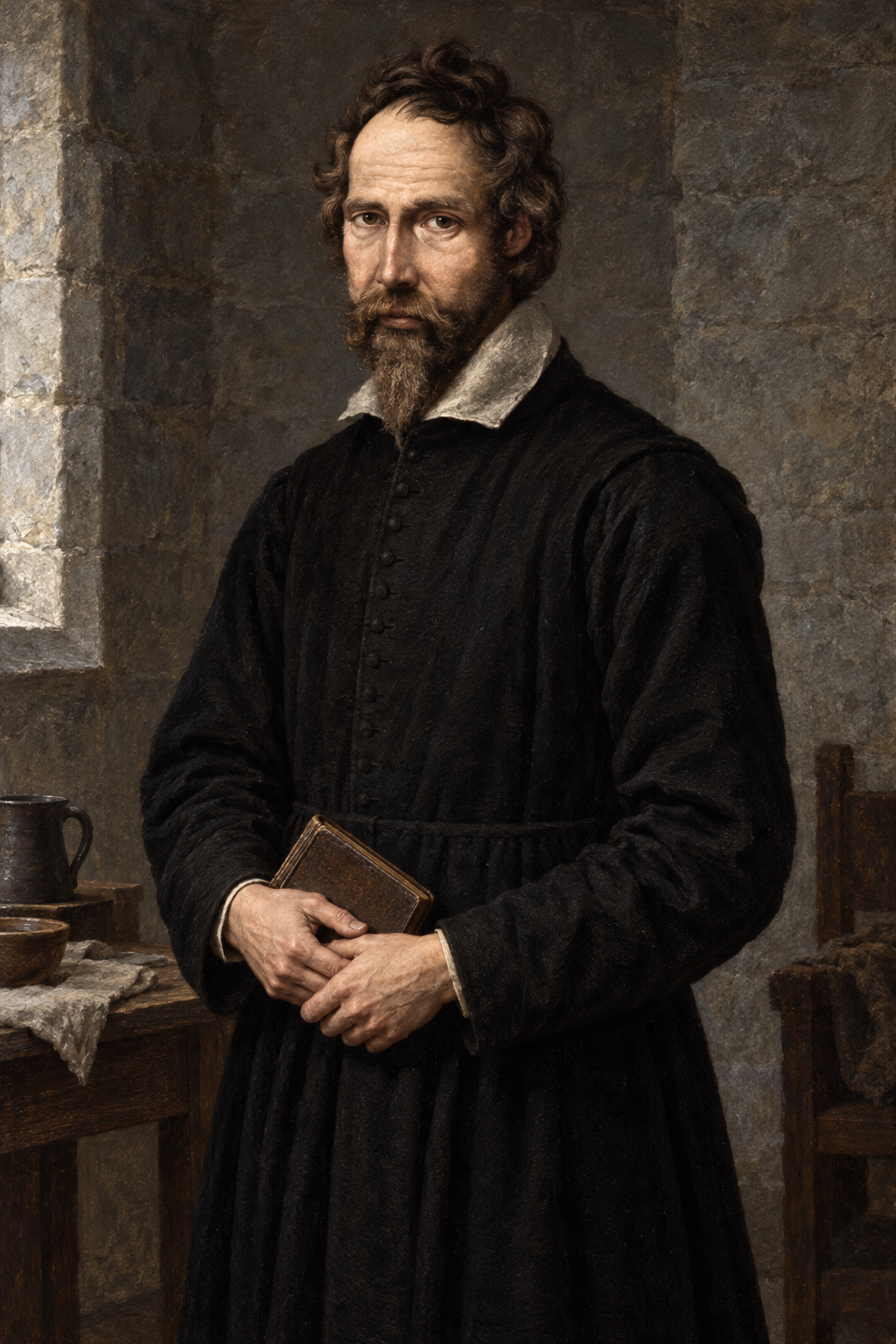
About Cuthbert Mayne
Cuthbert Mayne was an English priest whose return from training at Douai ended in imprisonment and execution in Cornwall. The Diocese of Plymouth remembers him as the first of the seminary priests trained on the Continent to suffer martyrdom in England. His early life began in Devon, at Youlston near Barnstaple, and included schooling at Barnstaple Grammar School. Before becoming a Catholic, he served as a minister of the Church of England.
At Oxford he studied first at St Alban Hall and then became chaplain at St John’s College. College archivist Michael Riordan describes his association there with Edmund Campion and Gregory Martin. Their friendship belonged to a period when some members of the college outwardly conformed to the established church while retaining Catholic sympathies. Mayne’s religious development took place within those unsettled loyalties, rather than through an isolated decision detached from his friends and education.
A letter from Martin fell into official hands in 1570, putting Mayne at risk of arrest. The diocesan biography describes his escape to Cornwall and subsequent arrival at Douai in 1573. There he studied for the Catholic priesthood and was ordained in 1575. He returned to England the following year. The journey joined an international network of colleges to the practical need for priests among Catholics living under the Elizabethan religious settlement.
The Dictionary of National Biography records his departure with John Payne on 24 April 1576 and his service in the household of Francis Tregian at Golden, in the parish of Probus. He acted outwardly as Tregian’s steward while serving as chaplain. Arrest followed in June 1577, and Mayne was taken to Launceston. Tregian also paid a heavy price for sheltering him: the account records the loss of his property and a sentence of perpetual imprisonment.
The case against Mayne involved religious objects and statements as well as the celebration of Mass. John Wainewright’s account lists charges concerning a papal document, papal authority and an Agnus Dei devotional object. Mayne argued that the document was an expired announcement of the 1575 jubilee, not the operative authority alleged against him. He also challenged what the discovery of the devotional object, vestments and liturgical vessels actually proved.
The verdict did not end disagreement about the case. Wainewright reports that one judge reconsidered the sentence and referred the matter to the Privy Council; other judges were also inclined to doubt the conviction. Nevertheless, the execution proceeded. The older Dictionary of National Biography notes a significant legal distinction: the later statute making ordination abroad itself a capital offence had not yet been enacted when Mayne was tried.
Political questions cannot simply be removed from this history. Riordan’s college account reports that Mayne expressed support for assisting an invading Catholic prince. That reported statement complicates a wholly private picture of his religious allegiance. It should be identified as a report, rather than silently treated as an authenticated quotation.
Peter Lake’s study places the proceedings within wider debates over Catholic and Puritan threats among Elizabeth, her councillors and bishops. His published notes also caution that an older narrative of Mayne’s trial confuses some legal details. That warning matters when reading devotional accounts: the existence of religious persecution does not make every later reconstruction of the charges equally reliable.
Mayne was executed at Launceston in November 1577. Plymouth’s diocesan calendar gives 29 November and commemorates him as a priest and martyr. The same calendar names him secondary patron of the diocese. This local remembrance connects his death with the communities in the south-west where he had grown up and worked.
His remains also became part of Catholic remembrance. Christopher Allison’s study describes the gathering and preservation of relics after the executions of Elizabethan Catholics, with Mayne’s death an early focus of that devotion. Allison considers whether a reliquary recovered at Jamestown could contain a relic of Mayne, but presents that identification as a possibility. It is not evidence that Mayne himself travelled to America, nor a secure identification of the remains.
Paul VI canonized Mayne with the Forty Martyrs of England and Wales in 1970. The ceremony also looked toward reconciliation: the pope welcomed the Archbishop of Canterbury’s representative and expressed hope that remembrance of the martyrs could help heal the division between Catholics and Anglicans. The homily’s conclusion treated their shared history as a reason to seek Christian unity.
At Launceston, the church dedicated to Mayne continues to receive pilgrims. Plymouth’s 2025 account describes its relic chapel and a route through places associated with his imprisonment and execution. A memorial plaque in the town square was unveiled in 2008. Alongside these public reminders, the parish remains a community of worship, welcome and service.
The national bishops’ heritage survey dates the church to 1911 and identifies Arthur Langdon as its architect. Its Byzantine and Romanesque forms belong to this later revival of Catholic public worship.
Wondering how to weigh the stories and sources? Learn how to read a saint biography.