Biography
Dominic de Guzmán
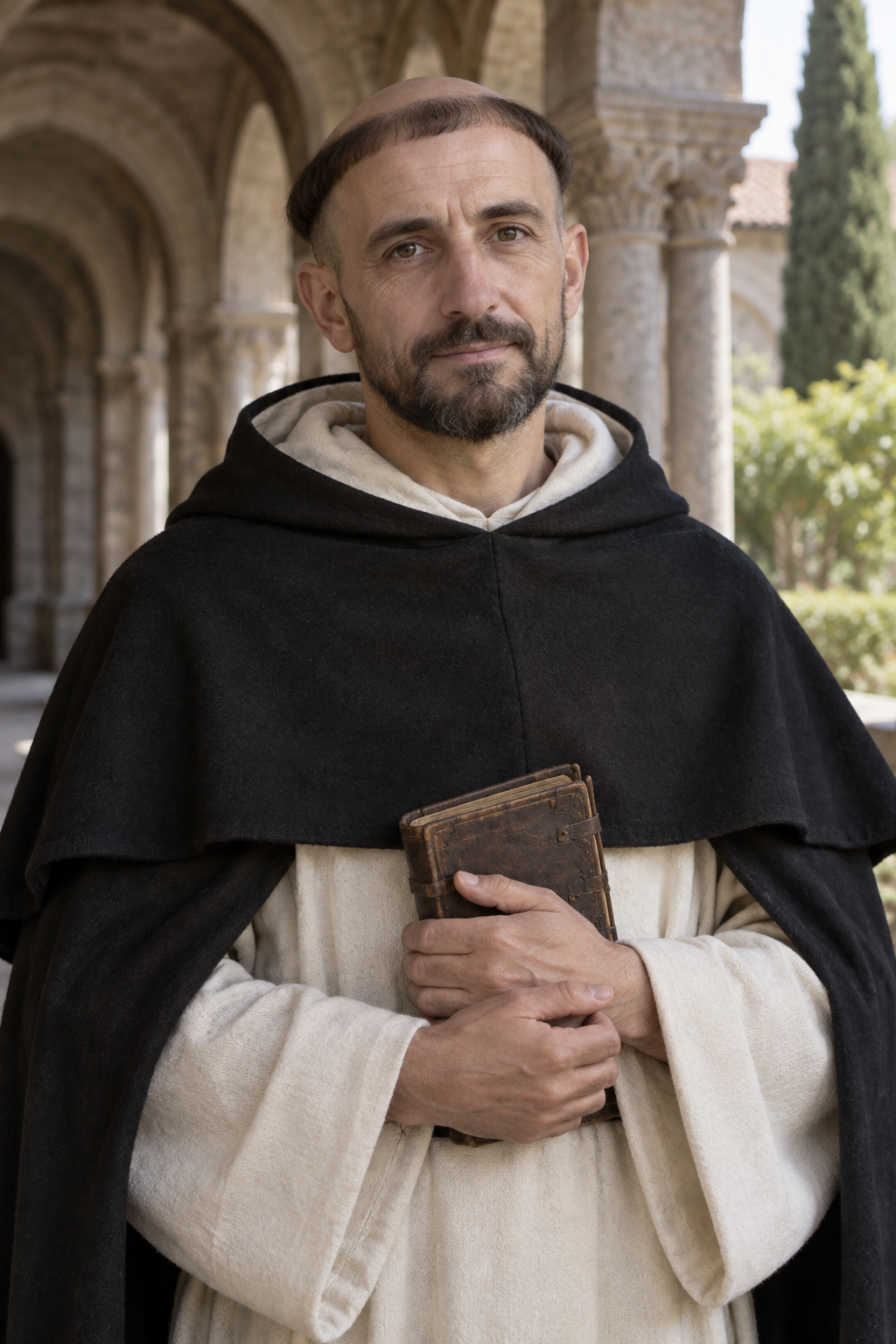
About Dominic de Guzmán
Dominic de Guzmán began his religious life in Castile, before the preaching journeys that would carry him across Europe. He was born at Caleruega in the 1170s; modern accounts differ over the year. He studied at Palencia and later joined the community of canons at Osma Cathedral. Gianni Festa's historical account places him there by the end of the twelfth century. Prayer, study, and shared responsibilities were part of his life before he began gathering the companions who became the Order of Preachers.
An early account by Jordan of Saxony connects Dominic's studies with a practical response to hunger. During a famine at Palencia, Dominic sold belongings, including books he needed, and used the proceeds to help poor people. Jordan says his example encouraged other teachers and students to give. The episode places learning beside an immediate human need: books mattered to Dominic, but so did the people struggling to find food around him. At Osma, Jordan describes him reading the Conferences of the desert fathers and returning to church for prayer during the night. The book offered accounts of spiritual discipline that he tried to put into practice, joining reading to the habits of daily life.
Travel with Diego, bishop of Osma, widened his work. The two journeyed north on diplomatic business for the Castilian king, passing through southern France. There they encountered religious communities whose teachings conflicted with Catholic belief. Dominic preached, debated publicly, and lived austerely. His work addressed divisions among people who already called themselves Christians, as well as the failings of clergy whose lives did not match their teaching.
The mission unfolded amid religious and political violence. Festa places the preaching effort alongside armed suppression rather than outside the conflict. A community of women at Prouilhe also became part of the undertaking. Women who had returned to Catholic practice could live together there, and Dominic continued his work in the region after Diego's death.
By 1215, Dominic had a group of fellow preachers and the support of Fulk, bishop of Toulouse. They needed a durable form of community life and authorization beyond a local mission. Following the pope's advice, the brothers adopted Augustine's Rule. Papal recognition came in stages: protection for the community in December 1216, an explicit preaching commission in January 1217, and a wider recommendation to bishops in 1218. These steps opened the way for the group to work beyond Toulouse.
Dominic then sent brothers away to establish communities elsewhere. Paris and Bologna were important destinations because their schools offered places to study, meet new ideas, and find new companions. This decision spread a small group's people and resources across several cities. The friars' houses combined life in common with work among the surrounding population, rather than removing them entirely from urban life.
Study was not a separate pursuit reserved for a few unusually gifted friars. Benedict XVI describes it as preparation for preaching, rooted in Scripture and attentive to questions raised by reason. Brothers traveled to speak and teach, then returned to communities where prayer and learning continued. This pattern gave their public work a supporting rhythm: time with books and other friars prepared them to address people beyond the convent.
Life in common also meant sharing decisions. In his centenary letter, Pope Francis emphasizes the chapters through which brothers discussed their work and chose a way forward. Authority had defined roles, but decisions did not depend solely on the founder's personal wishes. The structure could continue after his death, allowing later communities to respond to circumstances he had never encountered. Francis connects that pattern with Dominic's preference to be known among his companions simply as a brother.
Prayer accompanied the journeys as well as life at home. The later anonymous Nine Ways of Prayer describes Dominic bowing, kneeling, reading, and walking apart from a companion to pray. Its account joins physical movement to attention: hands, posture, and quiet helped express the prayer of the whole person. The text was written decades after his death and preserves the community's memory of these habits.
Dominic died in Bologna in 1221, after presiding over the first general chapters of the order. Gregory IX canonized him in 1234.
Later devotion often pictured him with a rosary. The familiar story that he introduced that prayer is a later tradition, not an established episode of his life. Herbert Thurston's historical examination distinguishes older practices of repeated prayer from later arrangements of mysteries and from the story linking them to Dominic.
His more securely established legacy is the community of preachers he helped build. The Dominican family came to include different forms of religious and lay life, not only traveling friars. As Francis's anniversary letter observes, that inheritance has supported teaching, scholarship, art, and service. Its continuity rests in people learning and working together, carrying shared responsibilities beyond the life of the founder.
Wondering how to weigh the stories and sources? Learn how to read a saint biography.
Explore similar vocations
Prayers for Dominic de Guzmán
Dominic de Guzmán: sourced prayer excerpt
Fulfill, O Father, what you have said, and help us by your prayers.