Biography
Drogo of Sebourg
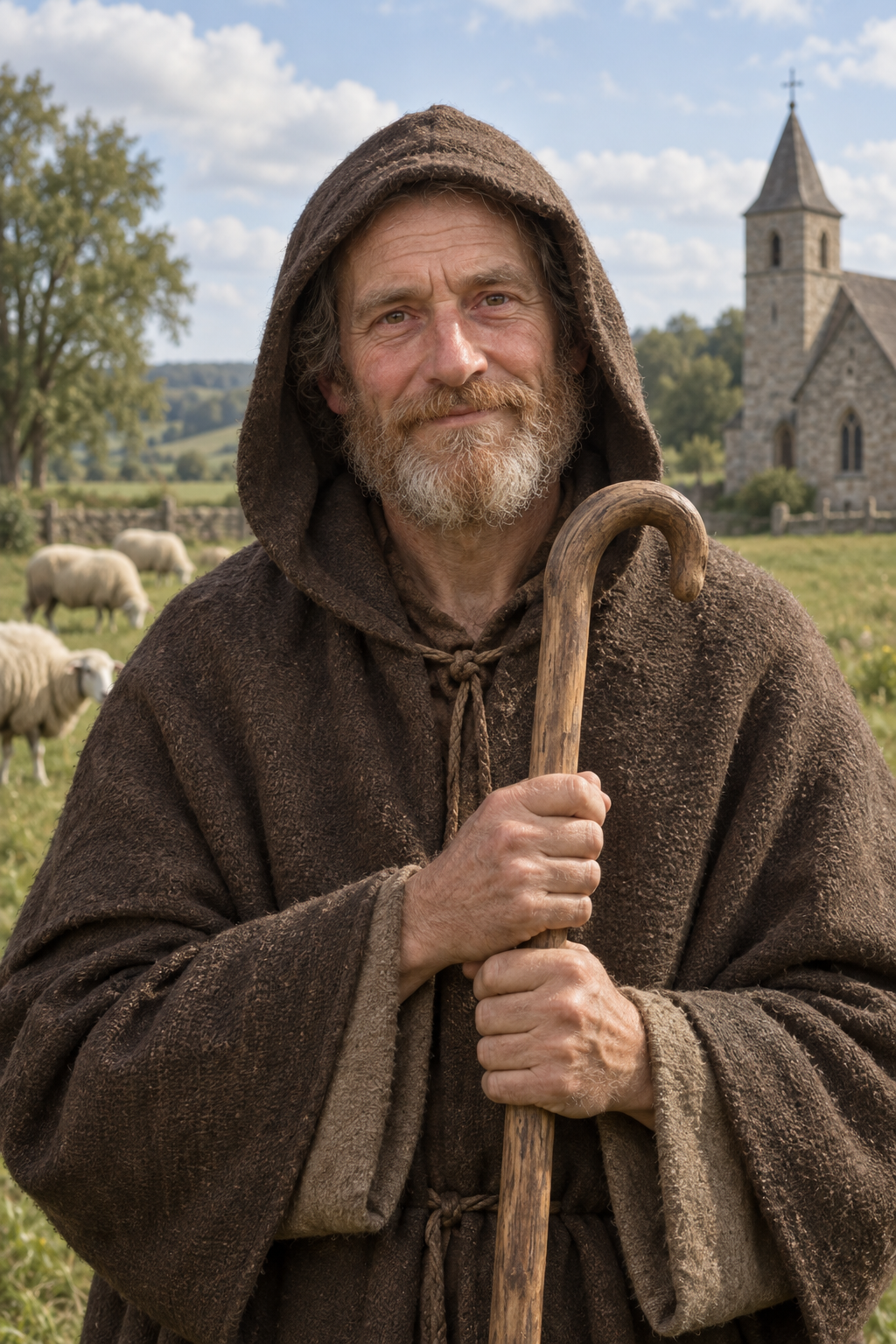
About Drogo of Sebourg
Drogo of Sebourg, called Druon in French and sometimes Drogon, belongs to the religious memory of the borderlands now divided between northern France and Belgium. The identity intended here is the shepherd and recluse associated with Épinoy and Sebourg, not another medieval Drogo. An Archdiocese of Cambrai calendar places him among four local hermits and says that he settled at Sebourg, lived for about forty years in a cell beside the church, and died in 1185. This diocesan memory securely documents a continuing local cult, but it was written many centuries after Drogo's lifetime. It does not provide contemporary records from which a modern critical biography could be reconstructed.
Local parish tradition gives his birth at Épinoy, now associated with Carvin, around 1118. It portrays him as an orphan whose father died before his birth and whose mother died giving birth to him. Later retellings made this loss the source of severe guilt, but no contemporary testimony records Drogo's thoughts. The responsible conclusion is narrower: Épinoy is his traditional place of origin, about 1118 is an approximate received date, and details about wealth, noble ancestry, or lifelong psychological distress remain uncertain. The profile therefore removes the database's exact March 14, 1105 birth date, which the reviewed sources do not support.
The remembered young Drogo relinquished property and traveled until he reached Sebourg. There he entered the service of a woman named Elisabeth Le Haire and worked as a shepherd. This vocation became the defining image of his cult. It joined ordinary labor, care for animals, and chosen poverty rather than ecclesiastical office. Parish accounts also say that he undertook nine pilgrimages to Rome and shared knowledge with shepherds along the way. Neither a route nor dated itinerary survives, so maps should show only the cities associated with the tradition. The popular claim that he was simultaneously on pilgrimage and tending sheep belongs to miracle legend and is not used as a factual event.
The tradition next says that illness, commonly described as a severe hernia, limited Drogo's movement. He then lived as a recluse in a narrow cell adjoining Sebourg's church, able to participate in worship through an opening toward the sanctuary. The diocesan calendar independently preserves the broad outline of a cell and a period of roughly forty years, while a parish description of Saint-Martin church reports that the present reconstructed hermitage dates from 1774. The present structure is therefore evidence of reception, not Drogo's untouched medieval room. His illness should not be romanticized: the sources remember real bodily restriction while interpreting his sustained prayer as fidelity within it.
Stories accumulated around the recluse. One says that fire destroyed the wooden church while Drogo remained unharmed in his cell. Another says that, after his death, relatives tried to return his body toward Épinoy, but the cart became impossibly heavy at Sebourg's boundary; the community understood this as his wish to remain. These episodes explain features in later art and landscape memory, including flames and a cart, but they are miracle traditions rather than documented occurrences. They should not determine a mapped fire site or funeral route. Their value is historical in a different sense: they reveal how residents interpreted Drogo as permanently belonging to Sebourg.
Drogo's death year varies across church sources. The Cambrai diocesan calendar gives 1185; a parish life gives April 16, 1186; Nominis gives April 16, 1189; the Norwegian Catholic synthesis records the same disagreement. Exactitude would conceal rather than resolve the evidence. This packet consequently records an approximate range from 1185 to 1189 in the narrative and does not preserve the inherited exact civil date. April 16 is retained as the traditional Roman Catholic feast because multiple church sources agree on the observance even while disagreeing about the year. A feast day is evidence of commemoration, not proof of a death certificate.
Sebourg still honors Drogo. The parish church is dedicated to Saint Martin but contains a shrine and reconstructed cell associated with the local saint. A modern parish account of the 2025 Trinity Sunday celebration calls him the village's patron, remembers him as shepherd and hermit, and reports that his reliquary remains part of local devotion. Shepherd patronage is well established in these sources. Claims that he is patron of coffee houses or every named bodily condition are not retained because the reviewed ecclesial evidence did not establish them. This distinction allows living devotion to be described without turning every circulating internet association into catalog data.
Drogo's profile is therefore a history of received witness as much as a life. The sources support a twelfth-century association with Épinoy and Sebourg, a remembered period of shepherding and pilgrimage, long enclosure beside the church, an April 16 feast, and durable patronage among shepherds. They do not support precise childhood dates, direct quotations, private motives, bilocation as a documented event, or an exact death year. No prayer is included because no text with suitable provenance and reuse rights was verified. His remembered actions nevertheless offer a concrete pattern: relinquishing privilege, accepting humble work, caring for living creatures, and sustaining attention when illness narrowed his world.
Wondering how to weigh the stories and sources? Learn how to read a saint biography.