Biography
Edward the Confessor
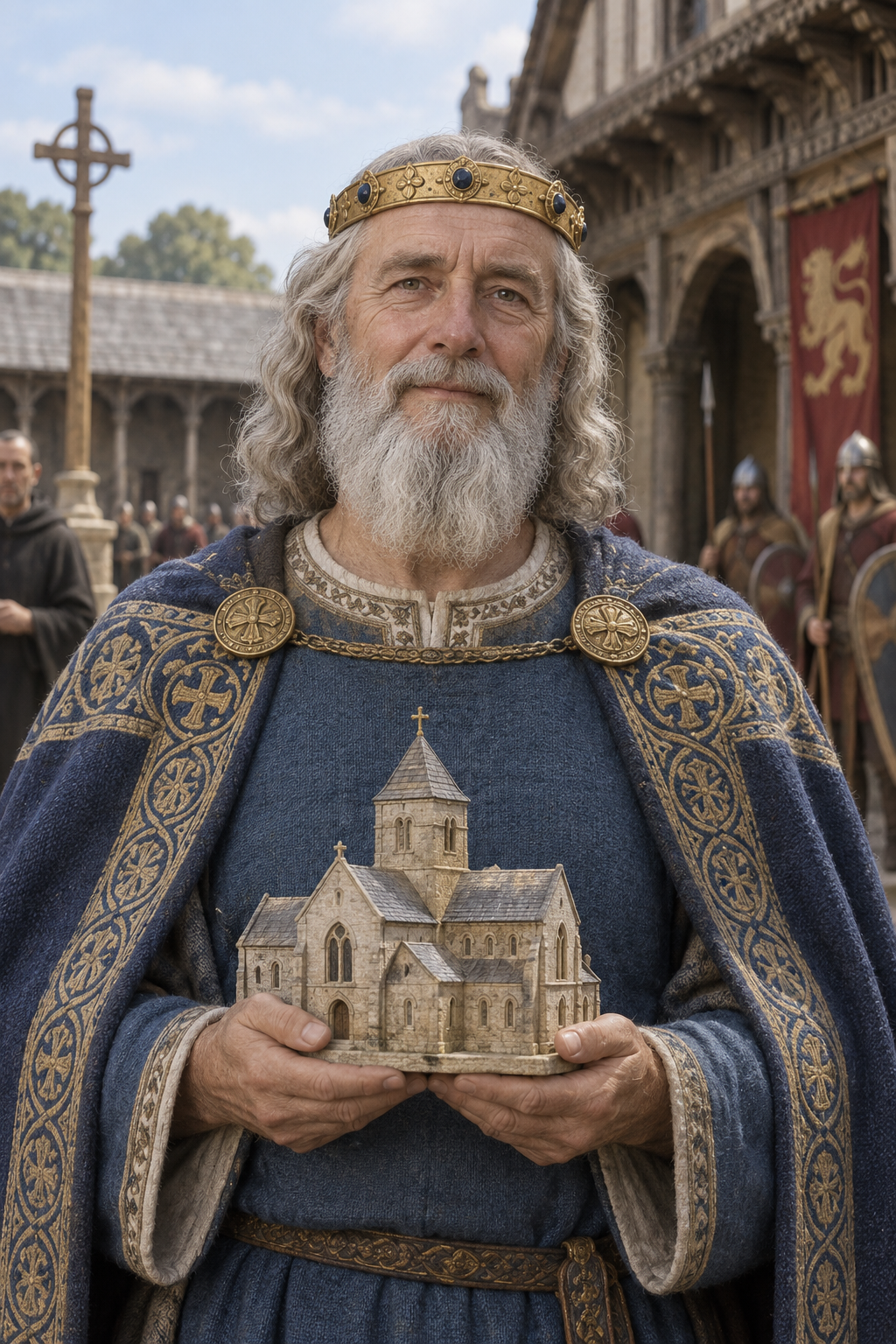
About Edward the Confessor
Edward the Confessor became king of England in 1042 after years of exile in Normandy. He was the son of King Ethelred and Emma, and a half-brother of his predecessor Harthacnut through their mother. His return restored a member of the old royal family to the throne, but it did not free him from the need to negotiate with powerful earls. His marriage to Edith, daughter of Godwin of Wessex, brought the king into the family whose influence would shape much of his reign.
His birth is usually placed around 1003; Westminster Abbey gives the broader range 1002–1005 and identifies Islip in Oxfordshire as his birthplace. His marriage to Edith in 1045 produced no children. Edith commissioned his biography. Edith had been educated at Wilton near Salisbury, and surviving references describe her as literate and skilled in languages.
The Anglo-Saxon Chronicle records Edward's coronation at Winchester at Easter in 1043. Its account also shows a harder side of royal politics. Later that year, Edward and leading earls went to Winchester and took his mother Emma's treasures. The chronicler explained this seizure by accusing her of withholding support from her son. That explanation belongs to the account's own political perspective; the action itself complicates any picture of Edward as a ruler untouched by conflict over wealth and loyalty.
Relations with Godwin broke down in the crisis of 1050–1052. Supported by other earls, Edward banished him and removed Edith from court. He then gave Norman supporters positions both around the king and in local government. Opposition to their growing influence helped Godwin return. Edward subsequently worked more closely with Godwin's son Harold, who commanded forces on his behalf. Royal authority depended on these shifting alliances, not simply on the king issuing orders that everyone accepted.
The Chronicle's account of the confrontation in 1052 describes fleets and land forces facing one another near London. It says men on Edward's side were reluctant to fight their own relatives and leave the country weakened against outsiders. Negotiators passed between the parties, hostages were exchanged, and a council restored Godwin's position and Edith's possessions. This was a settlement reached under pressure. The narrative preserves both the danger of civil fighting and the practical work by which an agreement replaced it.
Westminster was Edward's most enduring religious undertaking. He rebuilt an older abbey dedicated to Saint Peter, using the Romanesque style. The name distinguished this western church from Saint Paul's, the east minster of London. Its consecration took place on 28 December 1065. Much of Edward's building was later replaced by Henry III's Gothic church. Edward's connection with the abbey therefore concerns a foundation and an earlier building, not personal construction of everything visible there today.
The monastery was also a community of people with whom Edward worked. Abbot Edwin served as his friend and adviser. Edwin attended the consecration of Edward's church, the king's burial, and William's coronation later in 1066. Westminster's account of the abbot preserves a later inscription linking his counsel with the king's gifts, privileges and possessions for the monastery. The inscription is commemorative testimony, but it shows how the community remembered their shared role in establishing its resources.
Edward's closest surviving royal relative was his great-nephew Edgar, who was still young when the king died. Yet descent alone did not settle the succession. English Heritage's account explains that a ruler's nomination also needed the leading nobles' approval. The absence of Edward's own child left room for competing candidates and different interpretations of his wishes.
Edward died at Westminster on 5 January 1066. The early Life of King Edward describes Edith and senior figures gathered around him. It reports that he commended his wife and kingdom to Harold's protection. Harold's supporters understood this as a nomination to succeed him, but the meaning was contested. English Heritage notes that early accounts use different language for the transfer of power. The dying king's reported words should not be turned into an undisputed constitutional decision.
The record of Edward's reign also carries the interests of those who preserved it. The Life commissioned for Edith praises her brother Harold and presents him as Edward's chosen heir. Its second part was written after the Norman Conquest and laments the disaster. This second part may have been completed by 1067 and certainly before Edith died in 1075. This near-contemporary text is valuable evidence, but it is also a family's account of a lost political world.
Later devotion gave Edward another public life. A surviving medieval pilgrim badge in the British Museum shows him crowned and holding a sceptre. The damaged design originally included the ring-giving scene with John the Evangelist disguised as a pilgrim. That image belongs to the saint's legendary reputation, not a verified encounter. Such portable objects helped carry the memory of Westminster's royal saint beyond his tomb, joining the image of kingship to the devotional practice of pilgrimage.
Wondering how to weigh the stories and sources? Learn how to read a saint biography.
Explore similar vocations
Prayers for Edward the Confessor
Edward the Confessor — collect petition
grant that we may so confess the faith of Christ by word and deed, that we may, with all your saints, inherit your eternal glory;