Biography
Elizabeth Hesselblad
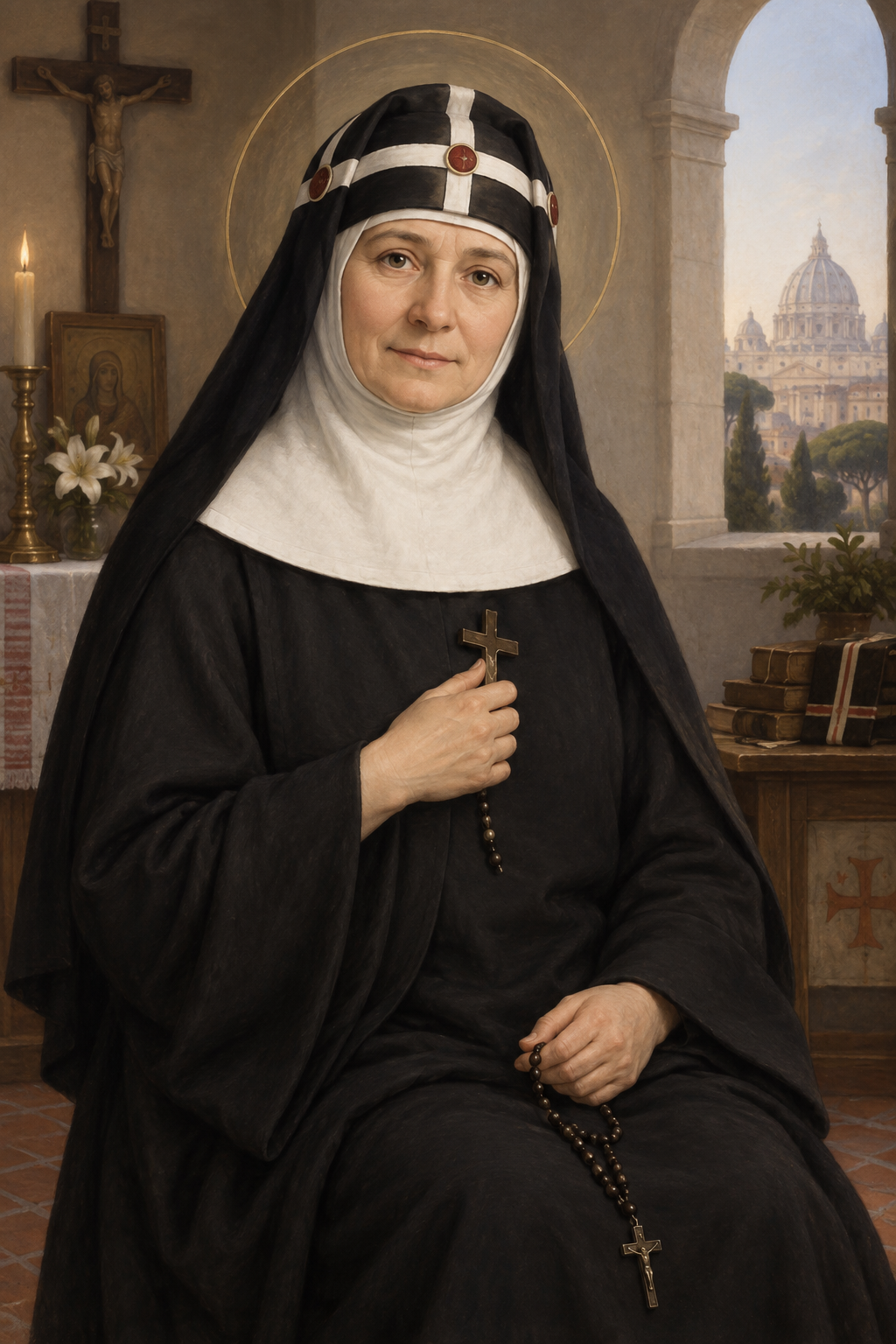
About Elizabeth Hesselblad
Maria Elisabeth Hesselblad was born in Sweden on 4 June 1870 and baptized Lutheran. She was the fifth of thirteen children. In 1888, at age eighteen, she emigrated to the United States. The Swedish Women’s Biographical Dictionary describes her upbringing in several communities and notes the family’s financial strain.
In New York, Hesselblad trained and worked as a nurse. She trained and worked as a nurse in New York. Nursing brought her close to illness and suffering and provided a living during her years in the United States. Her medical work gave her a livelihood in the United States while she cared for people who were ill.
Hesselblad’s encounter with Catholicism developed through study, friendship, and travel. The Vatican beatification biography names Jesuit Johann Georg Hagen as her instructor and spiritual director. On 15 August 1902, she was conditionally baptized into the Catholic Church in Washington, D.C. The Vatican canonization booklet also says she studied Catholic doctrine and received conditional baptism in 1902. The Swedish biographical dictionary records that she came into contact with a Catholic Cuban family for whom she worked as a nurse. Jesuit Johann Georg Hagen guided her study, and she was conditionally baptized in Washington on 15 August 1902.
In 1903 Hesselblad traveled to Rome, where she visited the house associated with Saint Bridget of Sweden. The Vatican biography says that she felt drawn to serve there. She settled in Rome at the House of Saint Bridget. In 1906 Pope Pius X permitted her to take the Bridgettine habit and make religious vows. The Swedish Women’s Biographical Dictionary adds that she had serious bleeding ulcers and was thought to be terminally ill when permission was granted. The Roman house she entered had been associated with Saint Bridget, and at that time Carmelite nuns lived there. In 1906 Pope Pius X allowed Hesselblad to receive the habit of the Bridgettine order and make religious vows.
Hesselblad sought to renew the Order of Saint Bridget, whose medieval communities had suffered interruption and dispersal. The official Order of the Most Holy Saviour account describes her aim as restoring the Bridgettine tradition while adapting its religious life to contemporary circumstances. The Swedish biographical dictionary clarifies that she wanted to revive and reform the old order, not simply declare herself founder of an unrelated medieval institution. Her Roman community combined prayer and liturgy with hospitality and outward activity. Her renewal joined a contemplative rule of prayer with hospitality and service, rather than treating enclosure as the only form of religious life. She regarded Saint Bridget’s medieval legacy as a living tradition that could be renewed for the needs of her own time.
In 1911 Hesselblad welcomed three English women as the first members of the renewed community at the house of Saint Bridget in Rome. The Vatican canonization booklet likewise says she refounded the Order in 1911. The renewed community began modestly, with women joining the Roman house and sharing its prayer and common life.
Hesselblad’s congregation received canonical approval in 1920 and expanded to other countries. In 1923 she helped re-establish a Bridgettine presence in Sweden, beginning at Djursholm near Stockholm; the sisters later established a community at Vadstena in 1935. The Vatican booklet records both Swedish foundations, and the Holy See’s beatification biography notes the 1920 approval and the Djursholm house. This adaptation placed prayer alongside hospitality and other outward-facing work. The Swedish foundations reconnected the order with the saint’s homeland, while houses in other countries extended its reach.
The Roman house at Piazza Farnese became a center for the congregation. The Swedish Women’s Biographical Dictionary says the community there obtained temporary papal approval in 1920 and that the Holy See granted permanent use of the church and house in 1931. The Vatican beatification biography likewise records the 1931 grant and later expansion to India in 1937. The house and church at Piazza Farnese gave the sisters an established base in Rome, from which they organized formation and received visitors.
During the Second World War, Hesselblad and the Bridgettine house in Rome sheltered Jews persecuted under racial laws. Yad Vashem’s profile documents Hesselblad’s assistance to Jews in Rome and recognizes her as Righteous Among the Nations. The rescue took place amid persecution and danger; the sources consulted do not identify a complete number of those sheltered, so none is asserted here.
Later accounts sometimes call her an ecumenical pioneer; SKBL cautions that her mission was explicitly Catholic, although her communities became meeting places for Christians from different traditions. Her purpose remained Catholic, though her houses received Christians from different backgrounds.
Hesselblad died at the House of Saint Bridget in Rome on 24 April 1957. Pope John Paul II beatified her on 9 April 2000, and Pope Francis canonized her on 5 June 2016. The Vatican News calendar commemorates her on 24 April. Pope Francis’s canonization homily names her among the newly proclaimed saints but does not supply a separate biography. Her significance rests in renewing a Bridgettine community, sustaining houses of prayer and hospitality, and assisting people persecuted during the war.
Wondering how to weigh the stories and sources? Learn how to read a saint biography.