Biography
Elizabeth of Portugal
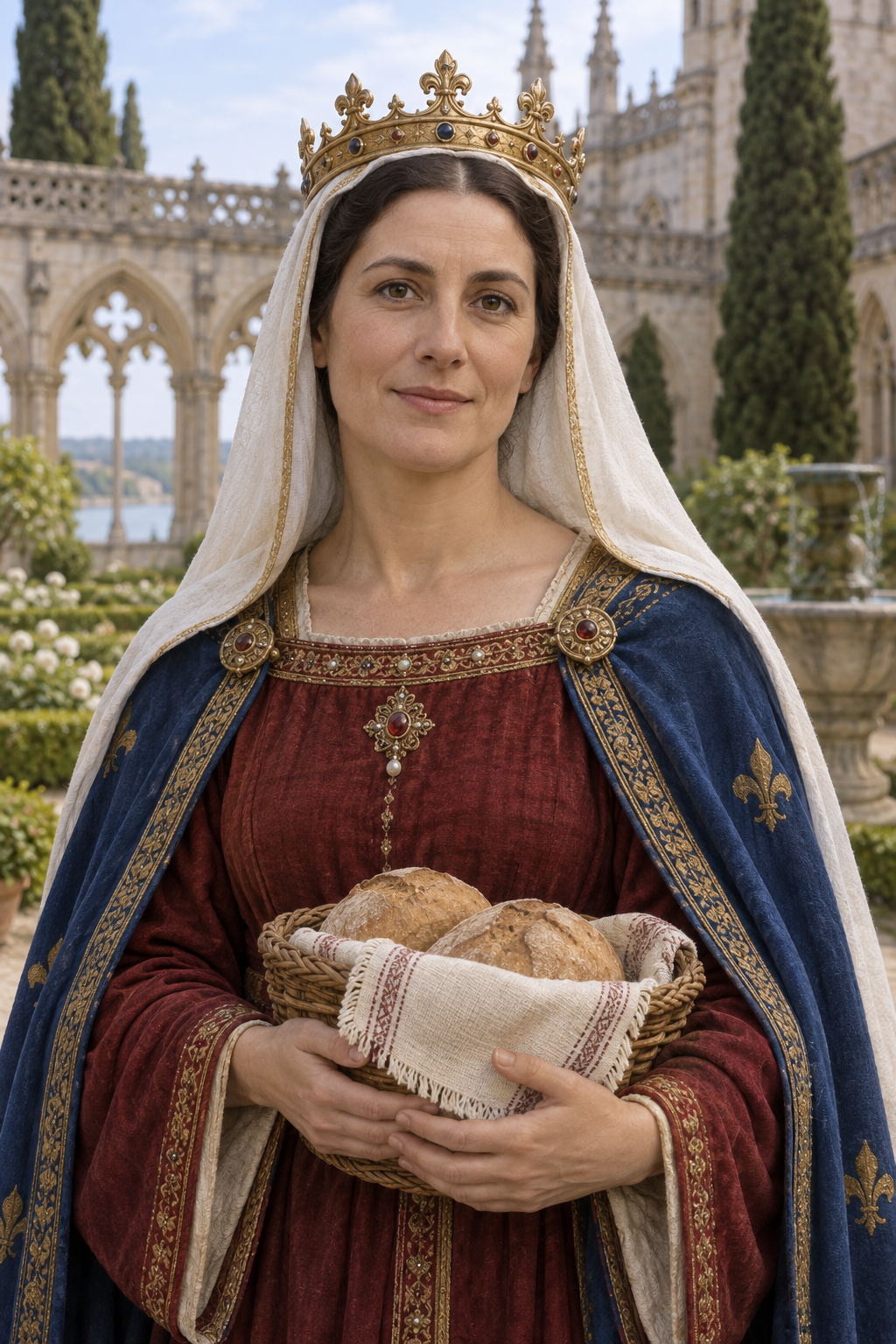
About Elizabeth of Portugal
Elizabeth of Portugal entered royal life as a child, through a marriage that joined the ruling houses of Aragon and Portugal. Her father was Peter III of Aragon, and her mother was Constance of Sicily, from the Hohenstaufen family. The marriage to King Denis in 1282 served a diplomatic purpose as well as establishing a household. The young queen had to find her place in another kingdom, while retaining family connections that later gave her access to rulers across the Iberian peninsula.
She was named for her great-aunt Elizabeth of Hungary. Capes describes her praying the Divine Office daily. Later devotional accounts describe a disciplined pattern of prayer, fasting, and personal service that continued after her marriage. Florence Capes's account emphasizes that Elizabeth enlisted women of her court to help people who were poor or ill. Her charity was therefore not confined to gifts sent at a distance: it also involved a household organized around practical assistance. These accounts preserve her reputation for patience within a troubled marriage, but their moral judgments about the entire court should not be mistaken for an impartial description.
The queen's peacemaking was part of political life, not simply a private response to family quarrels. Joana Ramôa points to correspondence with her brother James II concerning Portuguese people in Aragon, and to Elizabeth's participation in the negotiations at Torrellas in 1304. The later conflict between Denis and their son Afonso also involved nobles resisting royal centralization. Stories of Elizabeth riding between armies dramatize her intervention, but the underlying struggle cannot be reduced to a father's favoritism or a son's resentment.
In Coimbra, Elizabeth gave sustained attention and resources to the community now known as Santa Clara-a-Velha. She refounded it in 1314 rather than creating its history from nothing: an earlier foundation by Mor Dias had been dissolved after a property dispute. Her support paid for rebuilding under successive master builders, with a church and cloister forming the center of the community. Beside the monastery she established a hospital for poor people, with its own chapel and cemetery. She also built a palace nearby, making this part of Coimbra a place where royal residence, worship, and assistance to the vulnerable stood close together.
After Denis died in 1325, Elizabeth settled in her palace beside the convent. She wore religious clothing without making the vows of a Poor Clare, maintaining a life connected both to the religious community and to affairs outside its walls. Her final testament, made in December 1327, arranged for her body to rest in the monastery church. Her widowhood also included bereavements within the younger generations of her family. Withdrawal from court did not remove the responsibilities and sorrows that came with belonging to a royal dynasty.
Elizabeth retained the management of her property and did not bind herself to wearing the religious habit permanently. The tomb she commissioned combined a royal identity with religious dress, expressing the memory she intended to leave. This costly monument does not support a simple story that she had abandoned all possessions.
The early stories of her holiness are also stories about the people around her. Historian Maria Helena da Cruz Coelho draws attention to women in Elizabeth's household, religious communities, and the groups receiving her help. The medieval life describes her washing poor people's feet and giving alms, placing accounts of healing alongside those acts of service. One episode tells of a mother seeking help for a blind child and receiving clothing for herself and her daughter. The healing belongs to the religious narrative; the story's attention to a distressed mother and a child's material needs helps explain the queen's lasting appeal. These religious stories illuminate medieval devotion; they do not independently establish that miraculous cures occurred.
In 1336, another conflict drew Elizabeth away from Coimbra toward Estremoz, where her son Afonso IV was staying. His opponent was Alfonso XI of Castile, Elizabeth's grandson. She reached Estremoz ill and died there on July 4, 1336. Her body was taken to Coimbra in accordance with her wishes.
Devotion developed around her burial place long before formal canonization. Royal support helped bring recognition of her cult under Leo X in 1516. That recognition provided for an ordered liturgical observance, rather than leaving devotion solely to local custom. Urban VIII canonized Elizabeth on May 25, 1625, after a long process promoted by the Portuguese and Spanish courts. In Coimbra, the celebrations included clergy, religious communities, and the university. The queen's public memory thus continued through institutions as well as through individual prayer.
Portugal's liturgical texts remember her especially for reconciliation and works of mercy. The prayers connect her example with service to peace and with love of God and neighbor. They commemorate a married woman and widow whose religious commitment operated within family responsibilities, royal power, and the practical demands of caring for others.
Wondering how to weigh the stories and sources? Learn how to read a saint biography.
Explore similar vocations
Prayers for Elizabeth of Portugal
Elizabeth of Portugal: sourced prayer excerpt
Dai-nos, Senhor, o vosso Espírito de paz.