Biography
Emilio Moscoso
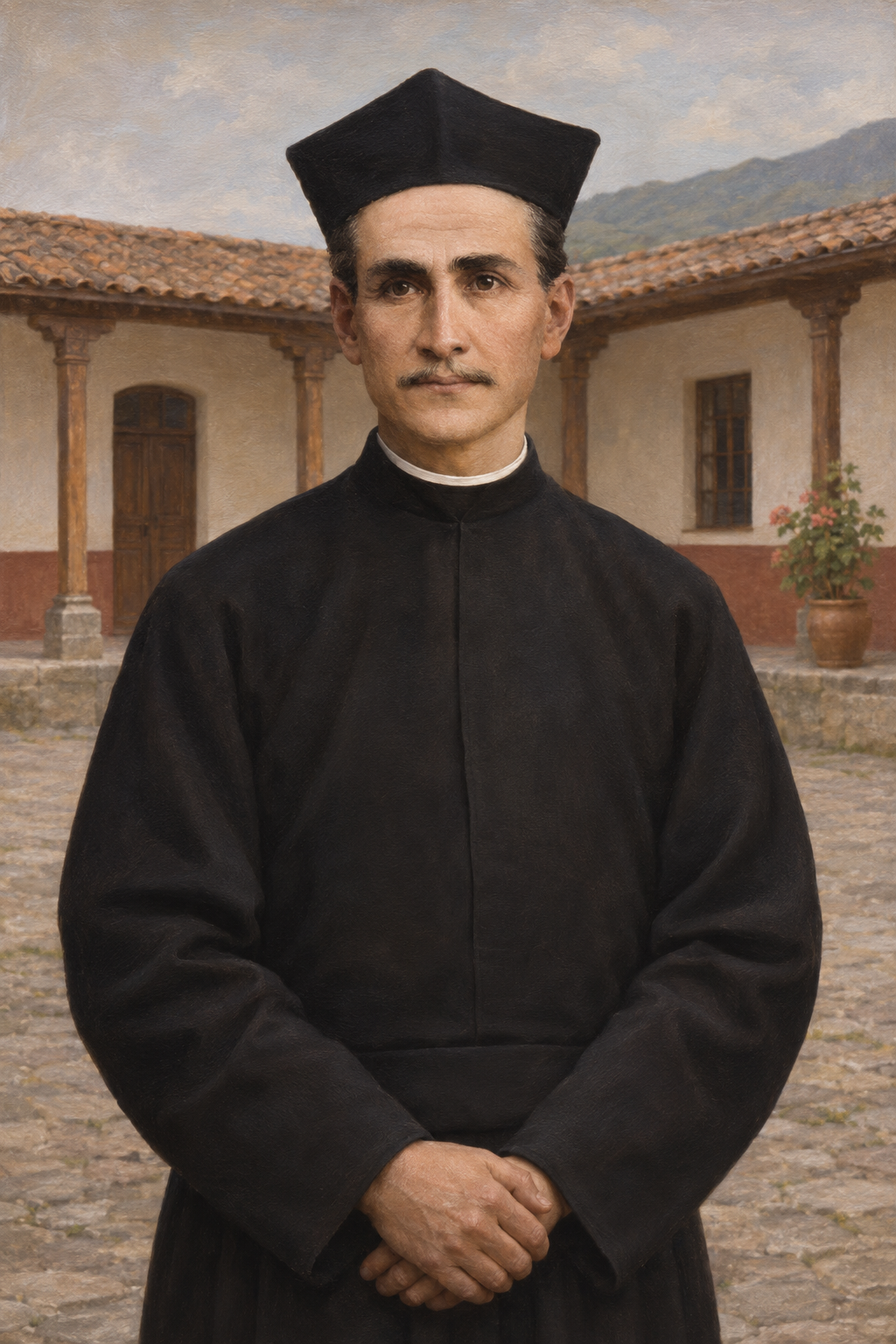
About Emilio Moscoso
Emilio Moscoso was an Ecuadorian Jesuit whose years in classrooms and religious communities ended in the violence that overtook Riobamba in 1897. He was born at Cuenca on April 21, 1846, into the large family of Juan Manuel Moscoso Benítez and María Antonia Cárdenas Arciniega. The family had the means to provide a substantial education. Emilio began studying law before entering the Society of Jesus in his home city on April 4, 1864. His father resisted the decision. Emilio completed his novitiate at Quito and made his first religious profession on April 27, 1866. Teaching became an early and enduring responsibility. His assignments took him to Riobamba, then Guayaquil, and back to Riobamba, where he taught literature and philosophy. His own theological education continued at Quito and Pifo and later in France. He was ordained before leaving Ecuador, on November 1, 1876. Further formation at Manresa in Spain prepared him for his return to South America.
His time in Peru reveals a ministry wider than the schoolroom. A Jesuit account drawing on the house diary places his arrival at Callao on August 2, 1879. Soon afterward he began visiting prisoners, including Chinese prisoners receiving Christian instruction. In November he assisted another priest with baptisms and heard confessions in the prison. When that priest left as a military chaplain, Moscoso assumed further responsibilities for religious women and a Sunday school. He also went to San Bartolomé hospital to minister to people wounded during political fighting. At the Colegio de la Inmaculada he taught grammar, arithmetic, geography and history. War complicated the school year, and the community's premises were partly converted into a military hospital. The account describes priests attending soldiers as well as attempting to continue classes. Moscoso left Peru in February 1881. These recorded visits, lessons and services place his priesthood among prisoners, pupils, religious communities and injured people.
Back in Ecuador, he served at the Colegio San Luis in Quito before returning to Riobamba. He then became the rector of an institution that included secondary education and a philosophy faculty. Ill health repeatedly led him to request relief from the office.
The Jesuit superior general Arturo Sosa later emphasized the circumstances in which Moscoso continued serving the young. The liberal revolution of 1895 brought new restrictions on the Catholic Church and intensified an already bitter conflict. In Riobamba the arrest of Bishop Arsenio Andrade in April 1897 deepened the danger. Moscoso and his companions continued their educational work rather than close the college and leave the town. Sosa's remembrance presents the rector's courage through those ordinary commitments: community life, teaching, prayer and solidarity with his fellow Jesuits. It recalls his visits to imprisoned companions and his return to share the community's situation. Eucharistic and Marian devotion belonged to that religious life. In this account, his final decision to remain grew out of responsibilities he had already been carrying, rather than a search for confrontation. The community's service to local young people continued even as the political situation became more threatening.
The official martyrdom decree distinguishes the armed struggle from the Jesuits' role. Antigovernment fighters entered the college during an attempt to take control of the city. The decree states that the religious were uninvolved in the fighting. Moscoso had appealed unsuccessfully to the civil authorities for companions who remained imprisoned. On May 4, 1897, army officers found him praying in his room and shot him. His death became the subject of a formal diocesan inquiry beginning in 2000. A supplementary inquiry followed, and historians and theologians examined the evidence within the Catholic process. In 2019 the Congregation for the Causes of Saints recognized the killing as martyrdom for fidelity to Christ and the Church. This is the Church's assessment of his death; the surrounding conflict also involved armed political factions whose actions should not be collapsed into a description of the whole population.
Cardinal Angelo Becciu presided at his beatification in Riobamba on November 16, 2019. The homily remembered a quiet, peaceful religious who nevertheless carried out difficult responsibilities. It linked his courage with years of priestly work and the formation of younger generations. Becciu also described later forms of remembrance: the Franciscan Sisters of Mary Immaculate understood their foundation as reparation for the violence, and Cuenca's Santo Cenáculo church became a place of Eucharistic adoration in his memory. For Catholics, the title Blessed Emilio Moscoso therefore recalls both a murdered priest and a life of education and prayer. The commemoration gives public expression to a memory preserved by religious communities and the people among whom he had worked. The beatification homily connected the public recognition with the everyday practice of faith. It called attention to service, consistency and generosity, presenting martyrdom as the culmination of a sustained Christian life. Its remembrance of Moscoso consequently included his work before the attack, alongside the circumstances of his death.
Wondering how to weigh the stories and sources? Learn how to read a saint biography.