Biography
Enmegahbowh
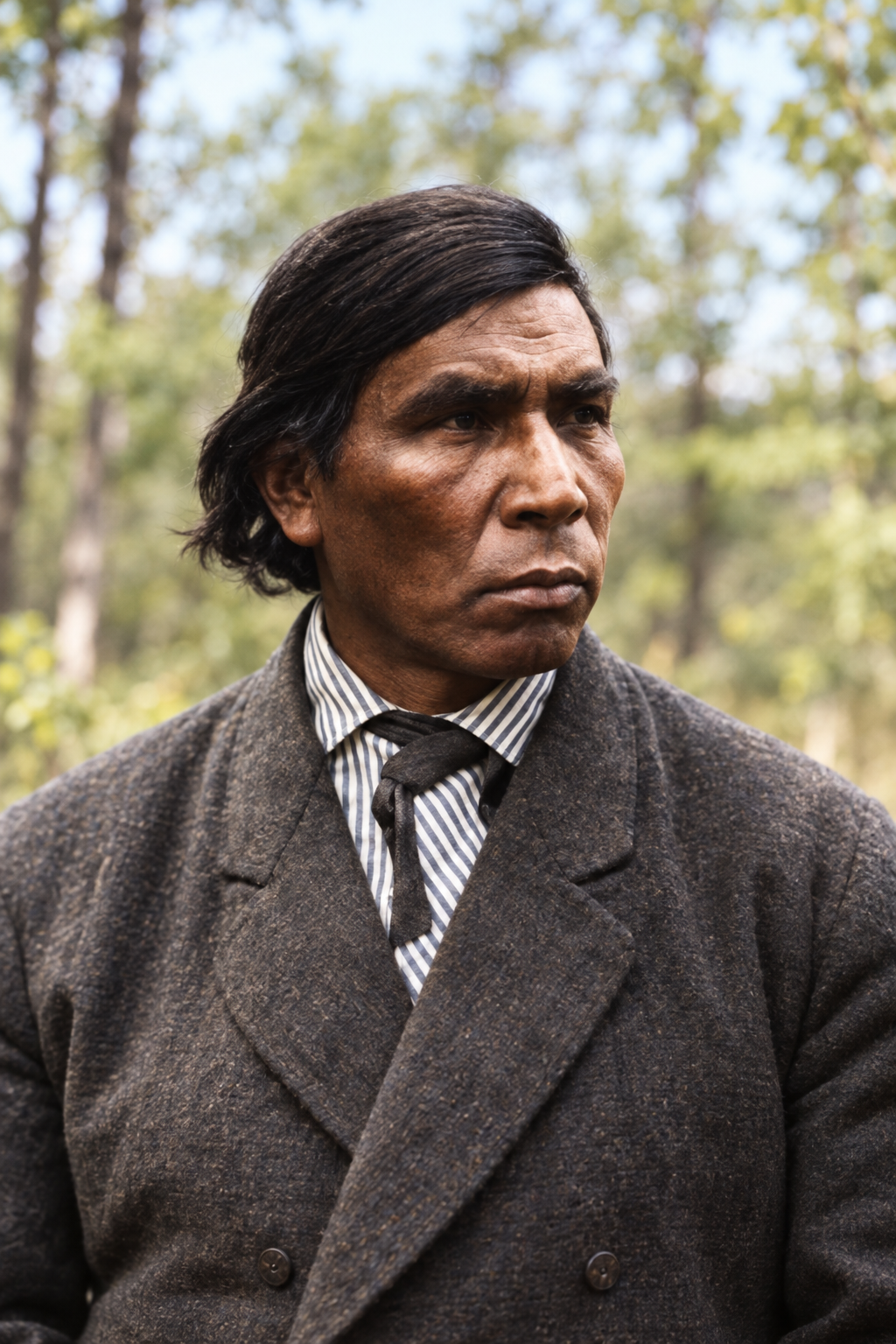
About Enmegahbowh
Enmegahbowh, also known as John Johnson, was an Indigenous Christian minister whose life connected communities in Canada and Minnesota. George Tanner’s history places his birth near Peterborough in Upper Canada. It describes his earlier work as a Methodist interpreter and his request for an Episcopal missionary. These details come through a later historical account, rather than a surviving birth record. Tanner records his ordination under Bishop Jackson Kemper at Faribault on July 3, 1859. Dakota visitors attended the service, and meetings afterward brought them together with the Ojibwe visitors who had accompanied Enmegahbowh. The account presents the occasion as a significant encounter across a history of conflict.
Bishop Henry Whipple remembered Enmegahbowh taking responsibility for the Gull Lake mission after the departure of the Reverend E. Steele Peake for military service. The nearest priest was a hundred miles away. Whipple’s memoir describes the steps toward ordaining him to the priesthood: a dispensation from the usual Greek and Hebrew requirements, an examination by three clergy, and the service in the cathedral at Faribault. Whipple also recalled their journeys together and Enmegahbowh’s humor. His recollections reveal a working friendship, although the bishop’s broader descriptions of Indigenous people retain the paternalism of nineteenth-century missionary writing. Whipple named the examiners as McMasters, Edward Welles, and Knickerbacker, and reported that the examination lasted a full day. He connected the ordination with the community’s ability to receive Communion regularly. The memoir also records a personal loss: the death of Enmegahbowh’s son George Johnson, himself a clergyman. Whipple described George as a gifted preacher and remembered his death as a severe blow to his father. In Whipple’s account, George was also the last of Enmegahbowh’s children.
Enmegahbowh’s own account, written late in life, records the difficult choices surrounding the conflict of 1862. He described warning an agency of danger, receiving a warning from Chief Crossing Sky, and escaping with his family to Fort Ripley. There he accepted armed sentinel duty despite misgivings about its relationship to his ministry. His testimony should not be reduced to a claim that he alone prevented a war. In describing removal to White Earth, he combined support for relocation as protection with grief over dispossession and the graves his family left behind. At the end of his account, he challenged accusations that rations made Indigenous people lazy: their hunting grounds and means of support had been taken away.
A letter he wrote in January 1874 offers another view of his ministry. Mourning Chief Isaac H. Tuttle, he described the chief as a leader whose support had sustained the community. Tuttle had offered his house for worship when there was no church building; services also moved between homes and into the open air. Enmegahbowh recalled visiting him during his final illness and celebrating Communion with others gathered around him. The letter does not conceal the missionary’s pressure for religious and cultural change, including his account of cutting the chief’s long hair. Yet it also challenges white Christians who doubted that Indigenous people could share their faith. Enmegahbowh’s grief and his appeal make clear that he understood Tuttle as a fellow Christian whose life mattered, not merely as a convert to count.
These personal accounts belong within a wider history of displacement. Historian Carol Berg describes how government and church policies at White Earth sought to replace Indigenous practices with European American ways of life. Rival denominations competed for influence over the reservation agency and its institutions. Her study also distinguishes the work of different educators, including Julia Spears, from later government and Benedictine schools. That context prevents the history of an entire reservation from being attributed to one missionary. It also makes the costs of Christian institutional power part of the setting in which Enmegahbowh worked.
Enmegahbowh died at White Earth on June 12, 1902. Tanner’s death notice agrees with the introduction to the account published shortly afterward.
His memory has continued through the community at St. Columba’s. In 2011, visitors from Christ Church Cathedral in Cincinnati received his damaged Bible for conservation. The restored volume was dedicated and returned in 2012, with members of the Ojibwe Nation taking part in the service. White Earth chair Erma Vizenor spoke of his faithfulness through adversity. The preservation of an object he used gives that remembrance a material connection with his life, while the ceremony shows that his legacy is carried by a living community.
In a pastoral letter in 2024, Bishop Craig Loya interpreted Enmegahbowh’s ministry as a witness across boundaries separating Indigenous communities, Christianity, and government. That is a present-day theological reading of his life. It does not erase the tensions in his own writings, where advocacy for his people existed alongside demands for religious change.
The Episcopal Church gave final approval to his calendar commemoration in 2003, following an earlier period of trial use. This is recognition within the Episcopal tradition.
Wondering how to weigh the stories and sources? Learn how to read a saint biography.