Biography
Enrique de Ossó i Cervelló
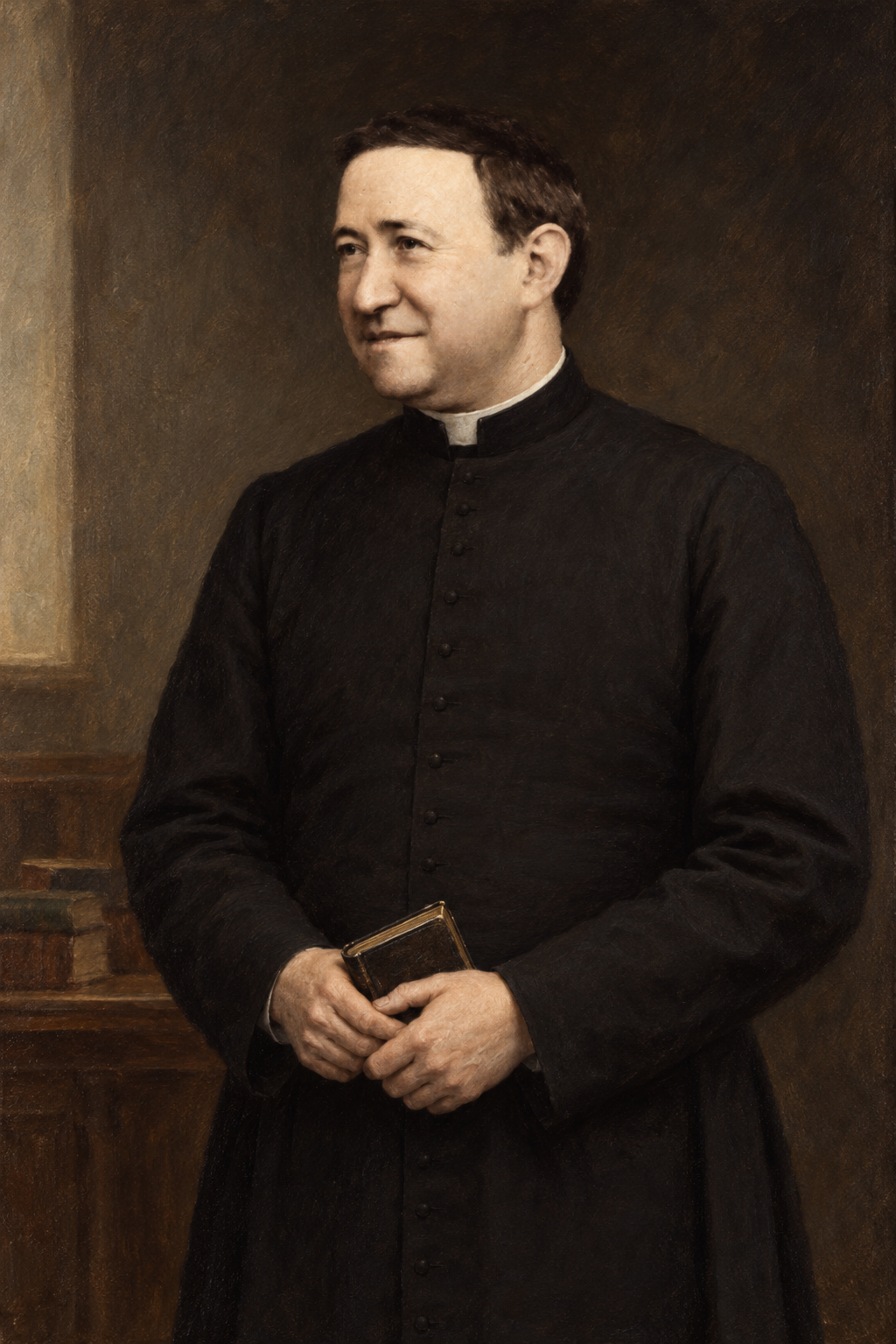
About Enrique de Ossó i Cervelló
Enrique de Ossó i Cervelló was a priest and educator whose work joined religious instruction with a deep attachment to Teresa of Ávila. Born in Vinebre on October 16, 1840, he faced different expectations at home: his mother hoped he would become a priest, while his father directed him toward commerce. He worked as an apprentice in Reus before leaving for Montserrat after his mother’s death in 1854. He returned with permission to study for the priesthood.
He was ordained at Tortosa on September 21, 1867, and celebrated his first Mass at Montserrat the following month. Teaching mathematics and physics at the seminary did not exhaust his interests. In 1871 he organized systematic catechism teaching in twelve churches of Tortosa. His practical guide for catechists grew from this work, helping others take responsibility for religious instruction.
The congregation he founded remembers education as a vocation that accompanied his priesthood. Its account emphasizes his wish to make Jesus known through personal encounter and instruction. Teresa provided both a spiritual guide and a model for prayer understood as friendship. He sought to bring that approach into the lives of children, young people, workers and women, rather than reserving religious formation for those entering a convent.
His associations created different ways of participating in this mission. Antonio Hernández Sanchiz distinguishes the lay women’s association from the later religious congregation. Its members were encouraged to live their faith in work, study and family life. Education mattered because he believed women could influence the wider society through their own formation and through their families. This conviction reflected his religious priorities and the social expectations of nineteenth-century Spain.
In 1876 he founded the Company of Saint Teresa of Jesus. The congregation’s account describes a founder attentive to organization, travel, correspondence and the needs of individual houses. He intended each community to sustain both religious life and educational work. The foundation gave a continuing institutional form to concerns that he had already pursued through teaching and lay associations.
His educational notes make the purpose of that work explicit. Addressing the congregation’s teachers, he describes their responsibility as a form of spiritual motherhood. Patience, affection, preparation and correction all belong to it. He asks teachers to adapt what they learn to the understanding of young children, and to consider what those children will later remember of their conduct. The teacher’s example matters alongside the lesson itself.
These notes also show the boundaries of his outlook. He opposed secular schooling and regarded Catholic belief as necessary to complete education. His goal was not simply the transmission of information: children should learn to govern themselves, develop good habits and fulfil their responsibilities. His account of freedom remains connected to religious duty and a specifically Catholic understanding of human happiness. His practical recommendations extended to the classroom itself: adequate light, adjustable ventilation and suitable furnishings. He urged the sisters to keep pace with educational improvements and comply with applicable regulations.
Prayer supported this active life. In the dedication to El cuarto de hora de oración, dated July 15, 1874, he explains that young women had asked for a short book to help with their daily meditation. He wrote during a retreat at the Desierto de las Palmas. His description of birds, moving leaves and the sea gives the work a setting of quiet attention, away from the demands of business.
The opening dialogue presents Teresa teaching a beginner how to pray. It distinguishes mental prayer from spoken prayer while insisting that speech should also involve attention to God. The form is instructional and devotional, not a record of a historical conversation. It invites the reader into a practice that Enrique wanted to make accessible beyond enclosed religious life.
His foundations also brought prolonged conflict. The congregation’s chronology of a property dispute records competing claims about land used for a Carmelite convent and the Teresian school and novitiate. Opponents challenged the second building’s location and its effect on the convent. Enrique defended the project and pursued appeals. The chronology records decisions against his position, and litigation continued after his death. This was a substantial institutional disagreement, not merely unspecified criticism. The same account preserves his argument that the project had received episcopal approval, alongside complaints that it restricted the Carmelites. Reading both positions prevents the dispute from becoming a simple story of personal persecution.
He died on January 27, 1896, while staying at the Franciscan convent in Gilet for prayer and solitude.
John Paul II canonized him at Plaza de Colón in Madrid on June 16, 1993. The homily emphasized his desire to form people who could teach others and linked that work with love for Christ. His continuing remembrance includes his role as a patron of catechists in Spain, keeping the teaching of faith central to the way the Church honours him.
Wondering how to weigh the stories and sources? Learn how to read a saint biography.