Biography
Eugène de Mazenod
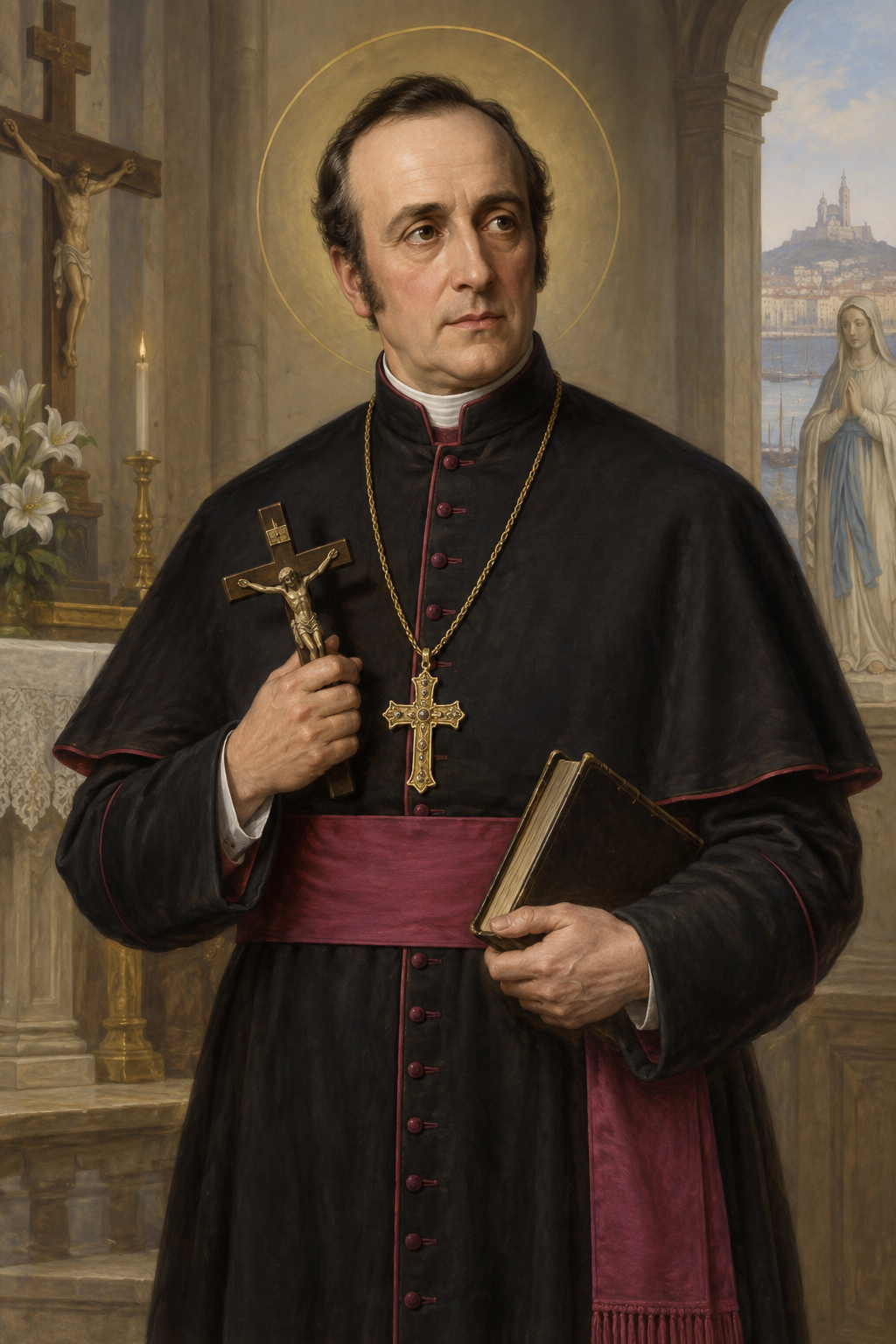
About Eugène de Mazenod
Eugène de Mazenod was born in Aix-en-Provence on 1 August 1782, into a family of the lesser nobility. The French Revolution transformed the conditions of his childhood. When he was eight, his family left France and began an eleven-year exile, abandoning property and moving among Italian cities. His father had held a senior financial office in Aix, but exile forced him to try commercial work to support the family. Financial difficulties followed. The Vatican account describes the family as approaching destitution, a sharp change from the social security in which Eugène had been born. His early life therefore joined privilege, political upheaval, and repeated uncertainty.
Eugène received only brief formal schooling in Turin. After the family moved to Venice, Don Bartolo Zinelli, a priest living nearby, undertook to educate him. The Vatican biography credits Zinelli with giving the adolescent both a fundamental education and a lasting religious discipline. The family's later move to Naples came amid financial problems; in Palermo, the kindness of the Duke and Duchess of Cannizzaro gave Eugène access to aristocratic society again. He adopted the title Count and enjoyed courtly life. These changes did not form a simple progression toward the priesthood. His early adulthood included a renewed attraction to status as well as periods of uncertainty and dependence on others.
Eugène returned to France in 1802, aged twenty. The world he encountered differed from the one his family had left: the Revolution had changed political and religious life, his parents had separated, and his mother hoped to arrange a wealthy marriage for him. The Vatican biography says that he became depressed and saw little future. His concern for people and the faith cultivated during exile nonetheless shaped a different course. The damaged condition of the French Church affected him deeply. He entered the seminary of Saint-Sulpice in Paris despite his mother's opposition and was ordained a priest at Amiens on 21 December 1811. The French Senate's biographical account likewise places his seminary entry in 1808 and links his decision to a religious experience in 1807.
After ordination, Eugène returned to Aix-en-Provence. He did not begin with an ordinary parish appointment. Instead, he served prisoners, young people, servants, and villagers whom he regarded as neglected by the usual structures of ministry. The Vatican account notes that he sometimes faced opposition from local clergy. He recruited priests who shared his desire to reach people in accessible ways. Their group traveled from village to village and preached in Provençal, the language spoken by many local people, rather than relying only on educated French. They instructed people and heard confessions, while maintaining a common rhythm of prayer, study, and community life. The initiative joined public preaching with sustained personal pastoral care.
The first community called itself the Missionaries of Provence. Its members sought to make popular missions a continuing work rather than a series of disconnected efforts. Eugène therefore asked the pope to recognize the group as a religious congregation. Pope Leo XII approved the Oblates of Mary Immaculate on 17 February 1826, and Eugène became its superior general. The congregation's own biographical account explains its origin in the post-Revolutionary religious needs of France and its service to people left at the margins. As superior, Eugène directed the community while continuing to preach and form its members. The Vatican biography says he guided the Oblates for thirty-five years. He insisted that apostolic work rest on spiritual formation and communal life.
The restored Diocese of Marseille also drew Eugène into a demanding administrative role. His uncle Fortuné de Mazenod became bishop, appointed him vicar general, and relied on him in rebuilding the diocese. Eugène was named auxiliary bishop in 1832 and consecrated in Rome. The appointment brought him into conflict with the French government's claims to control episcopal appointments. Vatican's account describes the ensuing diplomatic dispute as a painful period, complicated by tensions within the growing Oblate community. Eugène eventually succeeded his uncle as bishop of Marseille in 1837. The Diocese of Marseille independently records that succession and recalls his work on the city's new cathedral and the formation of missionaries. This office connected his religious congregation with the pastoral needs of a rapidly changing city.
As bishop, Eugène worked to rebuild local church life. The Vatican biography credits him with improving seminary formation, establishing parishes, building the cathedral and the shrine of Notre-Dame de la Garde, encouraging priestly discipline, and welcoming religious congregations into the diocese. The French Senate's historical account also describes efforts to renew local faith and clergy discipline. Marseille faced political change and cholera epidemics during his episcopate, as the diocesan history recounts. The local church's account presents the rebuilding of worship spaces and the sending of missionaries as linked tasks. Eugène's pastoral work was therefore both institutional and personal: he supported clergy and religious communities while maintaining the congregation's missionary purpose. These descriptions come largely from church institutions that remember his leadership, so they are presented as their accounts of his ministry.
The Oblates' work soon extended beyond rural France. The Vatican account names missions in Switzerland, England, Ireland, Canada, the United States, Ceylon, South Africa, and Basutoland. OMI World records that the first overseas mission was sent to Canada in 1841, and its institutional history traces later foundations to further requests from bishops. The small community thus became an international missionary congregation during Eugène's lifetime. Members preached, baptized, served parishes, and helped staff new dioceses. The growth followed Eugène's willingness to send missionaries when church leaders asked for them, even while the congregation remained relatively small. The history is not a claim that every mission proceeded without the inequalities of its era; it records the expansion of the congregation and the priorities its founder gave it.
Eugène remained bishop of Marseille and superior general of the Oblates until his death there on 21 May 1861. The Vatican biography records that Napoleon III had appointed him a senator in 1856 and that he was France's senior bishop at his death. It also preserves a final exhortation to charity within the congregation and zeal in its public work. Pope John Paul II canonized him on 3 December 1995. The dates and offices establish the outline of his public life; his significance rests especially on the congregation he founded and the pastoral structures he helped rebuild in Marseille. The Church's remembrance emphasizes his attention to poor and neglected people and his insistence that missionary activity remain rooted in community and spiritual formation.
Wondering how to weigh the stories and sources? Learn how to read a saint biography.