Biography
Eustace White
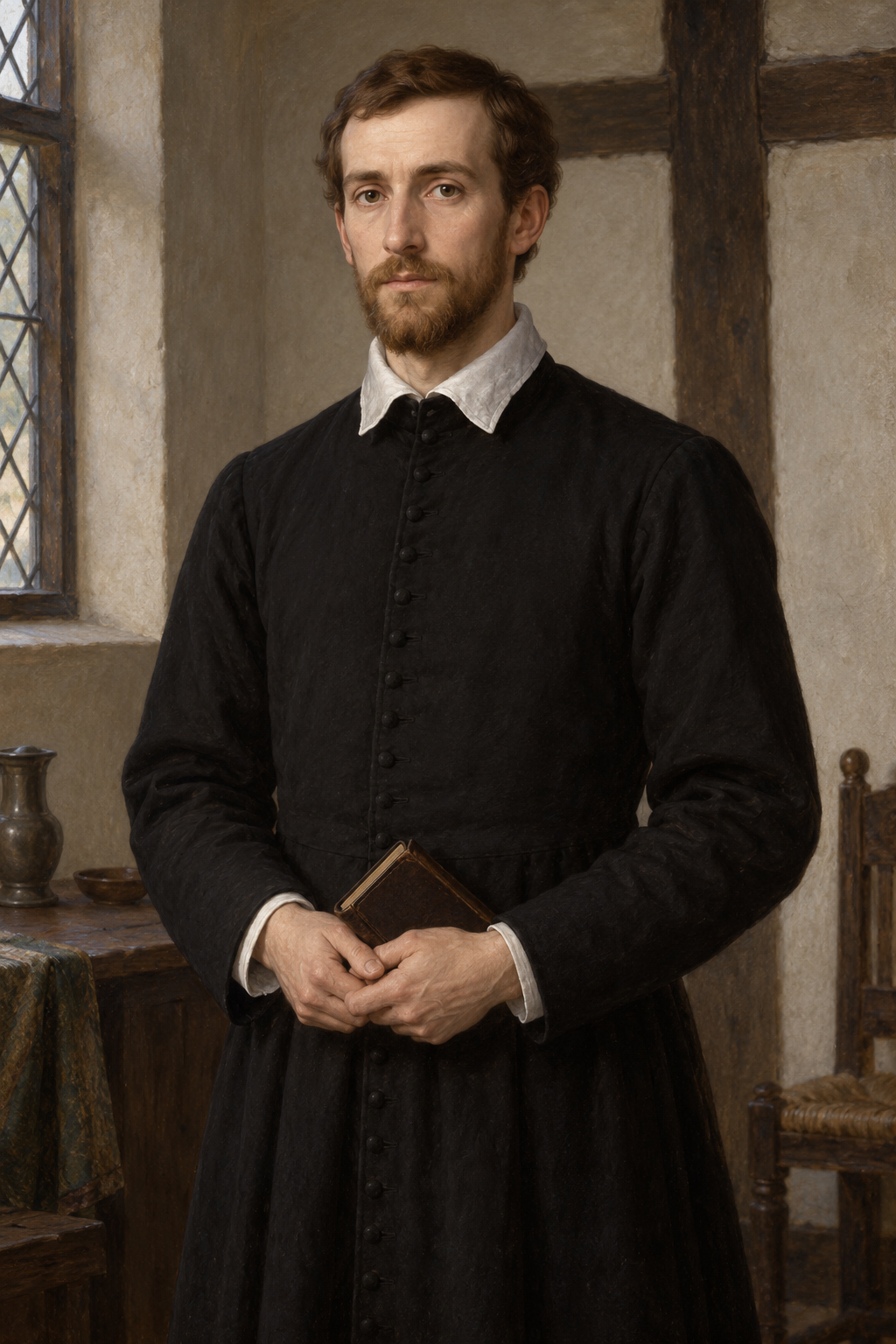
About Eustace White
Eustace White was an English Catholic priest executed at Tyburn on 10 December 1591. He came from Louth in Lincolnshire and belonged to a Protestant family before becoming Catholic. References disagree about his birth year, and the chronology of his ordination also requires care. His priesthood, mission and execution are better established than a reconstruction of his early life.
Mark Swaby’s study in The Venerabile reproduces records of his arrival at Rheims in October 1584 and admission to the English College in Rome in October 1586. A missionary oath entered in his own hand in February 1588 committed him to religious service and return to England. Swaby challenges older claims that he was already a priest when he reached Rome.
The same study gives a Douai diary entry describing him as a priest at Rheims in October 1588, followed by his departure for England on 2 November. That record conflicts with a later reference’s date of April 1589 for his diaconate. The exact date of ordination should therefore remain unresolved here. The surviving college and diary evidence nevertheless places his preparation abroad before his English mission.
His mission lay chiefly in the west of England. According to the Catholic Encyclopedia, he was arrested at Blandford in Dorset on 1 September 1591 after a conversation about religion with a travelling companion who informed against him. The account says that he then disputed publicly with a minister before being sent to London. He was confined at Bridewell, where the conditions and treatment of his imprisonment became central to later accounts of his martyrdom.
His own letter to the Jesuit Henry Garnet gives the most immediate account of that confinement. Dated 23 November 1591, it describes prolonged restraint, inadequate clothing and suspension by his manacled hands. White also records help from a fellow prisoner who passed food and necessities through a small opening. He had scarcely seen this man, yet expressed gratitude for the generosity shown to him.
The letter is also a request for practical help. White asks for money owed to him and for assistance through a Protestant friend able to gain access. He says Catholics in the west country would help if he could communicate with them. The record contains more than a description of suffering: it preserves food, clothing, access and friendship as urgent needs, together with an effort to keep contact with people outside the prison.
The political setting helps explain why authorities pursued such information. Juan Tazón Salces discusses White’s treatment within a study of Elizabethan security and the public justification of punishment. He places the confrontation between prisoner and torturer within a larger conflict between religious allegiance and a state that perceived threats to its survival. That interpretation describes the machinery of coercion; it does not demonstrate that White personally participated in an invasion plot.
Tazón also examines how accusations of treason were presented as a defence of public order. In that argument, punishment was not only directed at an individual: it communicated a warning and affirmed authority before an audience. White’s experience belongs to this contested political world as well as to the Church’s remembrance of religious persecution. The distinction helps explain why the same conduct could be represented as priestly service by Catholics and as danger to the realm by officials.
The study’s emphasis on fear is therefore significant. Information, suspicion and punishment could reinforce one another, making the prisoner’s situation part of an argument about legitimate power. Understanding that setting does not require accepting the charges against an individual as proven.
The Catholic Encyclopedia reports that White forgave Richard Topcliffe’s cruelty and prayed for him. It describes his condemnation for entering England contrary to the law and his declaration that his priesthood was the reason for his death. These reported words belong to the Catholic narrative of his final witness. The reference records a brutal execution by hanging, drawing and quartering; the details need not be repeated to understand the gravity of what he endured.
His death occurred on the same day as those of several other Catholic prisoners, but their arrests and execution sites should not be collapsed into one event. Swaby explicitly corrects a claim that White had been captured at Swithun Wells’s London house: he was already imprisoned in September. Edmund Gennings and Wells were executed at Gray’s Inn Fields, while White was taken to Tyburn.
White was beatified in 1929 and canonized in 1970 among the Forty Martyrs of England and Wales. His memory also remains local: the Catholic parish account at Louth presents him as a native of the town. That remembrance connects a priest trained abroad and imprisoned in London with the place from which his vocation began. His surviving letter gives that public memory a personal voice, marked by vulnerability and gratitude as well as resolve.
Wondering how to weigh the stories and sources? Learn how to read a saint biography.