Biography
Eustáquio van Lieshout
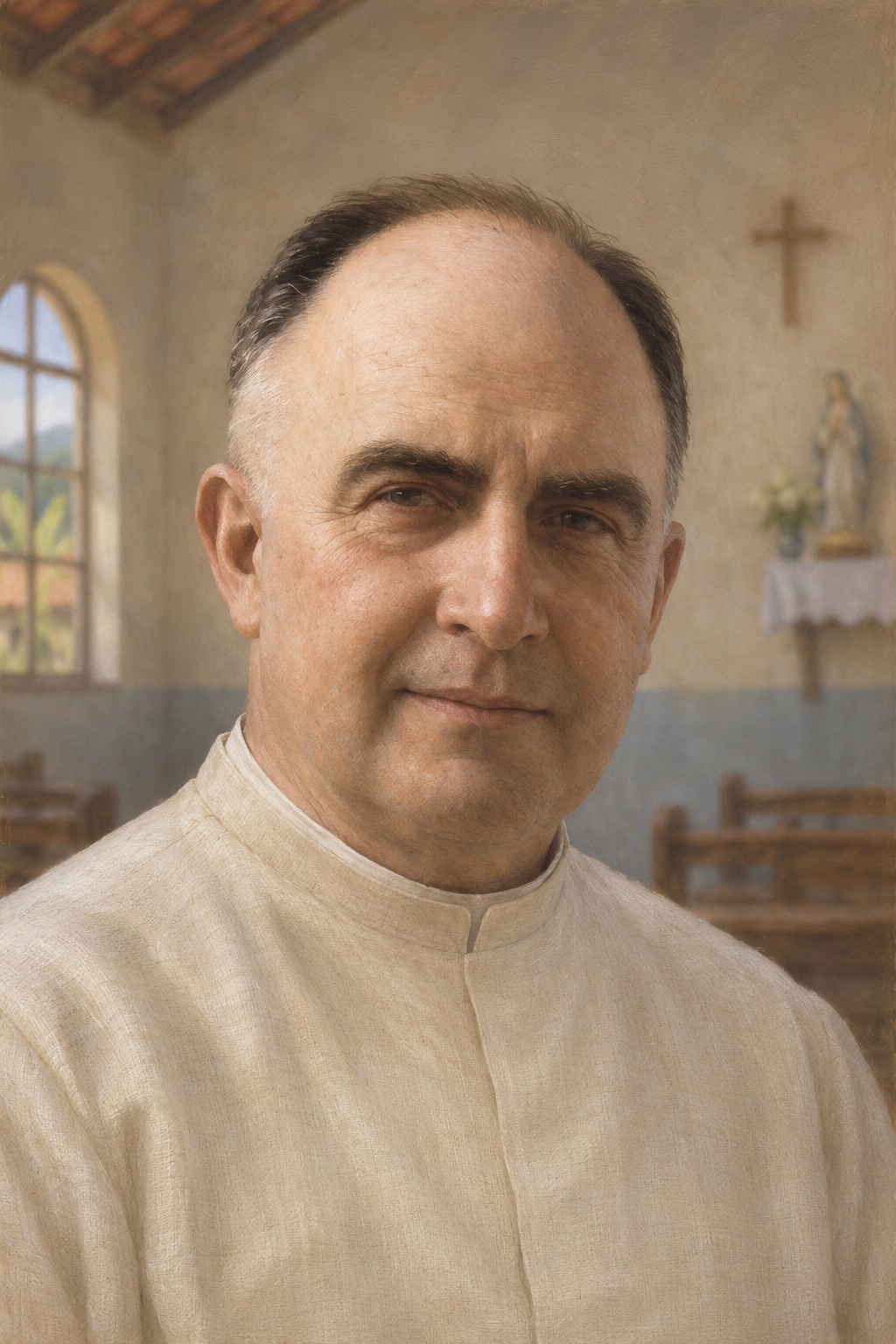
About Eustáquio van Lieshout
Eustáquio van Lieshout came to Brazil as a missionary after several years of priestly work in the Netherlands. Born Humberto van Lieshout in Aarle-Rixtel on 3 November 1890, he grew up in a Catholic farming family. Reading about Damien de Veuster helped shape his desire to join the Congregation of the Sacred Hearts of Jesus and Mary. He entered its novitiate in Belgium in 1913, taking the religious name by which he later became known in Brazil.
His companion Father Gil later gave a useful perspective on that upbringing. In testimony published from the 1962 church investigation, Gil remembered the religious life of the region they both knew: pilgrimages to shrines and the rosary prayed aloud along the way. He expressly warned that these practices were common among local people and should not be treated as unique to Eustáquio. The testimony places the future missionary within a shared culture of faith, without turning every childhood habit into a prediction of his later life.
After religious profession, Eustáquio was ordained on 10 August 1919. His early ministry included care for Belgian refugees in the Netherlands. He then prepared in Spain for a mission originally intended for Uruguay, but was sent instead to Portuguese-speaking Brazil in 1925. The change required a different destination and language from the one anticipated. It began the eighteen years of Brazilian service that would occupy the rest of his life, first in the region of Água Suja, now Romaria.
The cause’s historical account remembers his work in Romaria and neighboring parishes before his 1935 transfer to Poá, near São Paulo. Parishioners strongly resisted his departure from Água Suja. In Poá he became especially known for attention to sick people and families in difficulty. His reputation eventually drew visitors far beyond the parish itself, creating demands that the small town and the religious community struggled to manage. His ministry became inseparable from the problems caused by that growing public attention.
Anthropologist Juliano Almeida examined the material side of this growing religious reputation. Drawing on Hulselmans’s early biography, his study describes visitors seeking water associated with Lourdes and, later, ordinary water blessed by Eustáquio. Eventually people sought a personal blessing rather than water alone. Almeida treats these objects and encounters as part of the circulation of religious practices in Poá. His analysis helps distinguish the study of devotion from acceptance of every healing story as a medical finding.
Restrictions and transfers followed. During a stay in Patrocínio, Eustáquio wrote in December 1941 about a retreat and the intentions people had entrusted to his prayers. He expressed joy over people returning to religious practice after long absences. The published letter identifies relieving suffering and caring for people’s spiritual lives as his pastoral aims. It offers his own account of what mattered during a period when his public work was limited, and shows that he understood his mission more broadly than the healing reputation surrounding him.
He arrived in Belo Horizonte in 1942 and worked from the chapel of Cristo Rei while plans developed for a church of the Sacred Hearts. The crowds seeking him required an organized system of numbered cards. Illness interrupted this period of ministry, and he died in Belo Horizonte on 30 August 1943, aged fifty-two. The church he had planned continued to be built after his death. His resting place later became part of the congregation’s continuing remembrance of his service.
A later account from the cause remembers the transfer of his remains from the Bonfim cemetery to the church of the Sacred Hearts. The church became a place of continuing remembrance associated with the greeting Saúde e Paz, health and peace. The account describes a monthly observance on the thirtieth, bringing prayer, confession and Mass into that remembrance. These practices show how the congregation joined attention to his burial place with ordinary parish worship after his death.
His beatification was celebrated at the Mineirão stadium in Belo Horizonte on 15 June 2006, the feast of Corpus Christi. Cardinal José Saraiva Martins read the papal decree, and Archbishop Walmor Oliveira de Azevedo preached. The cause’s account records relatives from the Netherlands and members of the Sacred Hearts congregation among those present. The gathering joined his place of origin with the Brazilian communities where he had spent his missionary years.
In his homily, Walmor connected Eustáquio’s kindness with the Eucharist and practical care for others. He singled out attention to poor and sick people, and addressed the responsibilities of the living toward people in poverty, prisoners, unemployed people and those facing discrimination. The emphasis returned the celebration to service. Eustáquio’s example was presented through patient attention to another person’s needs, within the ordinary work of a parish and the larger demands of Christian solidarity. His greeting extended beyond those inside the stadium to families and communities following by radio and television, linking the gathering with people unable to attend.
Wondering how to weigh the stories and sources? Learn how to read a saint biography.