Biography
Ferdinand III of Castile
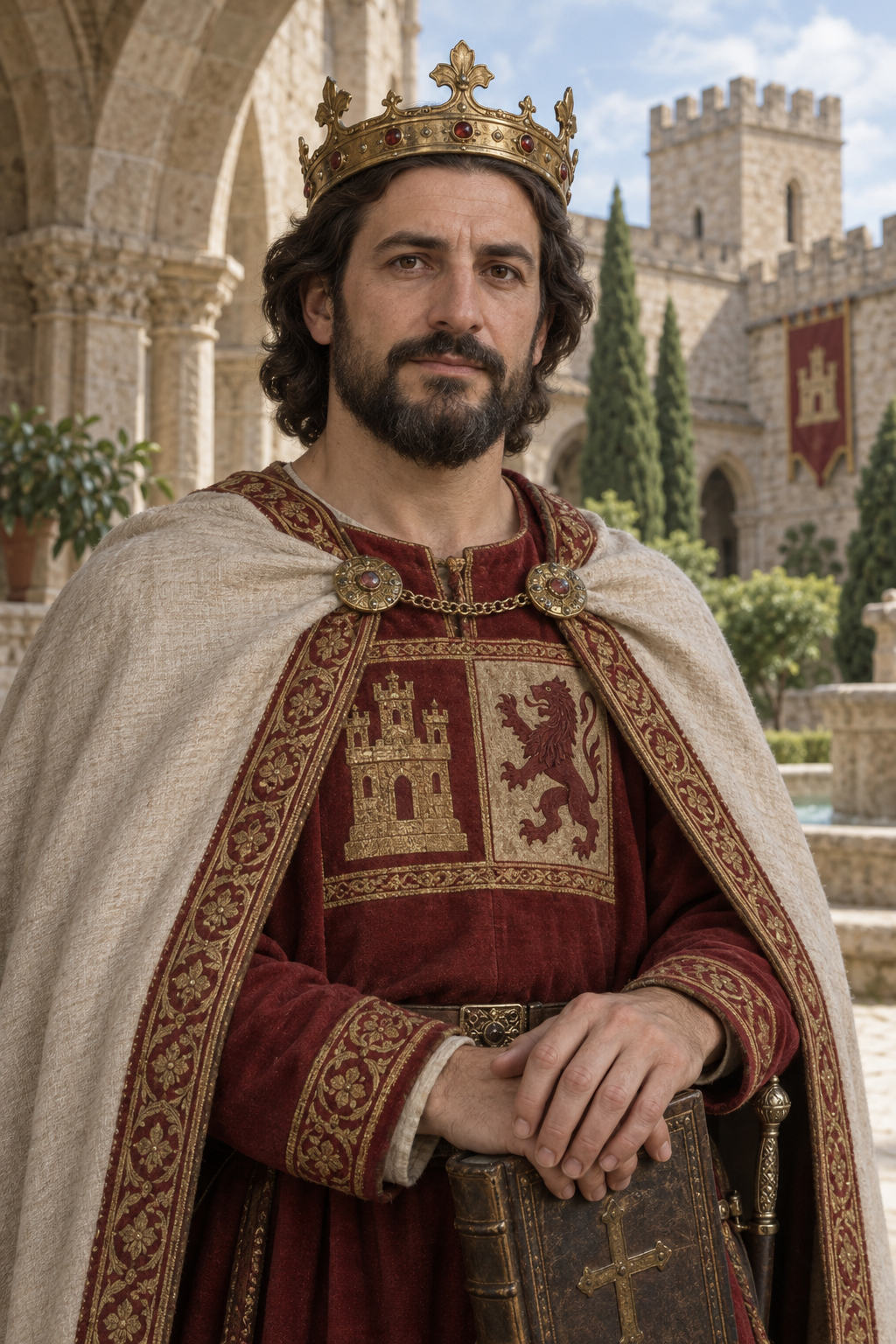
About Ferdinand III of Castile
Ferdinand III of Castile came from the royal families of León and Castile, the son of Alfonso IX and Berenguela. His birth at Valparaíso, near Zamora, is variously dated to 1199 or 1201.
He became king of Castile in 1217 after the death of his young uncle, Henry I. In 1230 he also acquired his father's crown of León, bringing the two kingdoms together under one ruler.
The union depended on negotiation as well as inheritance. Juan Gil of Zamora's medieval account describes rival claims from Ferdinand's half-sisters, Sancha and Dulce, whose father had left them the kingdom. Berenguela met their mother, Teresa, and arranged their withdrawal in exchange for an income. Ferdinand joined the agreement and assigned the sisters a lifetime payment.
Marriage and church patronage were closely connected in Ferdinand's early reign. He married Beatrice of Swabia in the old cathedral at Burgos on 30 November 1219. Bishop Mauricio, who had accompanied the bride, subsequently worked with the king to replace that building. Mauricio had studied French cathedrals, bringing knowledge of their designs to the project at Burgos. The foundation stone of the new cathedral was laid on 21 July 1221. Its plan drew on French cathedrals, and the eastern end was ready for worship around 1230. The king's support thus helped sustain a building project whose religious life began while construction was still continuing.
War carried a different cost. In recounting Córdoba's capture, Juan Gil describes Christian raiders killing inhabitants of a suburb before Ferdinand arrived to support them. Fighting and hunger forced the city to surrender in 1236. The account describes the Muslim population yielding to save their lives and the great mosque being converted into a church. Elsewhere Juan Gil praises Ferdinand for burning heretics and supplying fuel himself, a claim that reveals the chronicler's approval of religious coercion.
Jaén followed in 1246, and Seville surrendered in November 1248 after a long campaign assisted by a fleet. Ferdinand then reorganized Seville, granted it the law of Toledo, and distributed houses and lands among his knights. The cathedral's history distinguishes this conquest from legends about a Marian vision and a disguised visit inside the city.
The work of governing was shared among a much wider circle than the king alone. Manuel González Jiménez describes the court as a place of residence, a tribunal, and a council, where relatives, bishops, nobles, and lawyers advised the ruler. It received ambassadors, heard claims for justice, and considered domestic and foreign affairs. Berenguela seems to have carried particular responsibility during her son's long absences on campaign in the south. This account of government places his mother beside him not only at the moment of succession, but in the continuing administration of the realm.
Government also meant deciding how a growing kingdom would conduct its business. Historian Juan Carlos Ruiz Souza emphasizes Ferdinand's intention to bring its laws into closer agreement. The royal chancery began using Castilian instead of Latin in official documents, and the Fuero Juzgo, an inherited body of law, was translated. The king worked closely with bishops who were themselves patrons of learning and church building. Alfonso X continued some cultural enterprises that his father had supported.
At Salamanca, royal help took practical forms. In 1243 Ferdinand confirmed the privileges of the school established by his father. In 1252 he exempted scholars from tolls and assured their freedom of travel. These protections linked the university's work to the everyday conditions under which teachers and students moved through the kingdom. The university's own account places him between its foundation under Alfonso IX and its further development under Alfonso X. It credits the latter with the wider settlement of salaries, teaching posts, and institutional government. Ferdinand's contribution was therefore substantial support for an existing school, rather than the creation of the university by himself.
Seville's cathedral chapter preserves a more concrete record of his final months: a royal charter dated 20 March 1252. The endowment assigned the chapter a share of customs income, the town of Cantillana, other rents, and payments owed by Granada. It also gave the cathedral privileges comparable to those of Toledo. Such arrangements provided continuing revenues, not merely a gift at a ceremonial opening. Ferdinand died on 30 May 1252, soon after making the grant, and chose the cathedral as his burial place. Alfonso X continued and expanded the support. The surviving charter makes it possible to see religious patronage operating through land, taxation, and royal authority.
His reputation grew through chronicles and later devotion, and Pope Clement X canonized him in 1671.
That later history includes a specific military patronage. In 1805 Charles IV extended Ferdinand's patronage from a regiment of sappers and miners to the Royal Corps of Engineers. The Spanish army's engineering units continue to mark his day on 30 May. Their observance belongs to the reception of a medieval king, centuries after his death.
Wondering how to weigh the stories and sources? Learn how to read a saint biography.
Explore similar vocations
Prayers for Ferdinand III of Castile
Petition from Ferdinand's collect
escucha las súplicas de tu pueblo