Biography
Filippo Smaldone
About Filippo Smaldone
Filippo Smaldone was born in Naples on July 27, 1848. The Dicastery for the Causes of Saints places his childhood in a difficult period for Naples, southern Italy, and the local Church, including the political upheavals that overturned the Bourbon monarchy and strained ecclesial life.
The official profile says that in that climate Filippo made an irrevocable decision to become a priest and to bind himself to the service of the Church. His vocation should be described in relation to the tensions of his time without turning the page into a political history.
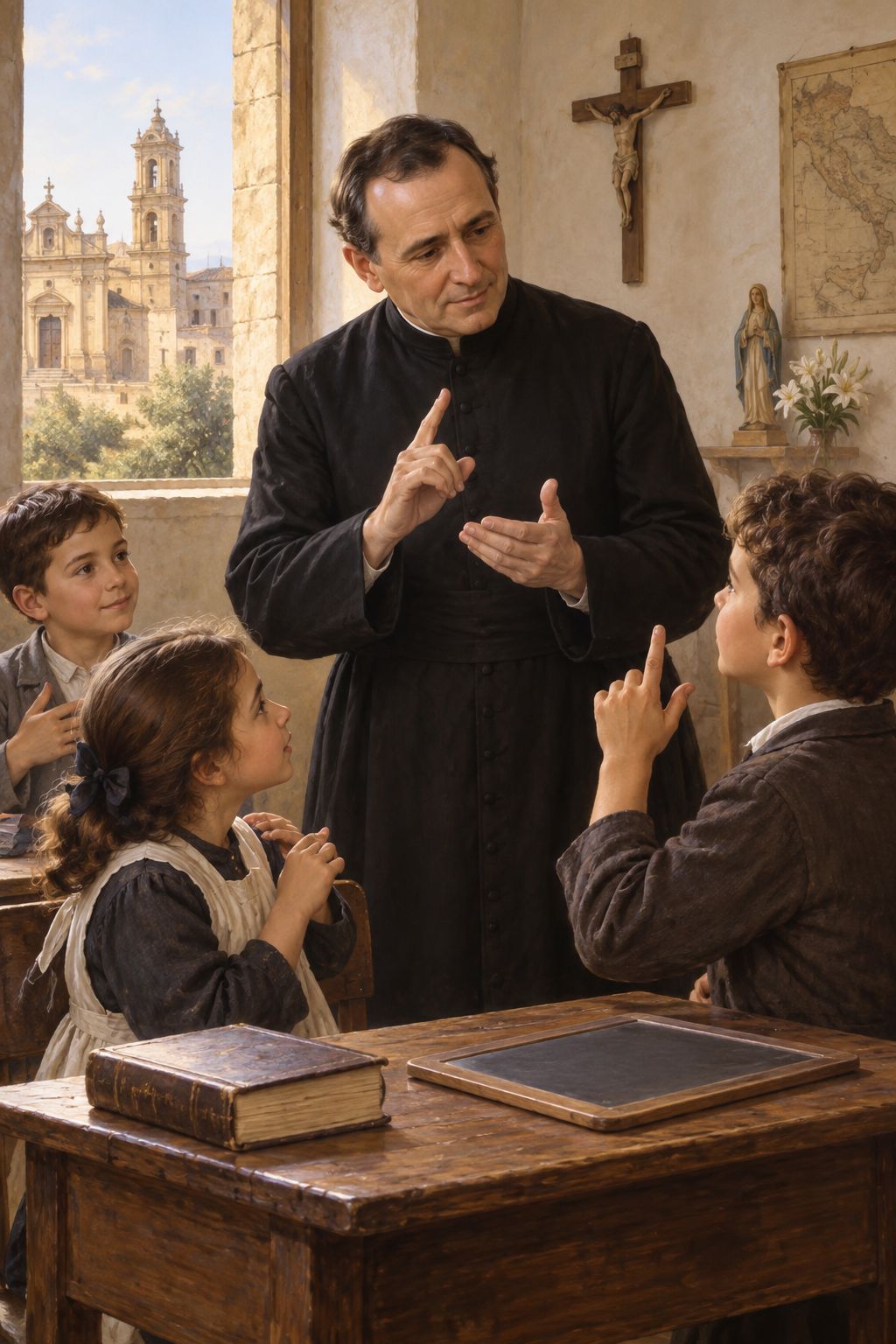
Even while he was still studying philosophy and theology, Filippo gave his ecclesiastical path a charitable direction. He began assisting deaf people in Naples, a group the source describes as numerous and often abandoned in that period.
The page should use respectful language for deaf people while still preserving the history of his ministry. Filippo's concern was not merely instruction as a school subject; the source repeatedly joins human formation, Christian formation, and practical care.
His zeal in this charitable work was stronger than his academic success. After difficulty with examinations before minor orders, he moved canonically from the Archdiocese of Naples to the Diocese of Rossano Calabro, whose archbishop, Pietro Cilento, received him because of his goodness and ecclesial spirit.
The diocesan move lasted only a few years. With permission, Filippo remained in Naples, continued ecclesiastical studies, and continued serving deaf people. He was ordained subdeacon in Naples on July 31, 1870, deacon on March 27, 1871, and priest on September 23, 1871.
As a newly ordained priest, he served as a catechist in evening chapels, collaborated in several parishes, and was especially connected with Santa Caterina in Foro Magno. The Dicastery profile also describes him as a regular visitor to sick people in clinics, hospitals, and private homes.
During a severe epidemic in Naples, Filippo himself became seriously ill. The source attributes his recovery to Our Lady of Pompeii, who became his favored devotion. This can be mentioned carefully as devotional context rather than used to build a miracle scene.
Filippo's privileged pastoral care remained the education and formation of poor deaf people. He grieved that many efforts of the time left their human and Christian formation frustrated. At one point he considered foreign missionary work, but his confessor directed him to recognize his mission among deaf people in Naples.
From then on, he gave himself entirely to that apostolate. He left his family home and lived with priests and laymen who hoped to found a congregation of Salesian priests. Although that plan did not succeed, he grew in pedagogical competence and began planning a stable institution for care, instruction, and Christian assistance.
On March 25, 1885, Filippo went to Lecce with Don Lorenzo Apicella to open an institute for deaf people. He brought with him several women whom he had already been forming, and this beginning laid the foundation for the Congregation of the Salesian Sisters of the Sacred Hearts.
The Lecce institute had female and male sections and eventually moved into larger quarters as the number of people served increased. The official profile says the former convent of the Scalze became its permanent seat and motherhouse. In 1897 a related institute followed in Bari.
Because poor families continued asking for help, Filippo's work widened. The source says he also received blind girls, orphaned girls, and abandoned girls, and that he opened houses with kindergartens, women's workshops, and boarding arrangements for female students, including one in Rome.
The institute and congregation faced serious trials from outside and inside. In Lecce, Filippo contended with a hostile lay municipal administration; internally, the congregation endured a painful secession involving the first superior general and a long apostolic visitation. The page should mention trials without turning them into polemic.
For about forty years Filippo kept working for the material support, moral education, and Christian formation of the deaf people entrusted to him and for the religious formation of the Salesian Sisters of the Sacred Hearts. In Lecce, he also served as confessor, spiritual director, eucharistic promoter, and mission organizer.
His last years included a long diabetic illness complicated by heart and circulatory problems. Filippo Smaldone died in Lecce at nine in the evening on June 4, 1923, after receiving the sacraments and the archbishop's blessing, surrounded by priests, his sisters, and deaf people from the work.
The Dicastery records his beatification by John Paul II on May 12, 1996, and canonization by Benedict XVI in Saint Peter's Square on October 15, 2006. It also gives June 4 as his liturgical memorial. The profile should center his priestly charity, educational patience, and respect for deaf people rather than treating them as background for his sanctity.
Artwork should show an Italian diocesan priest in a plain black cassock in a modest Lecce classroom, teaching deaf children respectfully with a book, slate, or gentle hand-sign cue. Avoid caricature, pity imagery, modern classroom objects, rendered words, institutional logos, and any exact-likeness claim.
Wondering how to weigh the stories and sources? Learn how to read a saint biography.