Biography
Florence Li Tim-Oi
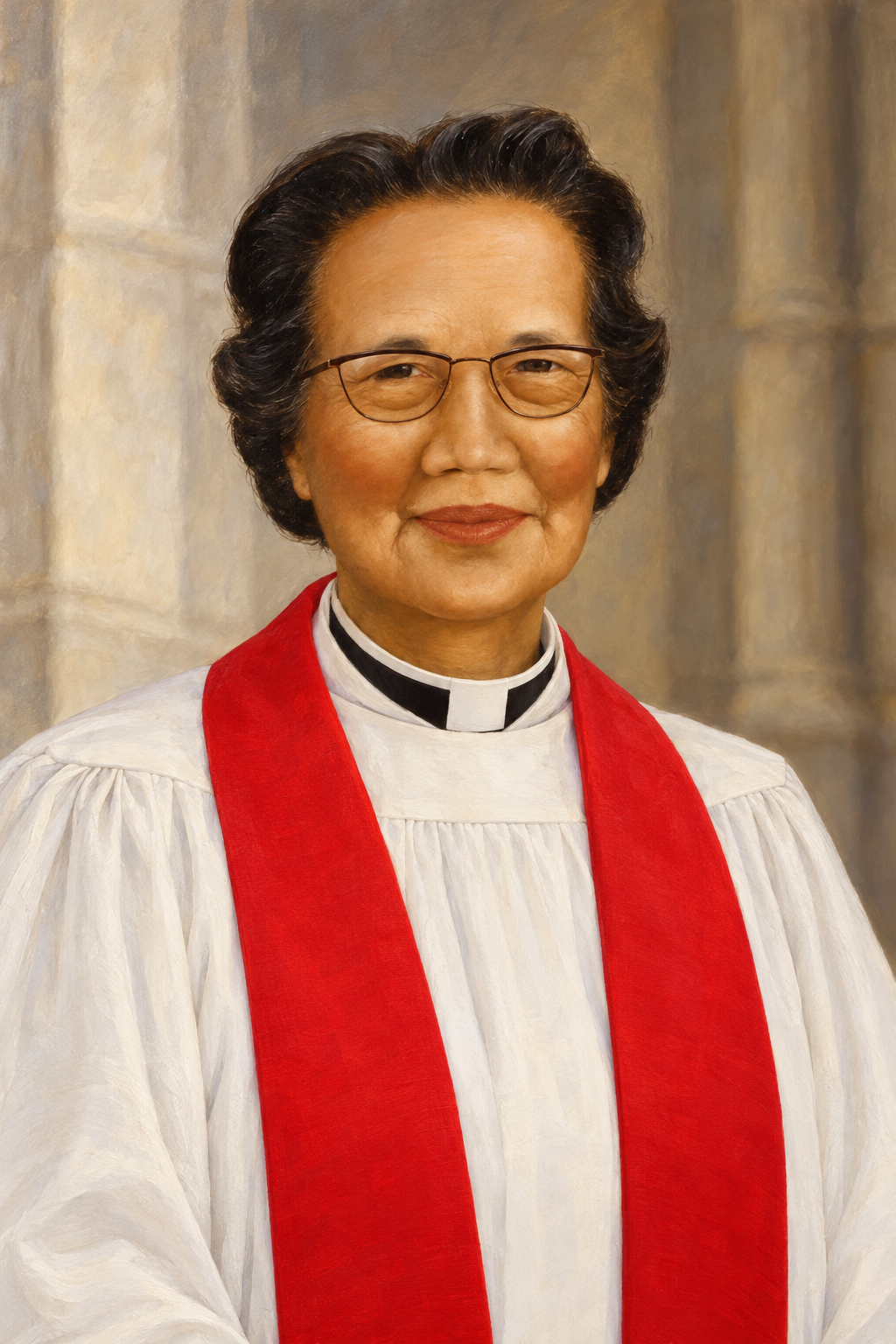
About Florence Li Tim-Oi
Li Tim-Oi was the first woman ordained an Anglican priest. After theological training in Canton, she became a deacon in 1941 and served a congregation in Macao that included wartime refugees. Bishop Ronald Hall ordained her a priest on January 25, 1944. Opposition followed, and in 1946 she surrendered her license to exercise priestly ministry, without renouncing her Holy Orders.
Her education had been interrupted by poverty. After attending her father’s school until fourteen, she waited until twenty-one to resume her studies at the Belilios Public School for Girls in Hong Kong. She graduated in 1934 and taught briefly before entering theological college. During the bombing of Guangzhou in 1937, she led fellow students in first aid and rescue work.
Her work in Macao joined worship with practical assistance. The congregation included Chinese, Western and Eurasian people, many displaced by war. She taught young people and sought government assistance to buy rice for parishioners in need. The fall of Hong Kong in December 1941 made visits from priests there almost impossible, disrupting regular Eucharistic services at Morrison Chapel. Historian Philip Wickeri places Hall’s decision to ordain her within this immediate pastoral need.
A February 1946 letter reproduced by Yanan Lu shows Li asking Hall to remain in office while offering her own resignation. She criticized the exclusion of women from priestly ordination as a church prejudice and expressed confidence that change would come. The letter preserves her disagreement with that restriction alongside her concern for the bishop and the diocese.
The dispute also affected the people she served. Wickeri reproduces a letter Li wrote in the summer of 1946 after Hall explained the church’s objection to her ordination to the congregation. Li described parishioners visiting to console her after the bishop left. Some women came in tears and questioned why the church’s treatment of women differed from the kindness they saw in Christ. Their response, preserved in her account, records support for her ministry within the congregation itself.
Her ministry in China continued through political upheaval. After St. Barnabas in Hepu closed in 1951, she studied at Yenching University in Beijing, examining the Three-Self Movement and Christianity in the changed political setting. The Episcopal Archives account records that she was assigned agricultural and factory work in 1958. A period at a Communist Party college followed in 1961, and she later returned to factory work during the Cultural Revolution. Open expressions of faith were dangerous; the account describes her effort to express Christianity through conscientious daily work. She retired from factory employment in 1974. When churches reopened five years later, worshippers had to reconstruct services from remembered practices and their different traditions.
Her later Canadian ministry involved ordinary parish responsibilities as well as public recognition. The Anglican Church of Canada records her appointment in 1983 as an honorary assistant at St. John’s Chinese congregation and St. Matthew’s parish in Toronto.
Yanan Lu’s study draws on correspondence with clergy who knew her there. Kenneth Kar Leung Fung recalled helping her remain in Canada, together with a parishioner and a former primate. Edmund Der described her willingness to celebrate the Eucharist and preach in Cantonese at least monthly. She also spoke about her experiences to the women’s group. He remembered her joining parishioners to distribute leaflets door to door in freezing weather. These recollections place her in the continuing work of a local congregation, serving people in their own language. Lu also records her participation in the 1984 Westminster anniversary celebration and her presence as an invited guest at the 1988 Lambeth Conference.
In a 1989 interview, Li recalled how the controversy had affected both her and Hall. She remembered suffering over the condemnation directed at the bishop as well as over her own situation. Her reflections appeared alongside her response to Barbara Harris becoming the first woman bishop in the Anglican Communion. Li had met Harris in Canterbury in July 1988 and described her as energetic, determined, and understanding. She interpreted their ministries as evidence that leadership in the Communion could extend beyond its predominantly white, male past. For Li, this change also mattered to the church’s responsibility for peace in a multiracial society. Her argument drew on biblical passages about unity in Christ and encouragement amid suffering. She credited the movements supporting women’s ordination, rather than presenting progress as the achievement of two individuals alone.
Li died in Toronto on February 26, 1992. The Anglican Church of Canada added her to its Calendar of Holy Persons in 2004 and commemorates her on February 26.
The Episcopal Church finally approved her addition to its calendar in 2006.
Its observance falls on January 24, distinct from the January 25 anniversary of her ordination. A 2022 General Convention resolution reaffirmed that commemoration and called the church to remember her ministry. These are Anglican calendar commemorations, rather than a declaration of Catholic canonization.
Wondering how to weigh the stories and sources? Learn how to read a saint biography.