Biography
Francesco Spinelli
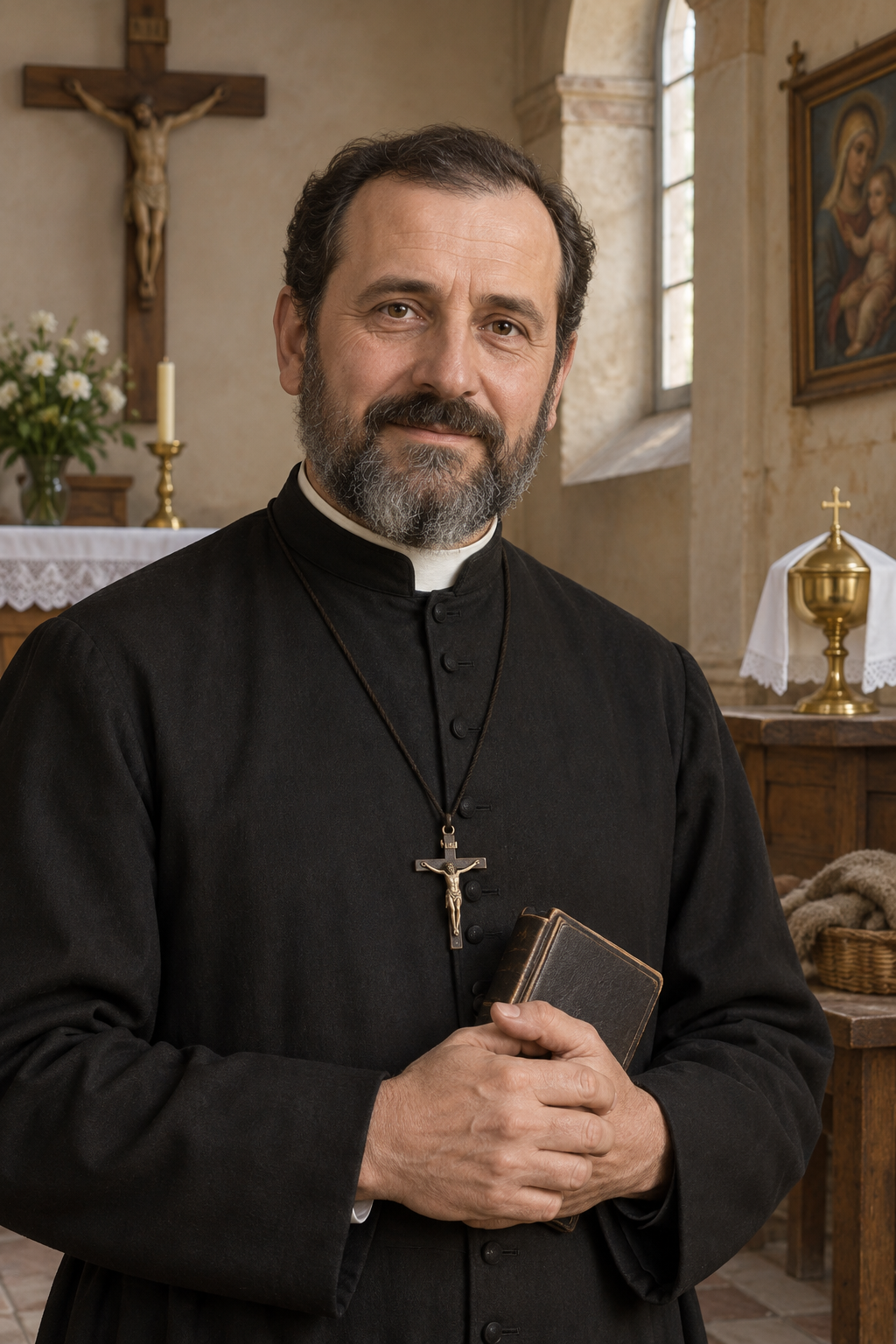
About Francesco Spinelli
Francesco Spinelli was born in Milan on 14 April 1853, in the residence of the Stanga family, where his parents, Bartolomeo Spinelli and Caterina Emilia Cagiaroli, were in service. He was baptized the next day in the Basilica of Sant'Ambrogio. Because his mother's health was poor, he spent roughly his first three years in the care of others at Verdello, in the province of Bergamo.
His schooling began at about six at the Gallina college in Cremona, and he was confirmed in that city in May 1861. In 1863 he entered the Collegio Sant'Alessandro in Bergamo, where he completed both the gymnasium and the lyceum courses with distinction before preparing for the priesthood.
The year 1875 shaped the rest of his life. During the jubilee proclaimed by Pius IX he joined a pilgrimage from the Diocese of Bergamo to Rome. According to his own later account, while praying at Santa Maria Maggiore before the relics venerated as the crib of Jesus, he knelt, wept and prayed, and in that moment seemed to see a company of young women who would adore Christ in the Blessed Sacrament.
On 17 October 1875, at twenty-two, he was ordained a priest by Bishop Luigi Speranza of Bergamo. He became curate to his uncle, Don Pietro Cagliaroli, in the parish of Sant'Alessandro in Colonna, taught religion at the Sant'Alessandro school and preached widely in the diocese.
The inspiration of Rome found its partner in Caterina Comensoli, a young woman who shared his wish to unite adoration of the Eucharist with service to the poorest. Their meeting in 1882 is placed at San Gervasio d'Adda.
After consulting Bishop Camillo Guindani of Bergamo, Spinelli began the Sisters Adorers of the Blessed Sacrament on 15 December 1882 with Comensoli and three companions. The community grew quickly, and within a few years it counted around a hundred sisters.
Growth brought heavy costs. The Dicastery's biography records that Spinelli became entangled in expensive property purchases and financial arrangements devised by other people, and that he could not meet the resulting debts. Following dishonest conduct by those who had drawn him into these obligations, he was declared bankrupt on 18 January 1889.
The collapse cost him his place in Bergamo and his role among the sisters there. The same biography says he felt abandoned and betrayed, yet forgave those who had wronged him. He took refuge with a small group of sisters at Rivolta d'Adda, a town in the Diocese of Cremona.
John Paul II later described these years as a true way of the cross, accepted in obedience, and spoke of the bitterness and disappointment Spinelli carried without abandoning his apostolate.
Spinelli asked to be incardinated in the Diocese of Cremona. Its bishop, Geremia Bonomelli, at first hesitated, but according to the Dicastery's account he was moved by the priest's humility and received him in March 1889.
At Rivolta d'Adda the work began again in real poverty, held together by perpetual adoration. The Bergamo community and the Rivolta community then went separate ways, with Comensoli leading the first and Spinelli guiding the second, which kept the name Sisters Adorers of the Blessed Sacrament.
On 10 November 1897 Bishop Bonomelli issued the decree canonically erecting the congregation. Rivolta d'Adda became, and remains, its mother house.
For more than twenty years Spinelli served as founder and superior. He formed the sisters in a Eucharistic spirituality and directed them toward abandoned children, the sick, people with disabilities and the poor. John Paul II singled out orphaned and endangered girls and people for whom public charity made no provision.
His ministry also reached beyond the congregation. The 1992 homily recalls his preaching on Eucharistic love and his support for priests in difficulty, and it describes foundations spreading from Cremona into other parts of Lombardy, including the areas of Como and Milan.
By the time of his death the institute counted 68 communities, according to the Diocese of Cremona.
Francesco Spinelli died peacefully at Rivolta d'Adda on 6 February 1913, with his sisters around him. His parting counsel to them was to love the Eucharist, serve the poorest and forgive without conditions. In 1924 his remains were moved from the town cemetery to the chapel of the mother house.
After the Church approved a healing attributed to his intercession, Pope John Paul II beatified him on 21 June 1992 at the sanctuary of Santa Maria del Fonte in Caravaggio.
A second healing, of a child in Kinshasa in 2007 after severe post-traumatic hemorrhagic shock, was approved for his canonization. Pope Francis canonized him in St Peter's Square on 14 October 2018, together with Paul VI, Oscar Romero and four others.
His memorial is kept on 6 February, the day of his death.
The congregation he rebuilt continues. The Diocese of Cremona reports roughly 250 sisters working in Italy, Congo, Senegal, Cameroon, Colombia and Argentina, in schools, hospitals, homes for the elderly, prison ministry and help for victims of trafficking, while keeping adoration at the center of their life.
Spinelli is remembered for holding together two things he refused to separate: time spent before the Blessed Sacrament and practical service to people others overlooked. His willingness to forgive after financial ruin and public humiliation is, in the Church's reading of his life, as much a part of his holiness as his foundation.
Wondering how to weigh the stories and sources? Learn how to read a saint biography.