Biography
Francesco Zirano
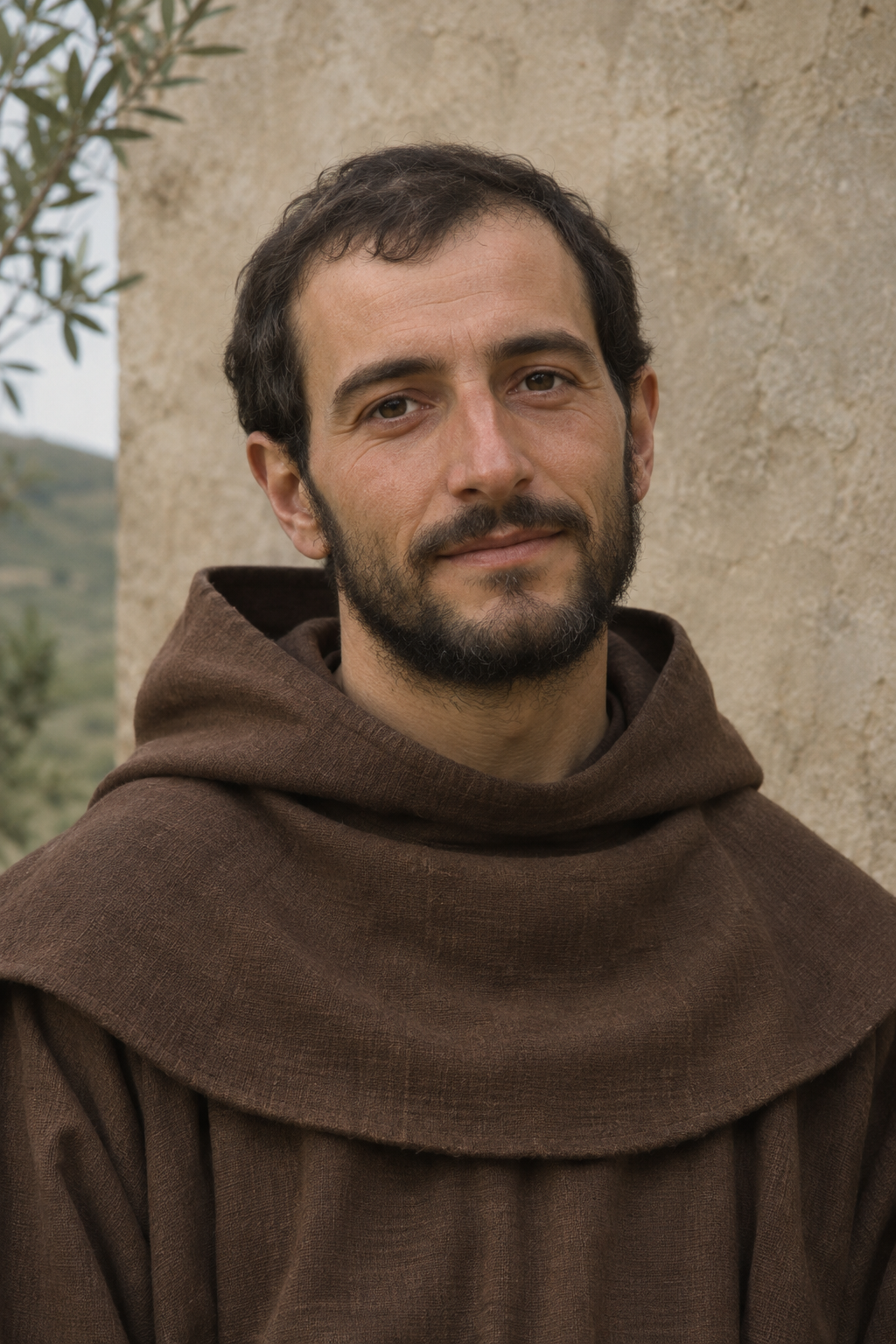
About Francesco Zirano
Francesco Zirano was born at Sassari in Sardinia, probably around 1564. His family worked the land and lived modestly. His mother’s name was Margherita; the available family record is limited, and the location and circumstances of his first schooling are uncertain. He entered the Conventual Franciscan community of Santa Maria di Betlem in Sassari. There he began a life that joined the common prayer of the friars with study and service to the people around their church.
He professed his Franciscan vows in 1580 and was ordained a priest in 1586. His responsibilities brought him into contact with worshippers as well as the daily needs of his fellow friars. The provincial biography names financial administration and the collection of alms among those duties. Such tasks were part of the working life of the convent. Zirano’s later journey to ransom captives grew out of a religious life already involving practical responsibility and dependence on the generosity of others.
The convent’s accounts also place him among the friars who travelled to neighbouring settlements collecting provisions. Historian Manlio Brigaglia noted these small traces of ordinary work in his account of Zirano. The North African journey would place the same friar in a much more dangerous setting. Cuco, a kingdom in the Kabyle region, had a Muslim ruler allied with the Spanish crown and opposed to Algiers. Religious affiliation alone therefore does not explain the alliances around him. Rival governments, diplomatic correspondence and the captivity of Christians all shaped the circumstances.
By 1598 he was serving as the convent’s procurator. Brigaglia describes journeys to collect grain and cheese, with the convent books even preserving the welcome refreshments provided when he returned. These records offer a modest glimpse of the friar before the dramatic events that later dominated his biography.
His cousin, Francesco Serra, was among the Christians enslaved at Algiers. Earlier efforts to secure Serra’s freedom had failed. Zirano obtained permission from Pope Clement VIII to collect money for ransom and then to travel personally to North Africa. He arrived in 1602. His intended rescue could not proceed through ordinary negotiations in the atmosphere of hostility surrounding Algiers. He nevertheless helped four Christian captives reach Cuco. His concern had extended beyond his own relative to others enduring captivity.
Zirano travelled in the company of Matteo de Aguirre, a Franciscan who served as Philip III’s ambassador to the ruler of Cuco. Surviving correspondence places the journey within Spanish plans involving Algiers. Zirano himself became involved in carrying news toward Spain. Gabriel Andrés, who studied the contemporary reports and their later publication, warns that accounts concentrating entirely on religious martyrdom can obscure this political and diplomatic setting. The rescue mission and the conflict between governments intersected in the events that brought him into danger.
He was captured and taken to Algiers, where the authorities demanded a large ransom. His cousin managed to visit him in prison. The Catholic account of his final days describes repeated offers to spare his life if he abandoned Christianity, and his refusal to do so. He was executed on 25 January 1603. These details belong to the martyrdom tradition on which the Church’s recognition rests; they should be read alongside the political suspicions surrounding his detention.
The story circulated soon after his death. Spanish and Italian pamphlets appeared in 1605, and later editions carried versions of it to new audiences. Andrés traces how these printed accounts drew on earlier reports and how subsequent writers reused them. Their repeated details are consequently not always independent testimony. The publications helped sustain Zirano’s memory, but they also shaped it for devotional purposes. That history of transmission calls for care with exact speeches and dramatic particulars attributed to his final hours.
The modern cause involved renewed work in archives and libraries, led largely by Conventual Franciscans in Sardinia. A diocesan inquiry was followed by examination of the material by historical experts, theological consultors, and the congregation’s cardinals and bishops. The friars’ report also remembers him encouraging other imprisoned Christians during his final days. His memory was thus preserved both through the older accounts of captivity and through the later effort to gather and assess the surviving evidence.
The historical experts considered the cause in 2003, and the theological consultors gave their judgment in 2013. Those separate stages brought historical documentation and the theological understanding of martyrdom into the formal process. The resulting recognition followed years of investigation rather than the mere repetition of an inherited title.
He was beatified at Sassari on 12 October 2014. Speaking after the Angelus that day, Pope Francis presented him as a priest and martyr who had preferred death to renouncing his faith. This is the Catholic Church’s judgment of his witness. The life remembered in that judgment began in an ordinary Sardinian Franciscan house and ended in captivity, after an attempt to restore freedom to a relative and to other Christians held far from their homes.
Wondering how to weigh the stories and sources? Learn how to read a saint biography.