Biography
Francis of Assisi
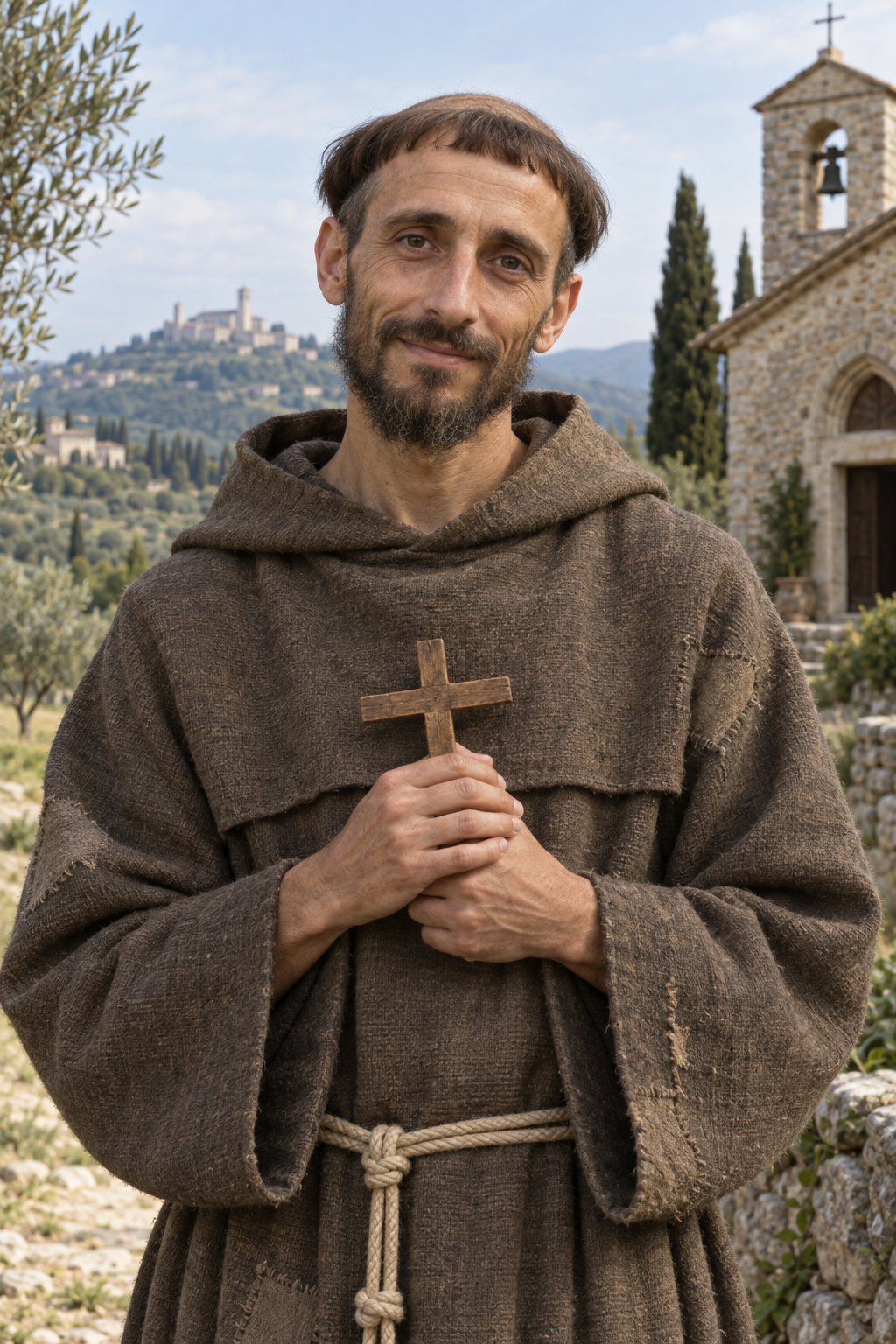
About Francis of Assisi
Francis of Assisi made poverty and life with overlooked people the center of a new religious brotherhood. Born in Assisi around 1181 or 1182, the son of a cloth merchant, he first hoped for the distinction of a soldier's life. Captivity and illness interrupted those ambitions. His conversion developed through successive choices. He broke with his father's expectations and renounced his inheritance before the bishop of Assisi. Companions eventually gathered around him, while Clare chose a life of poverty and formed a women's community. In 1219 Francis crossed the lines of the Fifth Crusade to meet Sultan al-Malik al-Kamil. He came to preach Christianity; the encounter did not produce the sultan's conversion.
The brotherhood needed recognition. Companions gathered in 1208 and visited Innocent III in 1209. The pope gave verbal approval to their proposed way of life. They stayed first at Rivotorto and then at the Portiuncula, the small church that became closely associated with their beginnings. This was not yet the final written rule under which the order would develop. Honorius III confirmed the approved Rule in 1223. The distinction matters: an initial gathering of companions had grown into a fraternity whose common commitments needed an enduring form.
Looking back in his Testament, Francis located his change of heart among people with leprosy. What he had once found repellent became bearable, even sweet, through serving them. He remembered the arrival of brothers as God's gift and described their first written commitment as a brief expression of Gospel life. Work belonged to that life: he wanted brothers to learn a trade, and to seek alms when payment failed. His poverty remained joined to fidelity to the Roman Church and reverence for the Eucharist. The Testament also contains a severe disciplinary demand: brothers who rejected Catholic faith or the prescribed office were to be held under guard and delivered to ecclesiastical authority. His final instructions joined personal simplicity to uncompromising obedience.
The approved Rule gives ordinary needs a place within demanding promises. Brothers were to own neither houses nor other possessions, receive necessities for their labor rather than money, and ask confidently for help when they needed it. Yet poverty did not excuse neglect. Provision for clothing had to take account of seasons and climate, and care for sick brothers required special attention. A brother was to make his needs known without shame; the others were to serve him as they would wish to be served themselves. Outside the community, Francis urged courtesy and discouraged quarrels or judgment of other people. Fasting could yield to obvious necessity. These instructions describe a shared discipline with room for bodily vulnerability, not a contest to see who could endure the greatest hardship without help.
The earlier Rule of 1221 reveals another side of that discipline. As the Franciscan ministers general explain in their anniversary letter, its vision of being lesser brothers challenges claims to status and possession. Brothers were to live gladly among poor and despised people, rather than seek a position above them. Their common life called for mutual service, and their manner of approaching others had to agree with the Gospel they preached. The letter points to a mission expressed through deeds as well as speech: receiving help and acknowledging dependence could also bear witness. This gives concrete meaning to Francis's language of fraternity.
At Greccio in Christmas 1223, Francis gave another teaching a tangible setting. Pope Francis, drawing on Thomas of Celano's early biography, recounts how he asked a local man named John to prepare a manger, hay, an ox, and a donkey. Neighbors came with lights and flowers, and Mass was celebrated over the manger. There were no statues in this scene: the gathered people encountered the Nativity through the place and the celebration. Its attention to Christ's humble birth belonged with Francis's attachment to poverty. Greccio offered people a way to contemplate the Gospel through things they could see, gathered in worship.
Illness did not silence his praise. Writing about the Canticle of the Creatures, the Franciscan scholar Ilia Delio places its composition near the end of his life, amid sickness at San Damiano. Its sun, moon, water, fire, and earth are not decorative scenery. Francis addresses creation through the language of kinship and turns that kinship toward praise of its Creator. The poem's joy stands alongside bodily suffering rather than depending on freedom from it. For Delio, this vision belongs to his faith in the Incarnation: the material world is a place in which God's generosity can be received and acknowledged.
Francis died at the Portiuncula on the evening of 3 October 1226. The Church canonized him in 1228.
The familiar Peace Prayer is a later association, not his composition. Its earliest known copy dates to France in 1912. The prayer's popularity has attached words to Francis that do not come from his own writings.
Wondering how to weigh the stories and sources? Learn how to read a saint biography.
Explore similar vocations
Prayers for Francis of Assisi
Adoration from the Testament
I adore you, Lord Jesus Christ
Prayer for Peace
Lord, make me an instrument of your peace. Where there is hatred, let me sow love. Where there is injury, pardon. Where there is doubt, faith. Where there is despair, hope. Where there is darkness, light. Where there is sadness, joy.
O Divine Master, grant that I may not so much seek to be consoled as to console; to be understood as to understand; to be loved as to love.
For it is in giving that we receive; it is in pardoning that we are pardoned; and it is in dying that we are born to eternal life. Amen.