Biography
Gabriel Longueville
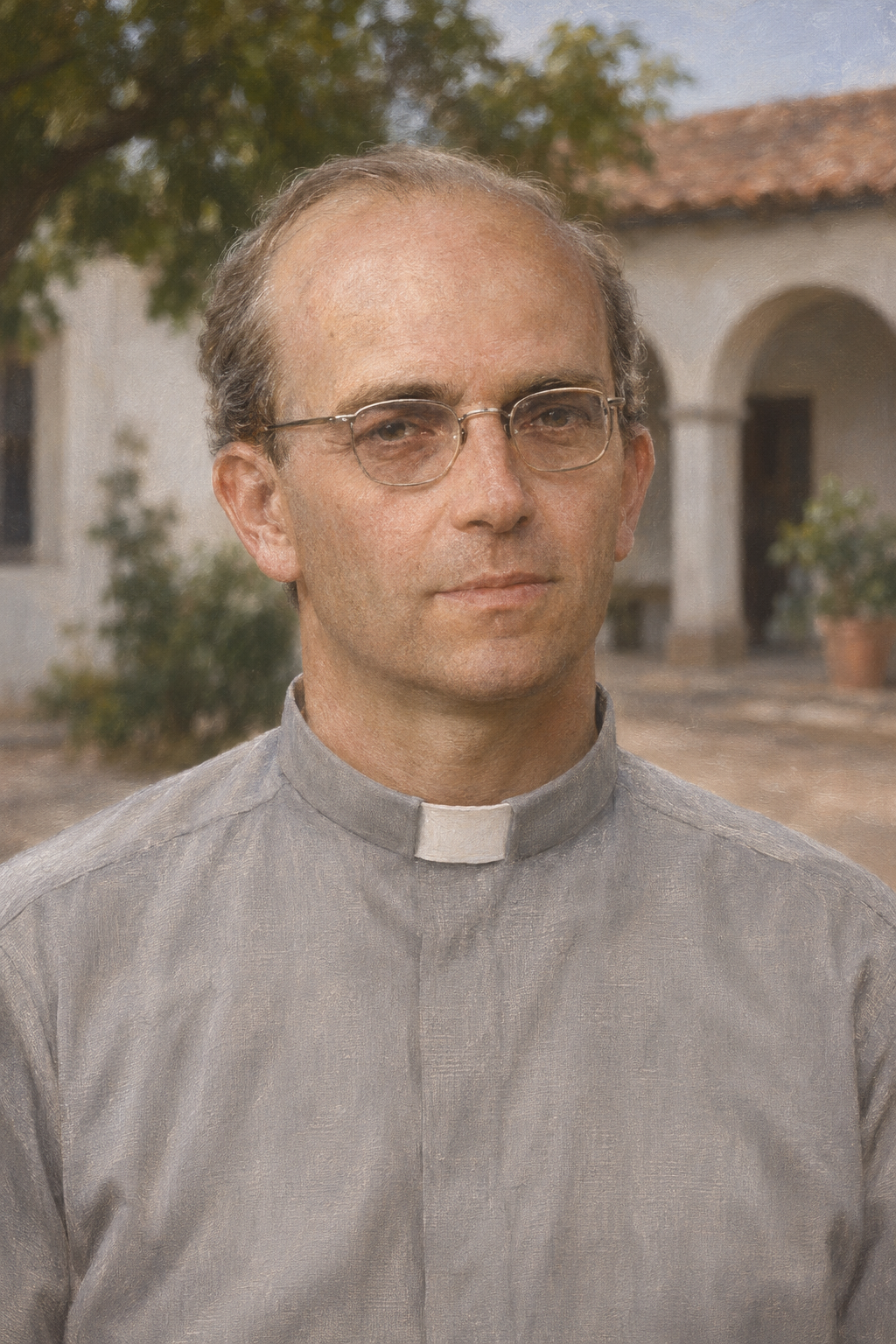
About Gabriel Longueville
Gabriel Longueville brought a teacher’s interest in language and an artist’s practical skills to his work as a priest. Born at Étables in Ardèche in 1931, he studied philosophy and theology at Viviers and was ordained in 1957. Further studies at Lyon included English and Spanish, and he taught English at the minor seminary in Annonay. The diocesan biography also remembers his drawing and painting. His later work in Argentina would combine these gifts with an effort to share the everyday circumstances of people in his parish.
In 1968 he asked to serve in Latin America as a fidei donum priest. He travelled first to Mexico in 1969 for preparation and reached Argentina in 1970. His initial assignment was in Corrientes, where he also took paid manual work. The choice was intended to bring him closer to working people, but it contributed to disagreement with the bishop. He subsequently found a different setting for his ministry in the diocese of La Rioja under Enrique Angelelli.
His letters give a more immediate view of his hopes. In an April 1971 letter, reproduced in the diocesan historical dossier, he planned to serve the poorer part of Chamical and earn some of his living through wood carving or other manual labor. These were practical choices about where to live and how to work, not simply general expressions of sympathy. The published excerpt shows him trying to connect parish ministry with close participation in a neighborhood.
A separate letter from October 1970 describes the practical difficulties of parish work in Corrientes. A group had begun repairing and cleaning the church, and he hoped they would next repair poorer homes. He questioned whether the needs of those households should have come first. He also described irregular attendance at catechism and his own changing reactions. The letter preserves his impatience and self-questioning alongside his plans, giving readers a missionary’s unsettled experience rather than a story in which every initiative succeeded.
His French diocese’s later remembrance also brought together people who knew this missionary setting. At the thanksgiving gathering in Étables in June 2019, a discussion addressed the church’s commitment to poor people across different places and generations. Participants included priests who had served in Latin America and had known Longueville and his companions. The diocesan report identifies these speakers and the subject of the conversation; it does not supply a transcript. The gathering therefore preserves a connection with living witnesses while leaving their individual remarks outside this account.
Reporting by Guilhem Dargnies describes a priest who visited by bicycle, shared maté and conversation, helped with household repairs and celebrated the Eucharist for people unable to travel. Carpentry helped place him alongside people whose working lives he wanted to understand. The report also describes a change in his response to popular devotion: he became more appreciative of the religious life of the people he served. His mission involved learning from a community as well as teaching it.
His concern extended to cooperatives and workers’ rights. Dargnies connects these efforts with the diocesan application of Vatican II and the Latin American bishops’ meeting at Medellín. Such work met hostility from powerful interests. The report’s interviews with the later Chamical parish priest and the cause’s postulator emphasize that spiritual care and defense of basic human dignity belonged together in this ministry. Longueville served within that common pastoral effort, alongside other priests, religious and laypeople.
Longueville and Carlos de Dios Murias were abducted in Chamical on 18 July 1976 and murdered. The Argentine public prosecutor’s later report records convictions for their killings in December 2012.
Their deaths became part of the collective Catholic cause of the La Rioja martyrs, whose beatification was celebrated in 2019.
His artistic work also remains part of his memory. The Diocese of Viviers publishes a devotional presentation identified as a Way of the Cross sculpted by Longueville. Its later meditations place the suffering of the four La Rioja martyrs beside the stations of Christ’s Passion. The presentation is an act of religious remembrance, rather than an independent account of every historical detail it contains. It nevertheless preserves the association between his craft and his Christian faith.
In June 2019, the diocese gathered at Étables to celebrate his beatification and that of his companions. The written report records a thanksgiving Mass and discussions involving people who had known the martyrs.
A parish centered at Annonay later took Longueville’s name when two parishes merged in 2021.
The parish history explains the choice in terms of a renewed common life across the Annonay area. Sainte-Claire and Saint-Christophe became a single parish under his name, with Annonay as its center. Remembering a former teacher and missionary became part of a present community’s effort to serve people across several towns and villages.
In 2022, Pope Francis recalled that he had personally known Longueville in Argentina and praised his attention to the poorest parishioners. Those memories connect his French origins with the people he served across the Atlantic.
Wondering how to weigh the stories and sources? Learn how to read a saint biography.