Biography
Gaetano Errico
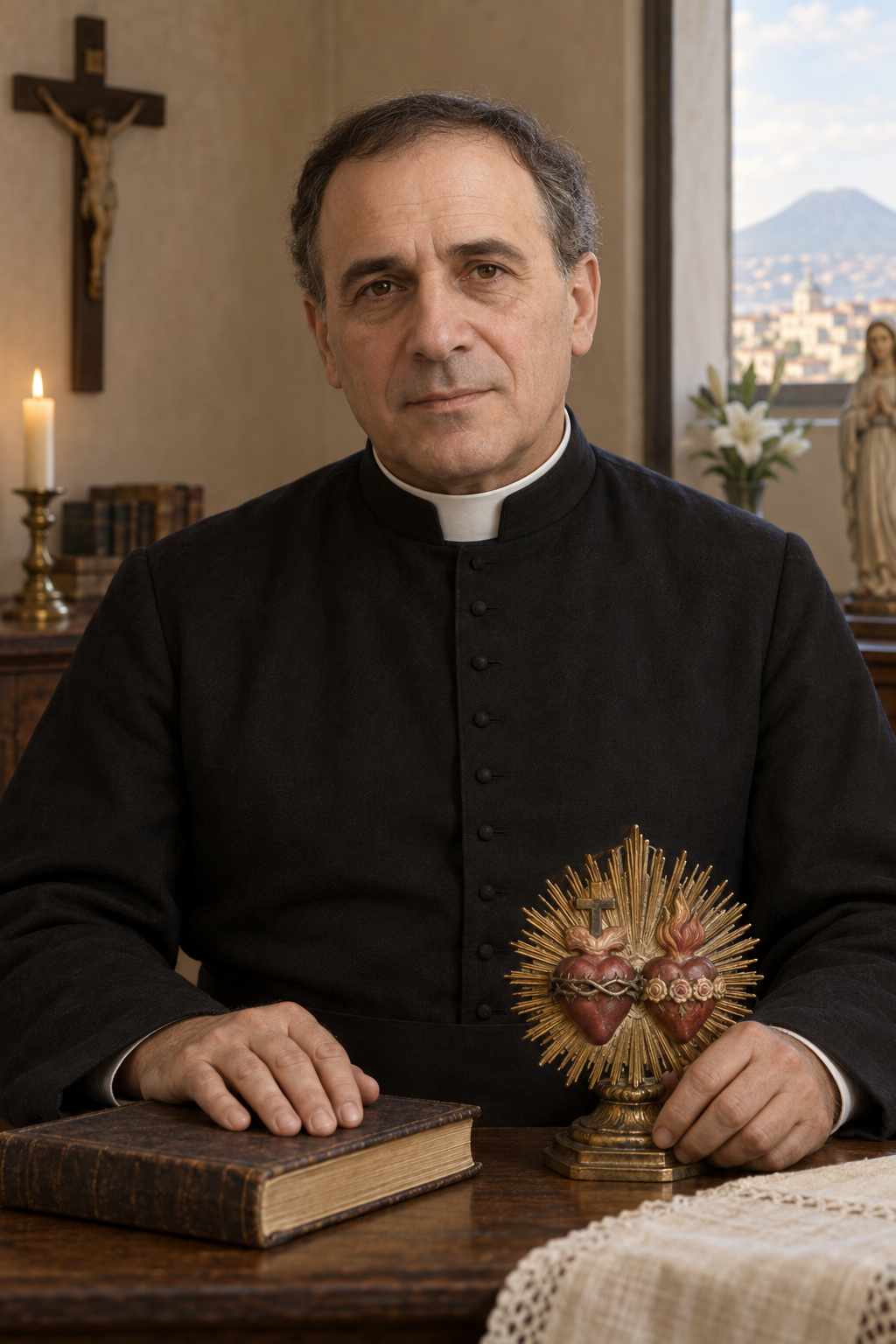
About Gaetano Errico
Gaetano Errico was born on 19 October 1791 in Secondigliano, then a farming settlement on the northern edge of Naples, and was baptized the next day in the parish church of Saints Cosmas and Damian. His father Pasquale ran a small pasta workshop and his mother, Maria Marseglia, worked as a weaver.
The Vatican's biography describes a devout household in which the boy learned his faith early. By about fourteen he wanted to enter religious life, but both the Capuchins and the Redemptorists turned him away because he was too young.
He was admitted instead to the archdiocesan seminary of Naples and began studies there in January 1808 as a day student. Because he lived at home, he walked the roughly eight kilometres to the city and back each day.
According to his congregation's biography, his course included philosophy, mathematics, canon law and four years of dogmatic theology, in which he did well.
On 23 September 1815 he was ordained a priest by Cardinal Luigi Ruffo Scilla, archbishop of Naples, in the Santa Restituta chapel of the cathedral.
Soon afterwards he was appointed teacher in the municipal school of Secondigliano, a post he held for about twenty years. The congregation's account stresses that he combined ordinary lessons with instruction in Christian doctrine.
Alongside the classroom he served the parish of Saints Cosmas and Damian, preaching, visiting the sick and spending long hours hearing confessions.
Each year he made a retreat with the Redemptorists at Pagani, where Alphonsus Liguori is buried. According to the Vatican biography, during the retreat of 1818 he reported a vision of Alphonsus, who asked him to found a new congregation and to build a church in Secondigliano in honour of Our Lady of Sorrows. This experience is known only from his own and his followers' testimony.
The church came first. The congregation's history records opposition from some local officials before the archbishop supported the plan. A public collection began in 1826, the first stone was blessed in December 1827, and building work started early in 1828.
The Church of Our Lady of Sorrows was blessed on 9 December 1830. In 1835 a wooden statue of the Sorrowful Mother by the sculptor Francesco Verzella was placed there, and it remains a focus of local devotion.
Beside the church he began to gather priests who shared his aims. In January 1831 he and a fellow priest asked the archbishop and the king for permission to open a house of retreat for clergy and a base for preaching missions.
Civil authorization came in March 1836, and on 1 October of that year a novitiate opened in Secondigliano. The community took the name Missionaries of the Sacred Hearts of Jesus and Mary.
In 1838 the Roman Congregation of Bishops and Regulars praised the new institute, and royal recognition in Naples followed. In 1846 Errico travelled to Rome to seek full approval. Gregory XVI received him but died that June, and on 7 August 1846 the newly elected Pius IX approved the congregation.
His brothers then elected him superior general. Under his leadership the missionaries opened further houses in the Kingdom of Naples, among them Bitetto and Itri, and in the late 1850s communities in Rome and Bari.
Throughout these years his central work remained the confessional and the pulpit. John Paul II later placed him against the background of a spiritual rigorism shaped by Jansenism, noting that he proclaimed God's mercy and called him a "true martyr of the confessional" who spent whole days receiving penitents.
Benedict XVI recalled that the street and the confessional were his chief places of ministry. He cited Errico's habitual greeting, "God loves you, when will we see each other?", and his advice that confessors should be as merciful as they could, since God is more merciful than his ministers.
In mid-October 1860 he fell ill with a respiratory illness and fever. He received the last sacraments on 28 October.
He died in Secondigliano on the morning of 29 October 1860, at the age of sixty-nine.
The Vatican biography records that townspeople greeted the news by saying that a saint had died. Crowds attended the funeral, and he was buried in the church he had built.
The diocesan process for his cause opened in Naples in 1866. Paul VI approved his heroic virtues in 1974. The Church accepted as miraculous the 1952 healing of Salvatore Caccioppoli, attributed to Errico's intercession, and John Paul II beatified him on 14 April 2002.
A second healing attributed to his intercession was approved in 2007, and Benedict XVI canonized him in St Peter's Square on 12 October 2008. His liturgical memorial is kept on 29 October.
His legacy is twofold. In Secondigliano, the church and statue he provided remain a centre of local faith. More widely, the missionaries he founded continue his work of preaching and reconciliation, and his memory offers the Church a model of a confessor who met sinners with patience rather than severity.
Wondering how to weigh the stories and sources? Learn how to read a saint biography.