Biography
Gaspare Bertoni
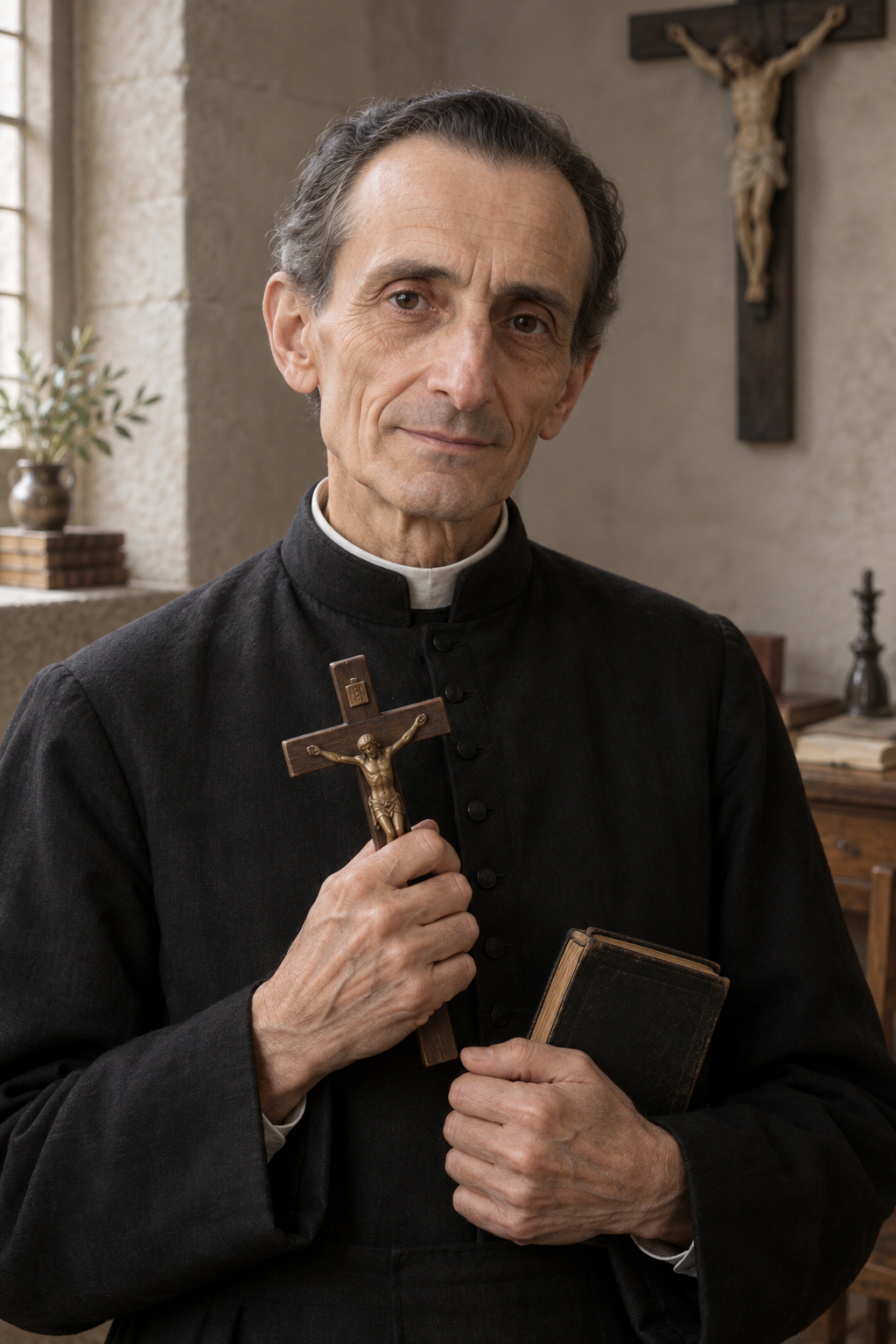
About Gaspare Bertoni
Gaspare Luigi Bertoni was born in Verona, then a city of the Republic of Venice, on 9 October 1777. His father, Francesco, came from a family of notaries and lawyers, and his mother, Brunora Ravelli, was from Sirmione on Lake Garda. He was baptized the following day in the parish church of San Paolo in Campo Marzo by a great-uncle who was a priest.
The household was comfortable and devout. A younger sister died in childhood, leaving Gaspare an only child. He was first taught at home and then attended the school of San Sebastiano, run by the city after the suppression of the Jesuits, where he came to know former members of that order.
Through a Marian congregation connected with the school he met Luigi Fortis, who later became superior general of the restored Society of Jesus. Later accounts place his sense of a call to prayer and priesthood at his first Communion, received around the age of eleven.
In 1795, at about eighteen, he began theology as an external student of the Verona seminary, taking the professor Nicola Galvani as his spiritual director. The following June the French armies entered Verona. During the occupation Bertoni joined a hospital fraternity founded by Pietro Leonardi to care for the sick and wounded.
He was ordained a priest on 20 September 1800. His parish priest entrusted him with the young people of the parish, and Bertoni organized them into a Marian association offering both religious and social formation. The Napoleonic government suppressed such groups by decree in 1807.
John Paul II later placed this work against the economic and moral hardship of a Verona worn down by war, observing that Bertoni saw the future of the Church in the formation of the young and set up youth oratories under the protection of Mary.
From May 1808 he served as spiritual director to the community Magdalene of Canossa had gathered at the convent of San Giuseppe. He also guided Leopoldina Naudet toward founding the Sisters of the Holy Family and assisted Teodora Campostrini with her own community.
His mother died in 1810. That September he moved to the parish of San Fermo Maggiore and was given responsibility for the spiritual formation of the diocesan seminarians. He gathered priests for regular meetings aimed at renewing the clergy in loyalty to the pope, and the Vatican biography credits him with restoring discipline in the seminary.
On 30 May 1812, according to the Vatican biography, he experienced an ecstasy while praying before a crucifix. Soon afterward he fell gravely ill with miliary fever and nearly died. He recovered, but for the rest of his life, some forty-one years, his health remained poor.
On 4 November 1816 Bertoni and two companions moved into a small house next to a suppressed church dedicated to the Stigmata of Saint Francis, known locally as the Stimmate. The property had belonged to a confraternity and was given to him for his work. From this beginning grew the Congregation of the Sacred Stigmata of Our Lord Jesus Christ, whose members became known as Stigmatines.
The community kept a strict common life of prayer and penance and opened a school that charged no fees. Its apostolate combined the Christian education of youth, the formation of clergy, and missionary preaching, offered at the disposal of the bishops. Despite the Franciscan-sounding name, the rule Bertoni drew up was modeled on Jesuit rather than Franciscan practice.
On 20 December 1817 Pope Pius VII named him an apostolic missionary. The Austrian authorities, who now governed Verona, restricted that ministry, so he concentrated on preaching and catechetical instruction closer to home.
His illness worsened with the years. The Dicastery records roughly three hundred surgical operations on his right leg. Even so, many people came to his bedside for guidance, among them Blessed Carlo Steeb and the priests Nicola Mazza and Antonio Provolo, and the Vatican biography calls him an "angel of counsel."
He also promoted devotion to the Five Wounds of Christ and to the espousal of Mary and Joseph, which became part of the congregation's spiritual heritage.
Gaspare Bertoni died in Verona on Sunday, 12 June 1853, in the afternoon, at the age of seventy-five. He was buried in the Stigmatine church in the city.
The congregation outlived its founder. Leo XIII approved it in 1890, Benedict XV approved its rule and constitutions in 1916, and Stigmatines reached the United States in 1905. It later spread to Brazil, Chile, the Philippines, and several countries in Africa and Asia.
Pope Paul VI beatified Bertoni on 1 November 1975. Pope John Paul II canonized him in Saint Peter's Basilica on 1 November 1989, the Solemnity of All Saints, together with Riccardo Pampuri. His feast is kept on 12 June.
In the canonization homily, John Paul II singled out Bertoni's gifts of wisdom and discernment, and his conviction that holiness is a call addressed to everyone, whether married people, the young, or workers, and not only to clergy and religious.
Treccani sums up his legacy as that of a promoter of schools for ordinary people, a trainer of clergy, and a preacher. The Stigmatines continue his work of education, priestly formation, and preaching at the service of local bishops.
Wondering how to weigh the stories and sources? Learn how to read a saint biography.