Biography
George Freeman Bragg
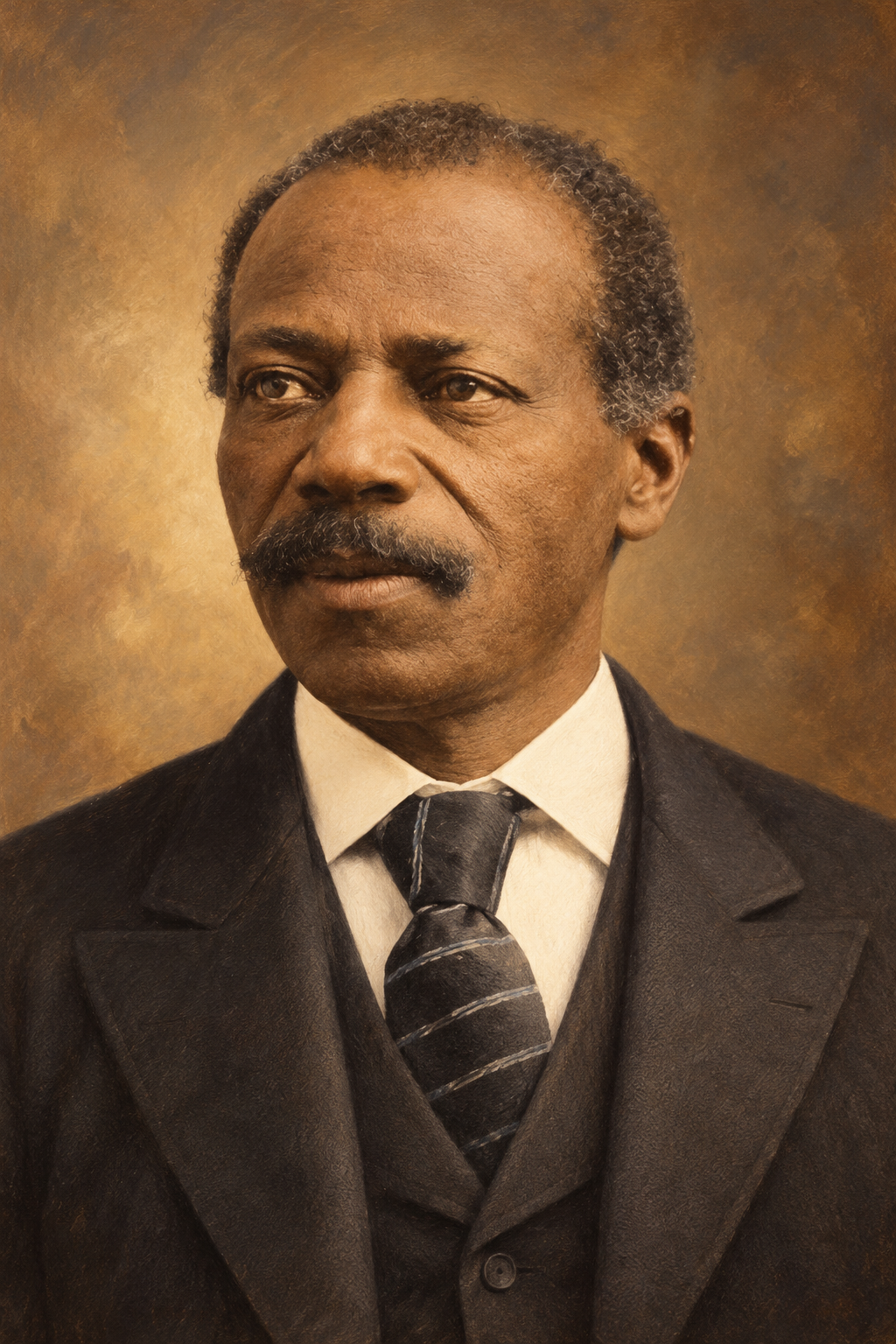
About George Freeman Bragg
George Freeman Bragg was an Episcopal priest, journalist, and historian who worked for Black people to participate fully in the life of their church. His ministry included the formation of younger clergy and the preservation of a history that church institutions had often neglected. Writing was one way he challenged the exclusion of Black Episcopalians from authority and recognition.
Born into slavery in Warren County, North Carolina, on January 25, 1863, he grew up in Petersburg, Virginia. His grandmother Caroline helped establish Saint Stephen’s Episcopal Church there. Bragg studied at its school and entered theological training, but the white rector expelled him for what was described as insufficient humility. He turned to journalism and political work before returning to the seminary. His father was a carpenter and his mother a seamstress.
He supported Virginia’s Readjuster movement and worked in William Mahone’s political organization. In 1882 he founded the Petersburg Lancet. A later dispute over a congressional nomination exposed the limits of his confidence in Mahone’s leadership. His newspaper eventually shifted from partisan politics toward the concerns of Black Episcopalians. He married Nellie Hill in 1887; they had four children.
Ordained deacon in 1887 and priest in 1888, Bragg challenged the longer period of service in the diaconate imposed on Black candidates. His subsequent ministry at Saint James in Baltimore lasted from 1891 until his death. He encouraged others to enter ordained ministry and worked through the Conference of Church Workers Among the Colored People to seek a stronger place for Black clergy and congregations.
His parish work involved financial stability as well as preaching and worship. The New York Public Library’s biographical account describes a small congregation that grew substantially under his leadership. It also records his involvement in the Maryland Home for Friendless Colored Children, which sought to provide domestic surroundings and foster placements. Beyond the parish, he pressed for Black teachers to teach Black pupils in Baltimore and worked against disfranchisement.
The library’s account also records his effort to secure a Black bishop and a district for Black Episcopalians. He remained committed to a church in which people could communicate across racial divisions, while seeking forms of organization that gave Black leaders greater authority. He was considered for episcopal office but never became a bishop. His title of doctor reflected an honorary degree rather than episcopal rank. He edited newspapers as well as publishing books and pamphlets. His surviving manuscripts include biographical essays on Daniel A. Payne, Blanche Kelso Bruce, and John Mercer Langston, showing that his historical interests extended beyond ordained ministry.
In The Whittingham Canon, published in 1913, Bragg explained why he supported missionary districts led by Black bishops. He described repeated exclusions from diocesan conventions and the failure of appeals to the national church. An arrangement that merely separated Black congregations without allowing them to act, he argued, offered no real organization. He wanted a structure through which they could exercise rights denied through ordinary channels.
He presented that plan as an accommodation to existing injustice, rather than the ideal form of church life. Full participation in a common diocesan convention remained his stated standard. Where that was prevented, he believed a missionary district could offer practical relief. His pamphlet also insisted that the church need not reproduce the disfranchising policies of civil government. The proposal arose from a struggle over effective power, not simply the location of worship.
Bragg’s historical writing served that struggle. The Episcopal Archives describes his books as preserving voices the wider church had neglected. He recorded the history of Saint Stephen’s, early Black clergy, and congregations whose achievements deserved recognition.
The preface to his 1922 History of the Afro-American Group of the Episcopal Church describes the labor behind the book. Bragg wrote of a loving congregation whose poverty left little money for wider projects. He thanked parishioners Edward P. Morris and William H. Knox for skilled work preparing the volume for printing. The history was therefore produced through the practical help of the community whose experience it sought to preserve.
He also described presenting Gustave H. Caution and Cornelius R. Dawson for ordination in June 1922. He had baptized both in infancy; they appeared with him in the book’s frontispiece.
Historian Nicole Myers Turner interprets his career as a pursuit of Black leadership and independent action within relationships that also required financial support from white church members. This reading resists reducing his choices to either submission or protest. His religious commitments and political experience informed one another. Turner connects that outlook to his education in a segregated theological school and his work in the biracial Readjuster coalition. She also emphasizes his understanding of the church as a place where Black members could learn and exercise political skills, as well as religious leadership.
Bragg died in Baltimore on March 12, 1940.
The Episcopal Church remembers him on August 3.
Wondering how to weigh the stories and sources? Learn how to read a saint biography.