Biography
George of Drama
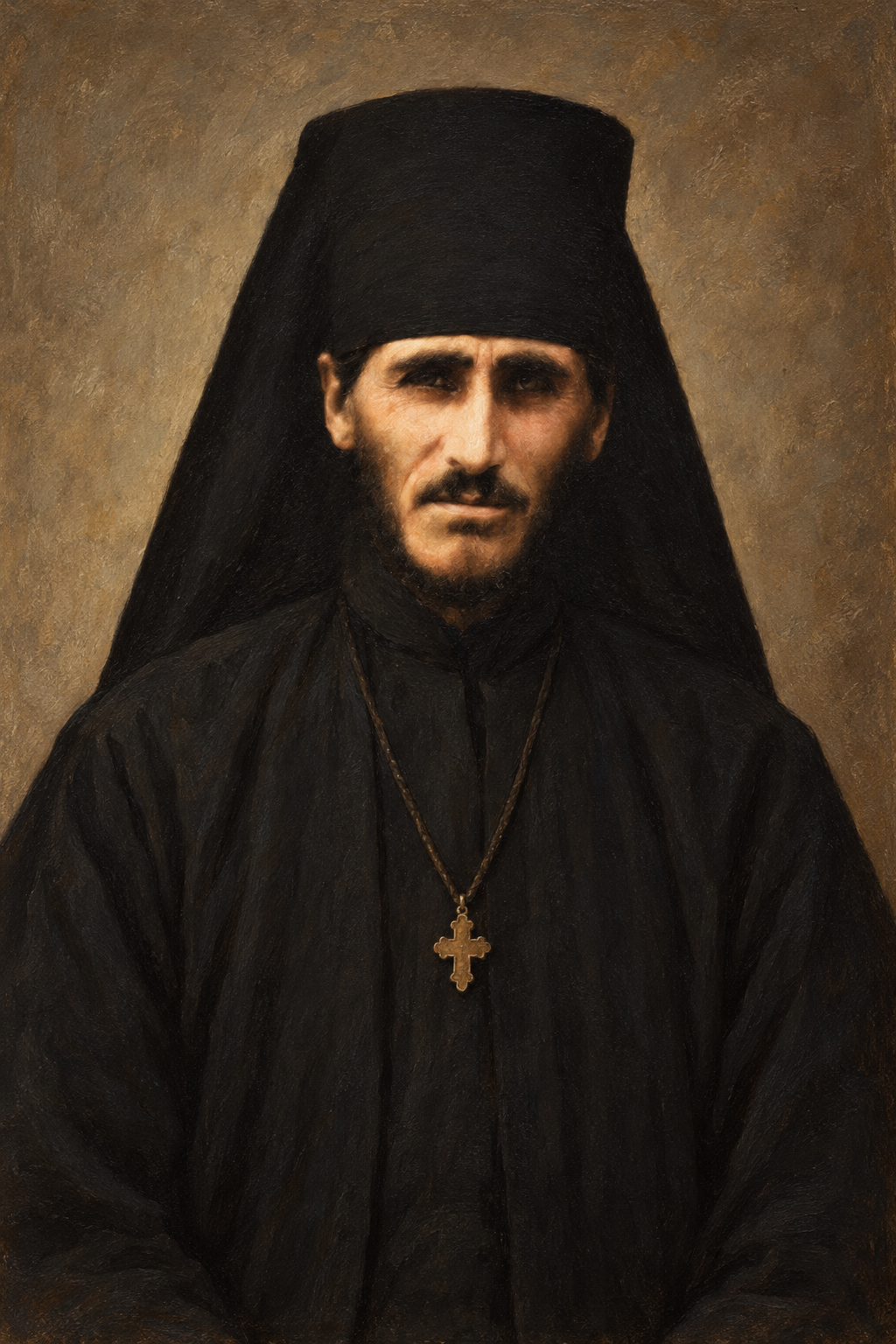
About George of Drama
George Karslidis, known as George of Drama, was born Athanasios in Argyroupolis in Pontus in 1901. Orphaned in childhood, he was raised by his grandmother before leaving the region and entering monastic life in Georgia. The Romanian Patriarchate’s account gives his monastic name as Symeon and dates his priestly ordination, when he received the name George, to September 8, 1925.
The church biography published by VEMA describes imprisonment and harsh treatment in Georgia, followed by lasting difficulty walking. It places his arrival in Greece in 1929 and his eventual settlement near Drama. These accounts remember a priest whose own suffering accompanied his work with others; their descriptions of miraculous deliverance belong to the devotional testimony surrounding his life.
At Sipsa he established a monastery dedicated to the Ascension and became known for hearing confessions. He died on November 4, 1959. Basilica reports his recognition by the Ecumenical Patriarchate in 2008 and records the Romanian Church’s decision to include him in its calendar in October 2015.
VEMA’s account emphasizes practical charity as well as prayer. It recalls visits to sick and poor people, food and clothes sent quietly to those in need, and bread prepared for visitors. It also describes a demanding spiritual adviser who valued repentance and did not seek admirers. Followers attributed foresight and extraordinary spiritual perception to him. Such reports form part of his received religious memory; they are not presented here as independently demonstrated abilities.
George’s religious instruction also addressed the responsibilities of laypeople. In an article collecting his counsel, Archimandrite Kosmas Lambrinos reports Periklis Kazantzidis’s recollection of advice about godparents. Their responsibility continued beyond the baptismal ceremony: they were to help children participate in church life and grow into good Christians. The same recollection describes George urging consistency in fasting rather than observing only the beginning and end of a fasting season. Lambrinos presents these teachings through remembered conversations, rather than a text written by George himself. They show the practical religious expectations associated with his guidance of families.
A later school project preserved memories of the monastery’s everyday life. Georgia Pataridou told pupils from Prosotsani that she had visited George at least four times before his death. She recalled taking a bus to Drama and continuing on foot to Sipsa, reaching him in the evening. Her account describes a modest bed with a board and woven cover, and two rooms where visitors could stay, with mats, pillows and quilts. She remembered food given to him being kept for workers repairing the monastery. On one visit she offered her own pocket money, but he refused it and told her to keep it for her future needs. She also repeated a memory involving her mother, who worried that poverty prevented her from arranging a memorial service. George reassured her that poorer people could do this when they were able. These details are personal and family recollections recorded decades afterward. They preserve the warmth with which Pataridou remembered him, alongside a picture of visitors sharing simple accommodation and bringing their concerns to a priest who understood limited means.
The monastery continued to develop after George’s death. A history supplied by the Metropolis of Drama describes a small community of women living in the city under Akylina Parmaksidou. When they sought a place for a monastery, Metropolitan Dionysios encouraged them to settle at Sipsa. Their arrival in April 1970 renewed the site around George’s small Ascension church. Anna Makkavaiou, whom George had made a nun, joined them. His former cell, where he had received visitors during winter or illness, was among the rooms restored. The sisters built accommodation, a refectory and other necessary spaces; the renewed monastery was inaugurated in April 1971 and formally recognized as a women’s community in 1976. The account also remembers practical difficulties, including insufficient water and the expense of building, despite the sisters contributing property and earnings. This later development belongs to the women who established the continuing community. It should not be confused with the much smaller setting in which George had lived and welcomed visitors.
At the celebrations in Drama in November 2008, Patriarch Bartholomew presented George as an example of twentieth-century Orthodox holiness. His address praised the priest’s endurance, forgiveness and concern for the people around him. It explicitly called him a heavenly protector of Drama and Macedonia, giving a direct basis for his local patronage. The patriarch urged listeners to follow George’s teaching and example as well as honor his memory.
His Georgian background remained visible in the few possessions described in his biography: church books in Georgian, vestments and icons. The same account remembers worship in Georgian, preserving a connection with the country where his monastic and priestly life had taken shape.
His veneration also reached Romania through an icon and a relic given to Patriarch Daniel by Metropolitan Pavlos in 2011.
Wondering how to weigh the stories and sources? Learn how to read a saint biography.