Biography
Gervasios of Patras
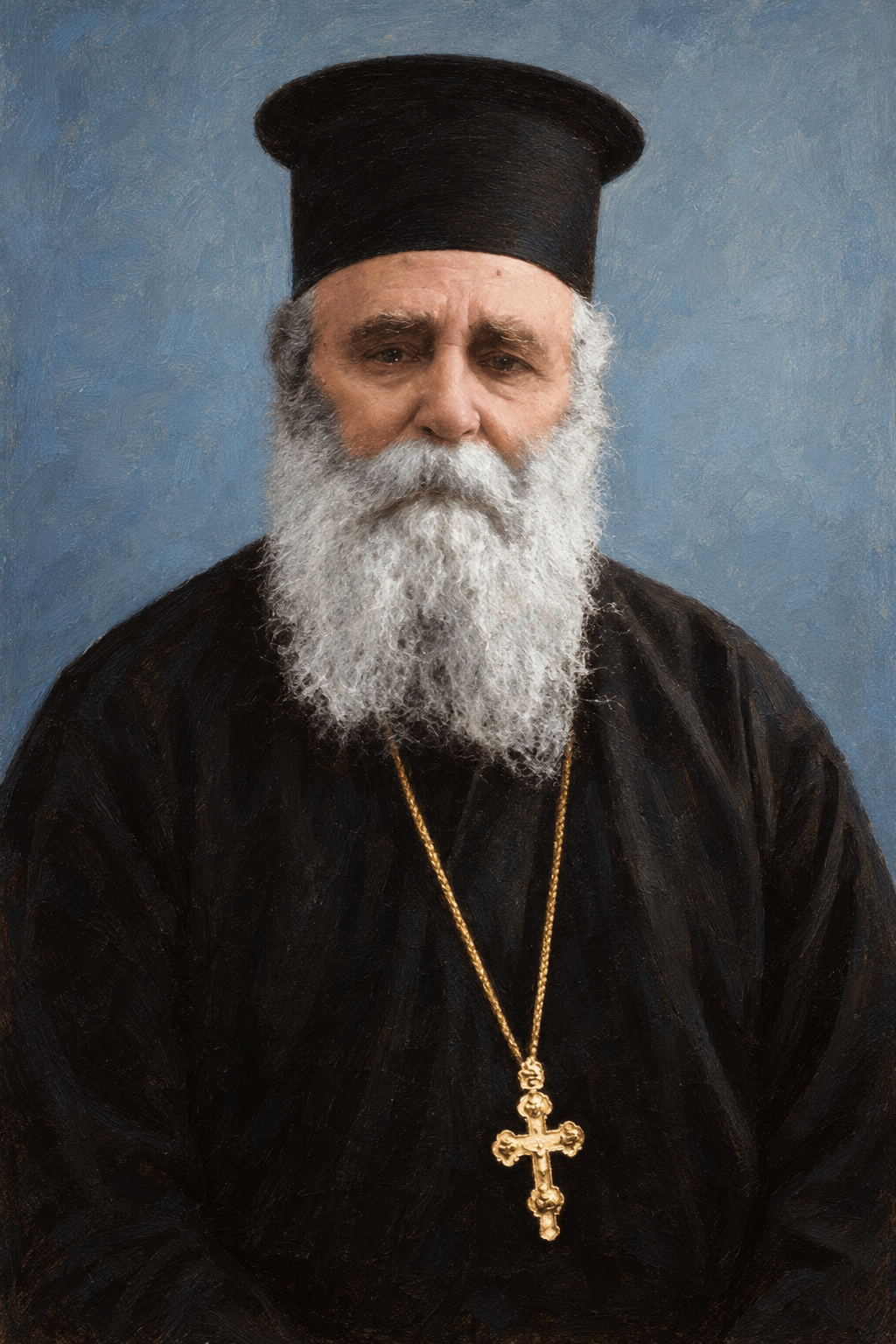
About Gervasios of Patras
Gervasios Paraskevopoulos was a Greek priest and teacher whose ministry became closely associated with Patras. Metropolitan Chrysostomos of Patras recalled his beginnings as Georgios, a poor child from Granitsa in Gortynia, and the help he received from Metropolitan Ierotheos. The same account connects his education at the Rizarios school with Nektarios and remembers subsequent service as a military priest, teacher, preacher and spiritual adviser.
His responsibilities sometimes took him beyond his best-known work with children. Evangelos Prinkipakis’s review of a substantial biography records a period as abbot of Girokomeio monastery and later service as chief administrative assistant to Archbishop Chrysanthos in Athens. The review describes his insistence on church discipline and the resistance it provoked. It also recounts an earlier ecclesiastical trial and subsequent restoration, presenting the charges as unjust. That is the interpretation transmitted by his sympathetic biographer, rather than a judgment made here from the original case records. Alongside these institutional roles, the account emphasizes his support for prisoners and his continuing ministry through confession. The review connects the Athens appointment with the encouragement of his friend, the theology professor Panagiotis Trembelas.
Teaching children was a central part of his work. The Greek Orthodox Christian Society’s account dates his catechetical schools in Patras to 1923 and his youth camps to 1946. It describes large numbers of young people learning the faith and joining in worship. It also preserves memories of his patience and approachability with children. His concern for religious education extended beyond lessons to the habits of family and community life.
Chrysostomos’s account also emphasizes his support for orphans, people in poverty and refugees from Asia Minor and Pontus. It remembers him as an advocate for people who had been wronged, alongside his work in schools and camps. These recollections place care for vulnerable neighbors within the same ministry as preaching and confession.
The camps gave children space for recreation alongside religious instruction. In a memorial issue of Apostolikos Logos, Sophia Moustaka describes the first postwar groups sleeping in simple accommodation and spending the day in games, gatherings and singing. Women volunteered to prepare meals, and many girls came from poor refugee households. Activities also included sewing, weaving and other practical skills. At Sychaina, land donated by Maria Konstantinidou made another camp possible. Moustaka credits the catechist Athina Theodosiou with encouraging Gervasios to accept the gift and helping sustain the work. Such details place volunteers and benefactors alongside the priest in the history of the camps. His teaching also circulated in print. Anastasia Kloni’s survey identifies studies of Sunday Gospel readings, a book applying church canons to pastoral questions, and an explanation of the Divine Liturgy. The last was intended to help worshippers understand what they heard and saw during the service. His published work thus extended instruction beyond the people able to attend his talks.
Gervasios’s spiritual testament gives a particularly direct account of his hopes for the Anaplastiki School. He asked its members to preserve their unity through humility and willingness to yield to one another. He also sought forgiveness from pupils, coworkers and people he had counseled, acknowledging that his words or actions had sometimes hurt them. For the school’s future, he wanted an independent institution devoted to the Christian upbringing of children. His proposals included kindergartens, craft instruction, camps and places where pupils could study. He specifically envisaged evening study space for boys whose poverty left them without a suitable room at home. Rather than flowers or commemorative gifts, he asked his supporters to remember these wishes and continue the work. The surviving online transcription is an edited combination of seven sheets bearing different dates, so it is read here as a collected testament, not as an unchanged document written on a single day. He addressed the school’s general assembly as its governing body and entrusted the continuation of its mission to the community.
When his mobility diminished in old age, he continued to speak to listeners through a microphone from his bed, with a room outside his cell serving as their gathering place. The account remembers an active teacher adapting to physical limitations. He died on June 30, 1964.
The Ecumenical Patriarchate recognized Gervasios as a saint on November 16, 2023. His shrine in Sychaina, Patras, centers on the Church of Saint Paraskevi, which he built and where his relics are enshrined. A report of his June commemoration in 2026 describes services and a procession there. It also records the metropolitan speaking about miracles attributed to him during his life and afterward; these are claims of religious devotion, rather than independently verified outcomes.
One of his pupils, Kyrillos Kostopoulos, helped carry his memory into print. Kostopoulos first published his account in 1976 and repeatedly expanded it; an English translation appeared in 1995. The successive editions combined personal recollection with an account of Gervasios’s teaching.
Wondering how to weigh the stories and sources? Learn how to read a saint biography.