Biography
Ghebre Michael
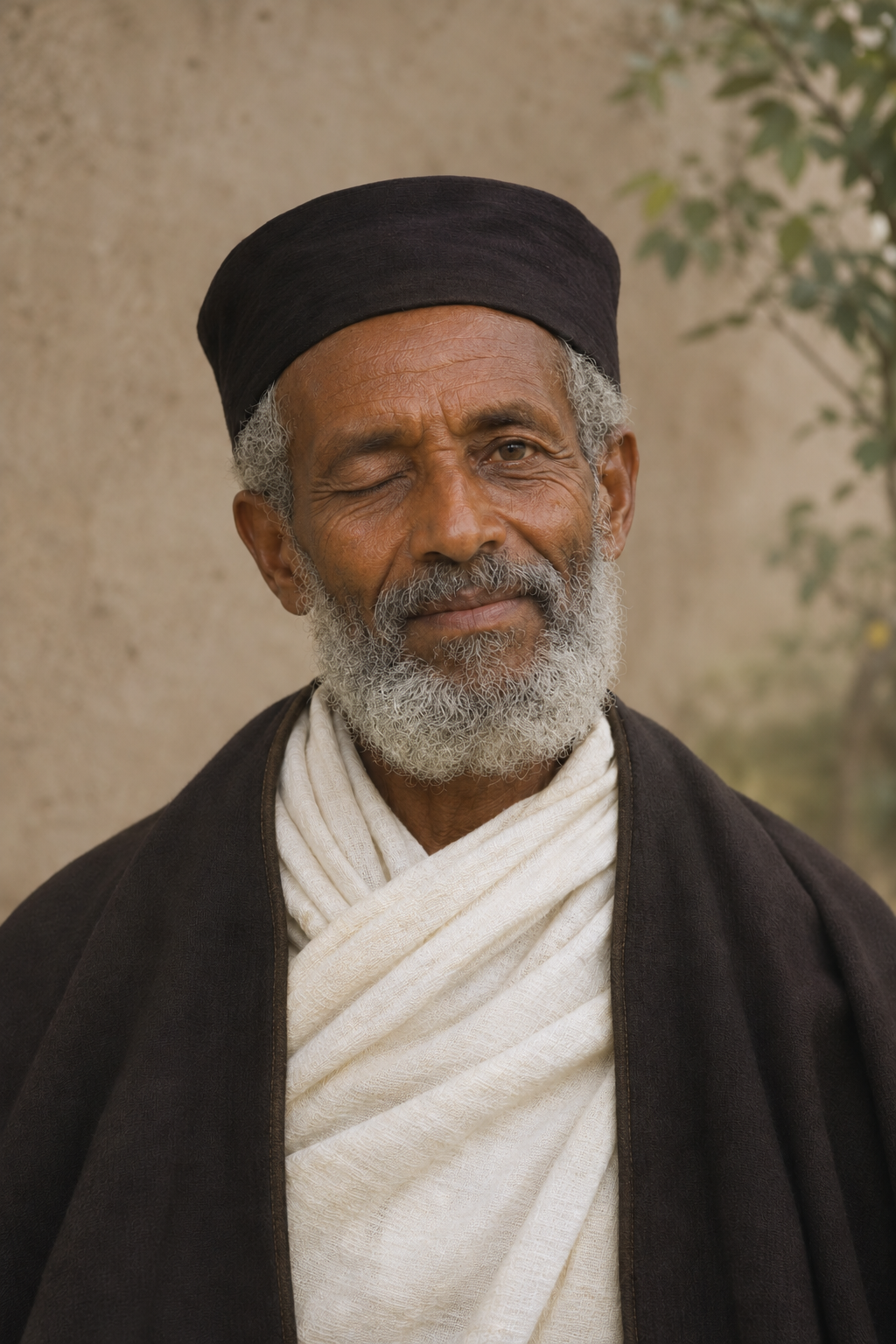
About Ghebre Michael
Ghebre Michael, also known as Abba Gabra Mikael, was an Ethiopian monk and scholar born near the end of the eighteenth century in Gojjam. The precise year and locality vary in the surviving accounts. He received his education in monastic schools and developed a reputation for learning. His interests included the Christian tradition preserved in manuscripts and the religious questions debated among Ethiopian scholars. He had already spent many years in study before his later association with Catholic missionaries.
An accident in childhood caused him to lose the use of one eye. He nevertheless continued his education and entered monastic life. The Vincentian account emphasizes his interest in the history and practice of monasticism. With permission from his superiors, he travelled to monasteries, consulted their libraries and discussed religious life with other monks. His journey toward Catholicism began within an existing Ethiopian Christian vocation, through study and a wish to understand more deeply the tradition in which he had been formed.
The 1920 account prepared for his cause describes visits to Debre Motsa, Gondar and Gunde-Gunde. It also records his work as a teacher, with younger students coming to him for religious and literary instruction. He was therefore both a learner and someone responsible for the formation of others. The questions that occupied him concerned Christian doctrine and religious life, but his teaching also belonged to the wider scholarly culture of the monasteries. His later story cannot be understood only from the final years of persecution.
In 1841 he joined a delegation sent to Egypt to obtain a new bishop for the Ethiopian Church. The journey also offered him the opportunity to visit Jerusalem. Justin de Jacobis, a Catholic missionary working in northern Ethiopia, accompanied the group. Its travels included Egypt, Rome and Jerusalem. Living and travelling alongside the missionary brought the two men into sustained contact. The relationship that developed during this journey became important to Ghebre Michael’s subsequent religious decisions and to his work in Ethiopia.
He entered communion with the Catholic Church in 1844. Jonathan Bonk’s historical summary places the production of a catechism and the translation of a work of moral theology into Amharic among his major contributions. This work made religious instruction available through a language used by the people he sought to teach. His contribution was consequently intellectual and pastoral as well as personal. He brought the skills of an Ethiopian scholar to the developing Catholic community, rather than simply receiving instruction from Europeans.
Justin de Jacobis ordained him a Catholic priest on 1 January 1851. The Daughters of Charity’s account recalls his teaching work with the missionary’s students. His vocation had thus moved from monastic scholarship into priestly service without losing its concern for formation. The relationship with de Jacobis also drew him close to the Congregation of the Mission. That connection is important to his later remembrance, but it requires care: his wish to join the congregation was interrupted before he could complete the ordinary process of admission.
De Jacobis later explained that distinction in a letter to his superior general. Ghebre Michael had intended to begin the congregation’s internal seminary, but imprisonment prevented him from doing so. He died while still a postulant. The letter nevertheless spoke of his deep attachment to the community. The Vincentian family therefore remembers him among its holy figures while acknowledging that he had not become a fully admitted member. His association rested upon a real intention and relationship, with the institutional step left unfinished by persecution.
Religious disputes became inseparable from the ambitions of political rulers. Under Emperor Tewodros, the demand for religious uniformity brought pressure upon Catholics to abandon their confession. Ghebre Michael refused. He suffered imprisonment, chains and repeated mistreatment. The formal cause narrative describes his death near the end of August 1855, after many months of captivity. Catholic recognition understands this death as martyrdom because of the sustained persecution for his faith, even though it resulted from the treatment he endured rather than an immediate execution.
A scholarly review published soon after his beatification also emphasized prolonged captivity and exhaustion. Its author, R.Janin, summarized the biography written by Jean-Baptiste Coulbeaux, a missionary with decades of experience in Ethiopia. The review records beatification on 3 October 1926. It belongs to an early stage of public Catholic remembrance, when accounts of the new Blessed circulated beyond Ethiopia. Its strongly confessional language reflects that setting and should be distinguished from a neutral description of the Ethiopian Orthodox tradition.
His writings remain an essential part of the life remembered behind the martyrdom. A catechism and a translated moral-theology text required more than the repetition of learned formulas: they addressed the task of communicating a religious tradition to readers and students. Bonk identifies that work as his principal contribution to Ethiopian Catholicism. The emphasis keeps the scholar and teacher visible alongside the prisoner. It also shows why local intellectual labour mattered to the development of a Christian community within an already ancient Christian society.
He is honoured by the Catholic Church as Blessed Ghebre Michael, priest and martyr. The Vincentian family celebrates his liturgical feast on 30 August. His life joins a long period of study, teaching and religious searching with a final refusal to surrender his convictions under coercion. Accounts of him differ on some dates and circumstances, but converge on the seriousness of his learning, the importance of his relationship with de Jacobis, and his endurance during the persecution that ended his life.
Wondering how to weigh the stories and sources? Learn how to read a saint biography.