Biography
Giles of Assisi
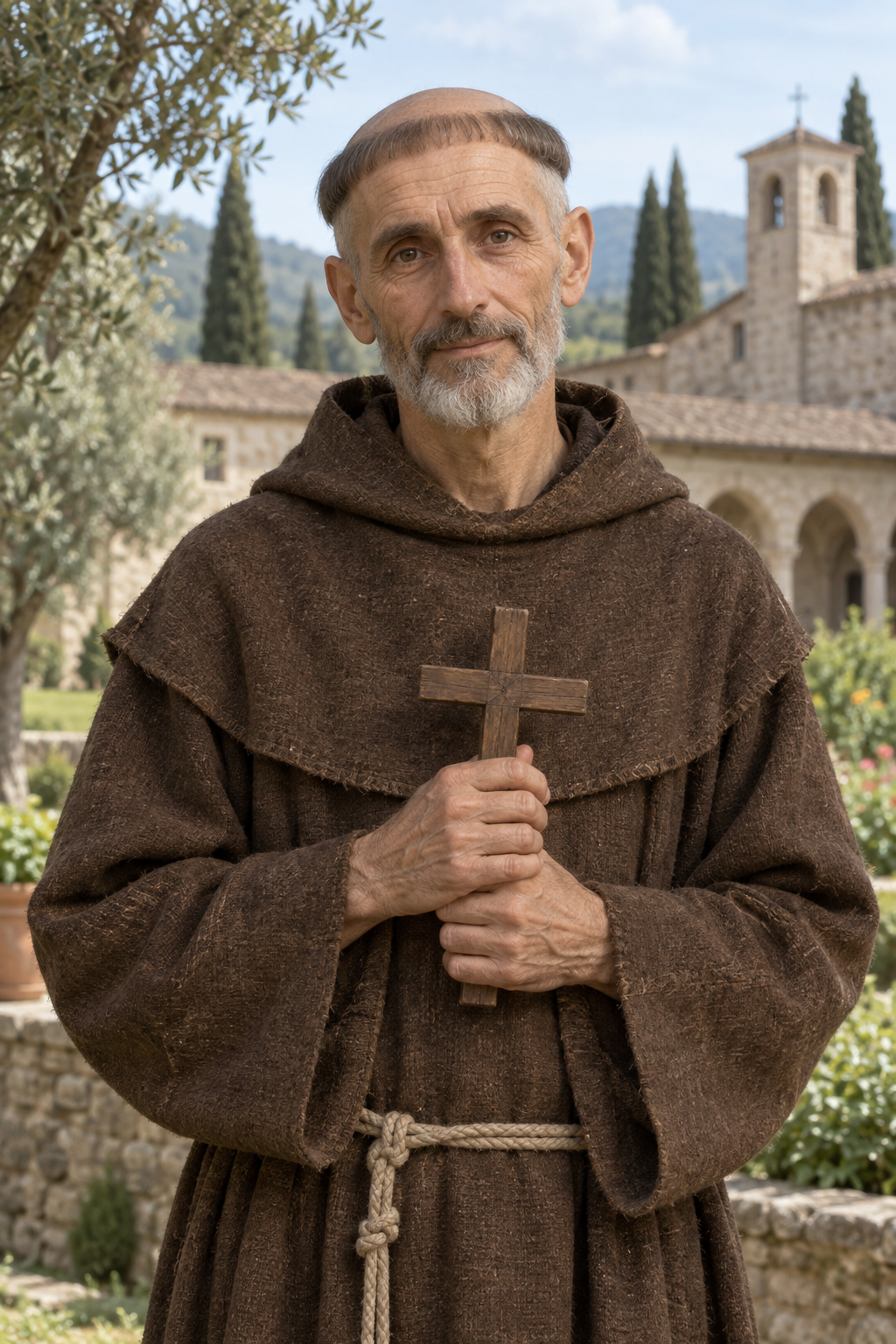
About Giles of Assisi
Giles of Assisi became one of Francis's earliest companions, a brother remembered for working with his hands and making room for prayer. His family and childhood remain unknown, and even his age when he entered the brotherhood cannot be established securely. His decision to follow Francis is associated with April 23, but the competing chronologies place it in 1208 or 1209.
The Legend of the Three Companions pictures Giles kneeling at the Portiuncula to ask Francis for a place among the brothers. Francis welcomed him, and the four brothers shared their joy before setting out in different directions. Another Franciscan account, the Mirror of Perfection, remembers a practical beginning to his poverty: at Francis's request, Giles gave his mantle to a person who needed clothing. The story describes his happiness in giving, not merely the discomfort of having less for himself.
The same collection later names his gift for contemplation among the qualities Francis valued in his brothers, alongside the different strengths he recognized in others.
Giles accompanied Francis into the March of Ancona, where Francis urged people to love God and change their lives. Giles added his own encouragement, asking their listeners to take Francis's counsel seriously. Their reception was mixed: the narrative remembers both wonder at their commitment and suspicion that these barefoot, poorly clothed travelers were mad.
Thomas of Celano also remembers Giles setting out with Bernard toward the shrine of Saint James at Compostela. In Celano's brief portrait, labor, obedience, solitude and contemplation already belong together; Giles is not remembered simply as a traveler who later discovered prayer.
A later chronicle tells of his unsuccessful mission to Tunis, where local Christians feared that the friars' preaching would put them in danger. They took the brothers aboard a ship, and the mission ended in a return to Francis rather than the martyrdom Giles had sought.
Giles reportedly asked Francis for an assigned place instead of unrestricted freedom to travel.
The Mirror of Perfection places Giles beside Bernard at the dying Francis's bed, close enough for Francis, whose sight had failed, to touch Giles's head while intending to bless Bernard. In that remembered gathering, the first companions were still together around the man whose example had drawn them into religious life.
After Francis's death, Giles increasingly sought the quiet of hermitages around Perugia, while remaining attached to the simplicity of the first brotherhood. He objected to the residence built beside Francis's tomb at Assisi. His withdrawal was therefore not only a preference for silence; the Franciscan historian Dominic Monti also understands it as a protest against changes in the order's way of life.
Giles also helped pass on memories of Francis: the companions' letter of 1246 names Brother John as a witness who had heard much of his information from Giles.
Bonaventure offers a more direct witness to Giles's prayer, stating that he himself saw the brother absorbed in states he understood as ecstasy. He presents Giles as a man without scholarly training who nevertheless reached profound contemplation through sustained attention to God. This is Bonaventure's religious interpretation of someone he had observed, not an independent confirmation of every vision later attributed to Giles.
His attributed teaching ranged from patience and humility to careful speech and obedience. Advice about prayer stood beside warnings about conduct, asking a listener to examine everyday behavior as well as inward devotion, rather than treating contemplation as an escape from responsibility.
The sayings attributed to Giles give this contemplative life a practical voice. They insist that service should continue even when its worker receives blame instead of praise, and that knowledge should bear fruit in conduct. One teaching compares guiding others toward goodness with walking the same road oneself: a preacher must not abandon the journey while pointing out its direction. His imagined model of service feeds and clothes the poor and builds hospitals and bridges, yet continues working when others think badly of him. The point is perseverance in useful care, not public recognition for the person providing it. These are counsels preserved by his followers, not a book that Giles can be shown to have written in his own hand.
His companions noted his advice during his years in hermitages, preserving conversations that later circulated in several collections.
He spent his final years at Monteripido outside Perugia and died in April 1262. The familiar date, April 23, is given in the scholarly biography, although the manuscript chronology has prompted debate. His cult was confirmed by Pius VI in 1777, long after the companions who had known him had died. The Franciscan family still remembers him on April 23, keeping his place among Francis's first companions. Giles's surviving legacy holds together the brother who traveled and worked, the adviser whose words called for action, and the old man remembered for his prayer.
Wondering how to weigh the stories and sources? Learn how to read a saint biography.
Explore similar vocations
Prayers for Giles of Assisi
Giles blessing
May the Lord forgive you.