Biography
Giovanni Antonio Farina
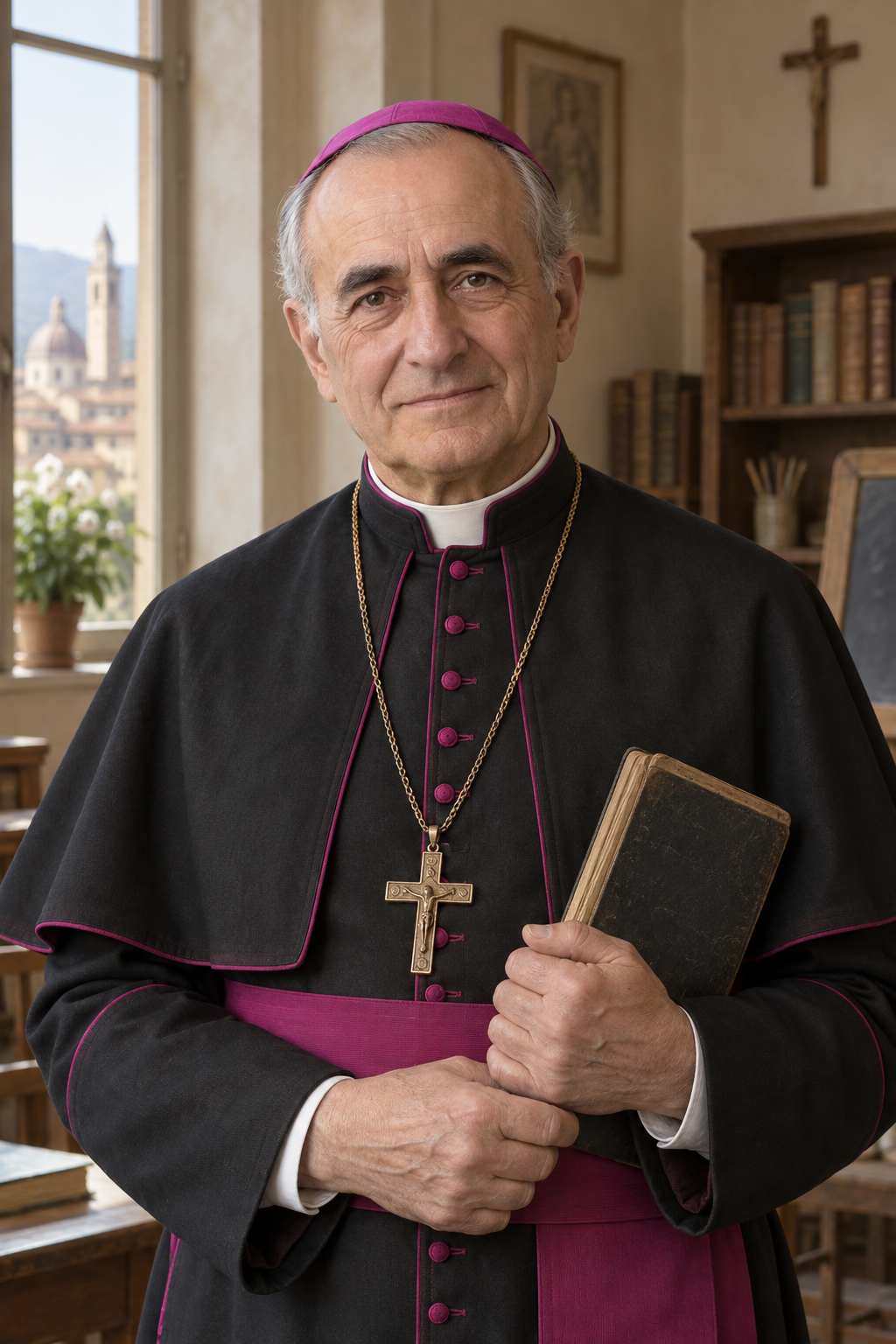
About Giovanni Antonio Farina
Giovanni Antonio Farina was born on 11 January 1803 at Gambellara, a village in the province of Vicenza in the Veneto, then part of the lands that would soon pass to Austrian rule. His parents were Pietro Farina and Francesca Bellame, and the household had a landowning background.
He was the second of five brothers in a devout family. After his father died, his paternal uncle, Father Antonio Farina, became his guide in both study and faith.
The uncle, a chaplain at Locara, gave the boy his elementary and classical schooling. The Dicastery's biography notes that he was known locally as a father to the poor and presents his care for people in material and spiritual need as the model his nephew later followed.
At fifteen Farina entered the diocesan seminary of Vicenza, where he studied theology while already teaching grammar to younger students. He was ordained a priest in January 1827 and afterward obtained a qualification as an elementary school teacher.
For about eighteen years he taught in the seminary and served as a spiritual director there. During roughly ten of those years he also assisted at the parish of San Pietro in Vicenza, and he later directed schools in the city.
At San Pietro he took on the direction of the Pia Opera di Santa Dorotea, a work for girls begun in the parish in 1827 under the influence of Father Luca Passi. A school of charity had been opened alongside it, but run mainly by lay teachers it struggled.
On 1 October 1831 Farina assumed responsibility for the school, which then had about two dozen pupils. He gave it new regulations and a pattern of daily prayer, and in 1834 obtained official recognition for what the Dicastery describes as the first public school for girls in the province of Vicenza.
Farina became convinced that the school needed teachers whose whole lives were given to the task. On 11 November 1836 in Vicenza he began a religious community of women teachers, the Sisters Teachers of St Dorothy, Daughters of the Sacred Hearts, dedicated to educating poor girls. He wrote its constitutions himself.
The work soon widened. Farina asked his sisters to teach girls from better-off families as well, and to receive deaf and blind pupils. He also sent them to nurse the sick in hospitals and to care for the elderly, including those at home.
According to the Dicastery, the institute received papal approbation under Gregory XVI in 1839. By the time of the founder's death it numbered some 330 sisters in 48 houses across the Veneto.
In 1850, at the age of forty-seven, Farina was named Bishop of Treviso, and he was consecrated on 19 January 1851. He began visiting the parishes of the diocese promptly, a visitation that ran from 1852 to 1858.
In Treviso he encouraged parish associations to help the poor both materially and spiritually, stressed religious instruction for children and adults, and tried to form a group of priests to care for the sick. It was during these years, in 1858, that he ordained to the priesthood the young Giuseppe Sarto, the future Pope Pius X.
His Treviso years were also troubled. A bitter dispute with the cathedral chapter over the bishop's jurisdiction absorbed much energy, and plans for a diocesan synod could not be carried through. The Dicastery states that his position was eventually upheld, but the conflict led him to ask for a transfer.
After the death of Bishop Giovanni Giuseppe Cappellari, Farina was transferred in 1860 to his home diocese of Vicenza, which he governed for twenty-eight years. The Dicastery records that on arrival he gave to the poor the money set aside for festivities.
In 1863 he held a diocesan synod, the first in Vicenza for well over a century, and issued new synodal constitutions. He reformed the discipline and studies of the seminary and set up confraternities for devotion and charity.
He made pastoral visits throughout the diocese, reaching mountain parishes on foot or by mule, and promoted devotion to the Eucharist and the Sacred Heart. His 120 pastoral letters and 456 circulars addressed the formation of clergy and the teaching of the catechism, including a role for lay catechists.
He took part in the First Vatican Council and signed the petition asking for a definition of papal infallibility, though diocesan business kept him from the final session. Toward civil authority he showed loyalty first to the Austrian government and, after 1866, to the Italian state.
A serious illness in 1886 left him weakened. He died of a stroke in Vicenza on 4 March 1888. His remains are venerated at the mother house of the congregation he founded in Vicenza.
Pope John Paul II beatified him on 4 November 2001, after the Church approved as a miracle the 1978 healing of a religious sister in Ecuador who had advanced cancer. A second approved case, concerning a difficult pregnancy and birth in southern India, opened the way to canonization.
Pope Francis canonized him in St Peter's Square on 23 November 2014, together with five other blesseds including Kuriakose Elias Chavara and Ludovico of Casoria.
His memorial is kept on 4 March. In Treviso and Vicenza he is remembered as the bishop of the poor, and his sisters continue his work of schooling and care in Italy and in communities abroad, from Ecuador and Jerusalem to India and Africa.
Wondering how to weigh the stories and sources? Learn how to read a saint biography.