Biography
Giovanni Battista de' Rossi
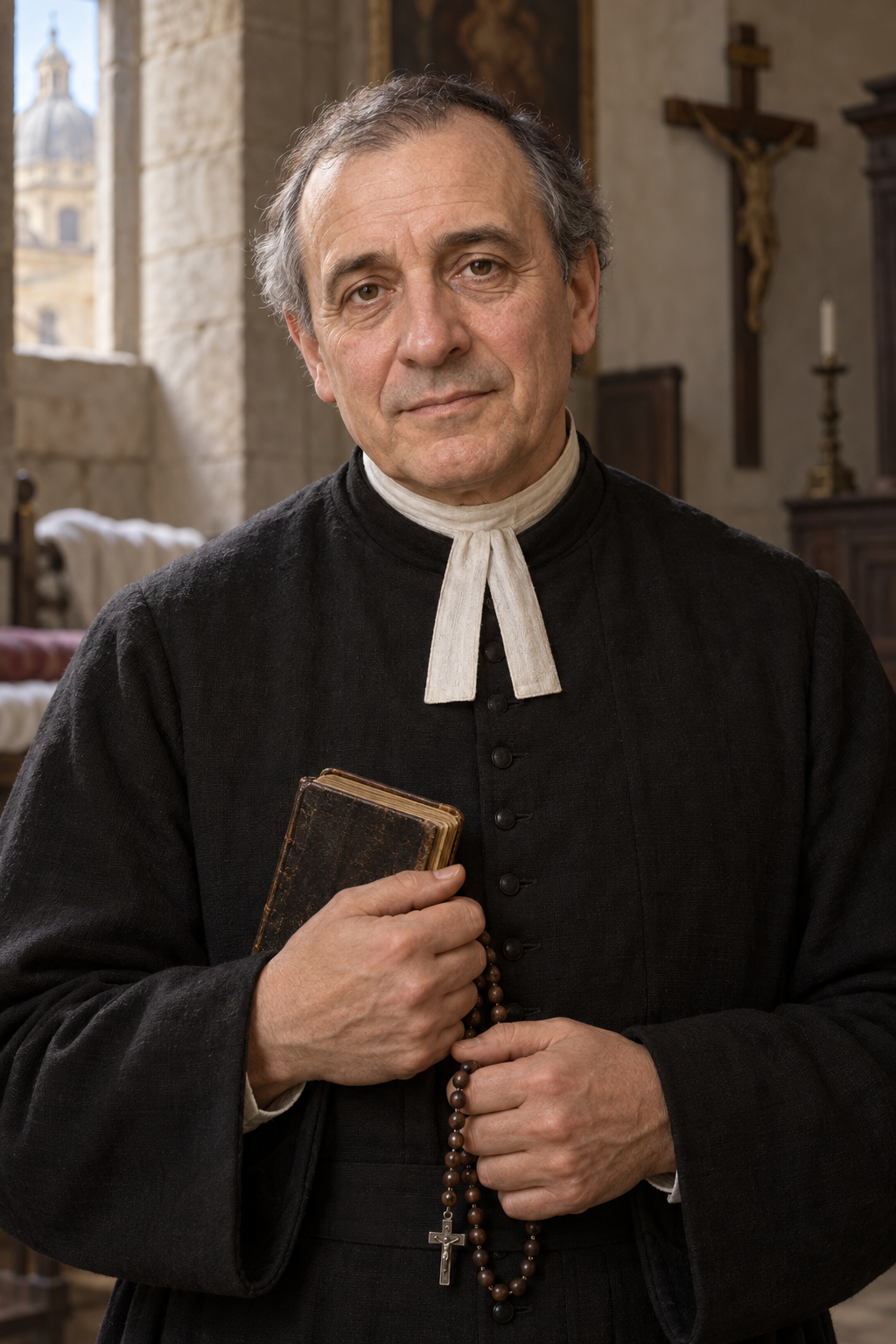
About Giovanni Battista de' Rossi
Giovanni Battista de' Rossi was born on 22 February 1698 at Voltaggio, a town in the Diocese of Genoa, to Carlo de' Rossi and Francesca Anfossi. The family had little money but was known for its piety, and Giovanni was one of four children.
When he was about ten he went to Genoa, where he lived in the household of a noble couple, Giovanni Scorza and Maria Bettina Cambiasi, serving as a page. While there he learned that his father had died.
In 1711 his cousin Lorenzo de' Rossi, a canon of the Roman basilica of Santa Maria in Cosmedin, brought him to Rome and enrolled him as a day student at the Jesuit Collegio Romano. There he joined the student sodalities that gathered for prayer, visited hospital patients and carried out other works of mercy, and he became known for drawing classmates to their weekly meetings.
Guided by his confessor, the Jesuit Francesco Maria Galluzzi, he resolved to become a priest and received the tonsure and minor orders. He did not enter the Society of Jesus. His friendship with Girolamo Vaselli, founder of a pious union of secular priests serving the poor at the hospice of Santa Galla, drew him toward a more directly charitable apostolate, and he joined that union in 1715.
His health gave way under constant activity and severe penances, and he began to suffer epileptic attacks that would trouble him for the rest of his life. He left the Collegio Romano and completed his theology at the Dominican college of the Minerva, where students could follow lectures without having to transcribe them.
Ordained with a dispensation on account of his illness, he became a priest on 8 March 1721. He celebrated his first Mass in the Jesuit church of Sant'Ignazio at the tomb of Saint Aloysius Gonzaga, to whom he was deeply devoted.
He then vowed to accept no ecclesiastical benefice unless obedience required it. He dressed plainly, gave away what he did not need, and kept his time for the service of others.
His early ministry went to people on the margins of Roman life. He preached at dawn or dusk to the herdsmen, carters and farm labourers of the Campagna who gathered in the old Forum, then called Campo Vaccino, and he visited, taught and helped the poor lodged at Santa Galla.
At Santa Galla he introduced set times of prayer and made himself available to talk with those staying there. Famiglia Cristiana writes that he spent several hours there most evenings for nearly fifty years.
Because the hospice admitted only men, he opened a house for homeless women nearby. On 1 June 1731 he rented a building from the Odescalchi family for it, and he placed its direction with Galluzzi and his successors so that it would not depend on him.
In 1735, after long hesitation, he agreed to become coadjutor to his cousin at Santa Maria in Cosmedin, and in 1737 he succeeded him as canon. He declined to live in the house attached to the canonry and used its rent for charitable purposes.
For years his illness made him afraid to hear confessions, and he sent the penitents he had moved to other priests. In 1738, recovering from a serious illness at Civita Castellana, he was persuaded by the local bishop to take up this ministry; after reviewing moral theology he received the unusual faculty of hearing confessions in any church of Rome.
The confessional became the centre of his life. He spent long hours each day with the poor and the uneducated, seeking them out in hospitals and homes, and preached in chapels, convents, barracks and prison cells. The Catholic Encyclopedia records that he came to be called the apostle of the abandoned.
His reputation grew. Clement XII excused him from attendance in choir in 1739 so he could keep hearing confessions, and Benedict XIV confirmed the exemption in 1743. That same year Benedict XIV asked him to give weekly religious instruction to soldiers and court officials at the oratory of San Filippo Neri in Via Giulia.
He accepted on condition that the work be unpaid and that he could continue visiting prisons and hospitals, which filled in summer when malarial fevers spread. He helped the sick materially as well as spiritually, but refused to let them name him in their wills.
In 1747, wishing to live as a poor man among the poor, he moved into the priests' residence at the Trinità dei Pellegrini and joined its charitable confraternity. In 1760 he gave up his canonry in exchange for a small pension.
According to Famiglia Cristiana, he also served as spiritual guide to several religious communities, among them the Brothers Hospitallers on the Tiber Island, and younger Roman clergy looked to him as a teacher.
From 1758 to 1763 he gave moral conferences to the clergy at San Tommaso ai Cenci, urging priests to help the victims of famine in the city. Some of his guidance for confessors and parish priests was printed after his death.
In 1763 his strength began to fail, and after several attacks of paralysis he died at his lodgings at the Trinità dei Pellegrini on 23 May 1764. He was buried in that church beneath a marble slab at the altar of the Blessed Virgin.
Miracles were attributed to his intercession, and a beatification process opened about seventeen years after his death, though the troubles in Europe delayed it. Pius IX, who had once led the Santa Galla priests' union, beatified him on 13 May 1860, and Leo XIII canonized him on 8 December 1881.
On 23 May 1965 his remains were moved from the Trinità dei Pellegrini to the new parish church dedicated to him in the Appio-Latino district of Rome, consecrated the day before.
His feast is kept on 23 May. He is remembered as a Roman secular priest who made the confessional, the hospital ward and the shelter his parish, and Vatican News reports that the women's house he founded, named for Saint Aloysius, is still at work.
Wondering how to weigh the stories and sources? Learn how to read a saint biography.