Biography
Giovanni Battista Piamarta
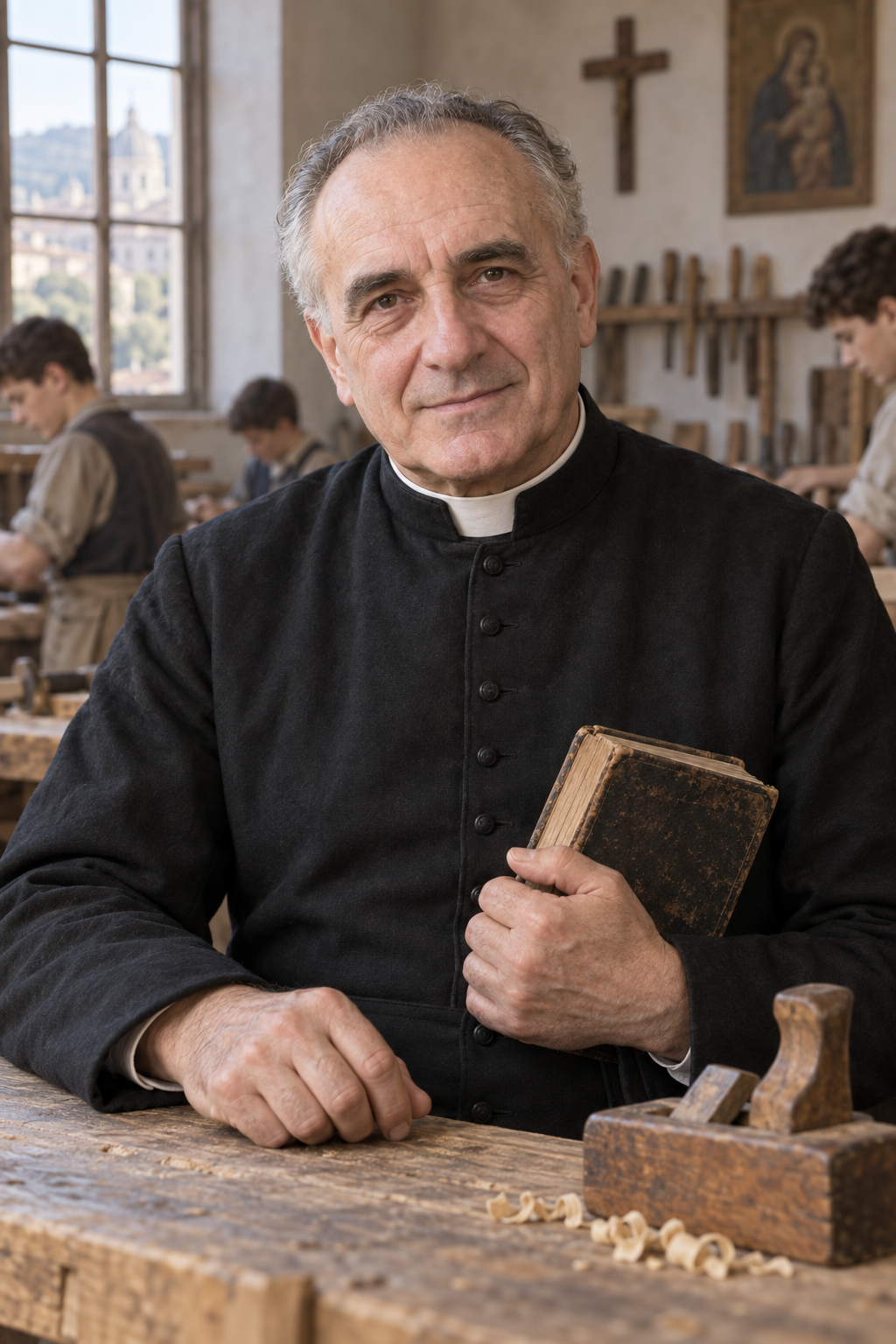
About Giovanni Battista Piamarta
Giovanni Battista Piamarta was born in Brescia on 26 November 1841. His father, Giuseppe, was a barber, and his mother, Regina Ferrario, was a seamstress; the family was poor.
His mother, remembered as deeply devout, died when he was nine. The boy was then looked after largely by his maternal grandfather and found a second home at the oratory of San Tommaso in the parish of Saints Faustino and Giovita, where his gift for music was noticed.
After primary school he was apprenticed to a mattress maker. Around the age of thirteen he came to know Don Pancrazio Pezzana, a parish priest who saw signs of a priestly vocation in him and encouraged it. At nineteen he entered the seminary of Brescia.
He was ordained a priest on 23 December 1865 and celebrated his first Mass on Christmas Day at Bedizzole.
For almost nineteen years he worked as a curate: a little over three years at Carzago Riviera, nearly two at Bedizzole alongside his mentor Pezzana, and then thirteen consecutive years, from 1870 to 1883, at the city parish of Sant'Alessandro in Brescia.
In these curacies his attention went especially to the young, through catechesis, the oratory and spiritual direction.
On 20 October 1883 he was appointed parish priest of Pavone Mella, a rural parish in the Brescian lowlands. His official biography records that he set himself against a determined effort to draw the people away from the Church there.
His years in the city had shown him the situation of boys who left home to work in Brescia's growing workshops and industries with little protection or formation. On 3 December 1886 a small house for such boys opened near the Castle of Brescia, supported by Monsignor Pietro Capretti and a former religious, Giovanni Turelli, with Piamarta as its driving force.
It began with four boys. Three were placed as apprentices with craftsmen and one at the Queriniana printing house. Within a few years carpentry, shoemaking and other workshops had been added, followed later by schools for further trades.
Piamarta took over the direction of the house on 1 February 1887, leaving parish ministry for it. When the young and indebted work seemed in danger of being closed, he is remembered as telling his bishop that he would die there with his boys. After Capretti's death it took the name Istituto degli Artigianelli.
The Queriniana press, established in 1884 by Brescian Catholic journalists, passed in 1886 into the management of the new institute. Under it the press printed Catholic periodicals and books and later became one of Italy's best-known Catholic publishers.
Piamarta also looked to the countryside, where poverty was driving many families to emigrate. In February 1895, with Don Giovanni Bonsignori, he acquired about 140 hectares at Remedello Sopra and opened an agricultural colony; from 1896 it issued a periodical, La Famiglia Agricola.
The colony aimed to form young people of the land both in Christian life and in up-to-date farming methods.
To give his works stability, Piamarta gathered the priests and lay brothers who shared them into a religious society. Its constitutions received diocesan approval in March 1900, with further approvals in 1902 and 1908.
This Pious Society of the Holy Family was approved in 1939 as the Congregation of the Holy Family of Nazareth. It later spread beyond Italy, to Brazil from 1957, Chile from 1983, Angola from 1992 and Mozambique from 2001.
Piamarta was also spiritual director to Elisa Baldo, a young widow of Gavardo. In 1898 she opened a house there to shelter sick women and orphans and to support catechesis for girls.
On 15 March 1911 Piamarta consecrated Baldo and eight companions; the group came to be called the Humble Servants of the Lord and was dedicated to the Christian and professional formation of girls.
His last years were marked by sciatica, heart and circulatory trouble and paralysis. During a visit to Remedello on 9 April 1913 he suffered a final attack. He received Viaticum on 23 April and died on 25 April 1913, aged seventy-one. His remains were moved in 1926 to the church of the Artigianelli in Brescia.
Pope John Paul II beatified him on 12 October 1997, praising a priest who led many young people to meet the Lord's loving and demanding gaze, and who found his strength in prayer.
Pope Benedict XVI canonized him on 21 October 2012. The Pope named the Artigianelli, Queriniana and the two congregations among his works and pointed to the long hours Piamarta spent before the Blessed Sacrament, lengthening his prayer precisely when work weighed most heavily.
His legacy remains concrete: the Artigianelli in Brescia, the Queriniana publishing house, and a congregation of priests and brothers still serving young people through schools, workshops and parishes in Italy, in Brazil and Chile, and in Angola and Mozambique. His feast is kept on 25 April, the anniversary of his death.
Wondering how to weigh the stories and sources? Learn how to read a saint biography.