Biography
Giovanni Battista Scalabrini
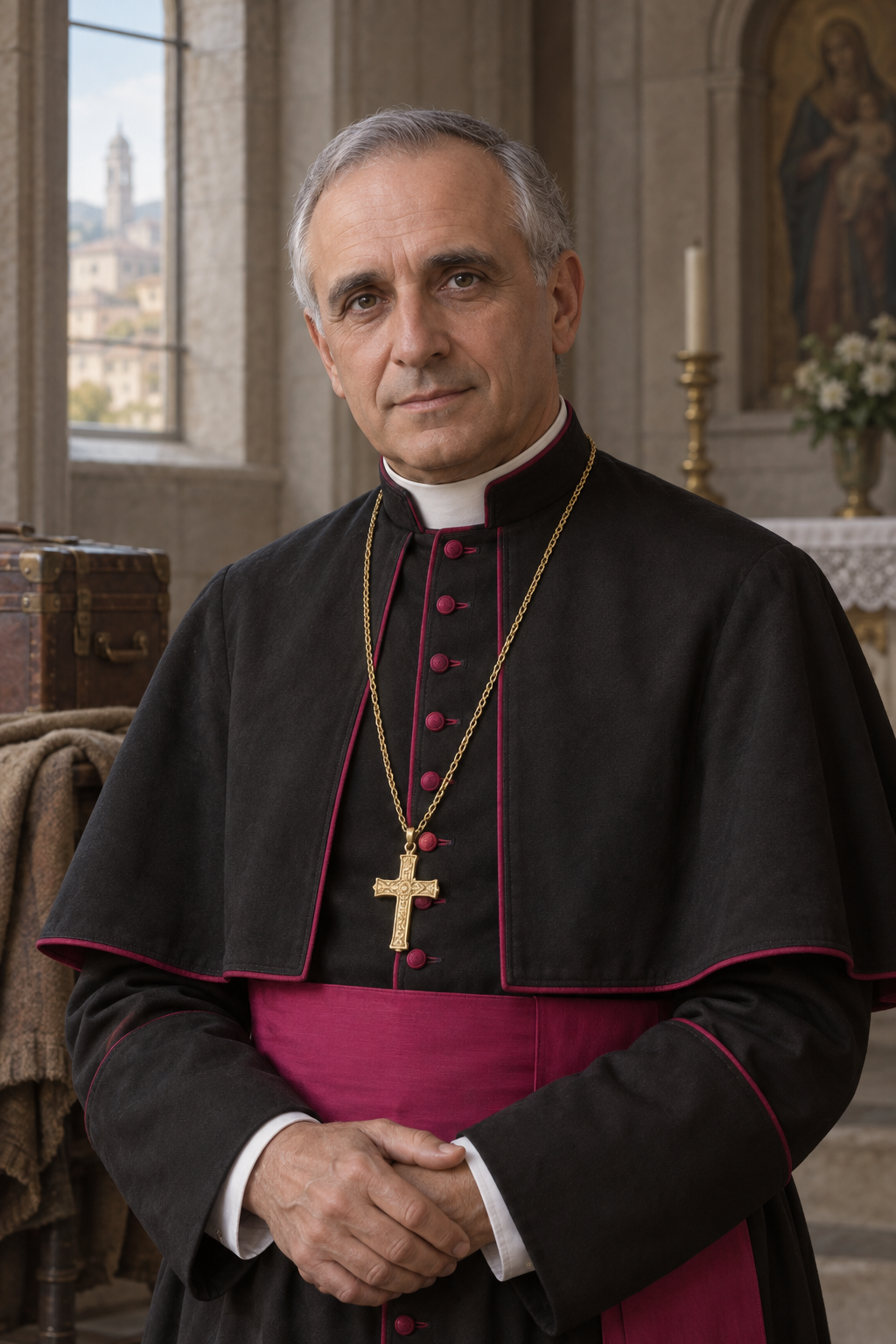
About Giovanni Battista Scalabrini
Giovanni Battista Scalabrini was born on 8 July 1839 in Fino Mornasco, near Como. The Holy See places him third among eight children in a modest family. Baptized that day, he entered the diocesan seminary of Sant'Abbondio in 1857 with his parish priest's guidance.
He was ordained on 30 May 1863. He hoped to become a missionary abroad, but the Bishop of Como kept him in local ministry. Scalabrini taught in the diocesan seminary and later became its rector. His first mission would be near home: preparing clergy within the diocese that had formed him.
During a cholera outbreak in 1867, he helped care for patients at Portichetto, near his birthplace. The Italian government recognized this service with a civil honor. A few years later he became pastor of San Bartolomeo on the industrial edge of Como, where the circumstances of workers and children became part of his pastoral attention.
At San Bartolomeo he reorganized the school, prepared catechists, visited sick and elderly parishioners and set up activities for children. He also encouraged a mutual-aid effort in a working-class neighborhood. Within five years this pastoral work had brought him wider notice; he became Bishop of Piacenza in 1876, when he was only thirty-six.
Piacenza was a large and varied diocese with 365 parishes, some in remote mountain districts. Scalabrini undertook five pastoral visits rather than governing only from the episcopal seat. He also held three diocesan synods. The journeys and gatherings kept his work tied to people and clergy throughout the diocese.
He also reorganized seminaries and supported systematic religious teaching. Pope John Paul II later emphasized that Scalabrini wanted children and adults to have access to catechesis in every parish. Pius IX called him an apostle of the catechism, a title recalling that sustained educational work rather than a separate office.
Charity in Piacenza had a practical shape. The 1997 Holy See biography recalls help for people suffering from disease and hunger, efforts to assist workers, and support for families in crisis. It also describes institutions for people with disabilities and forms of mutual aid. These activities stood beside his preaching and sacramental ministry; neither was an afterthought.
His parish visits revealed another problem: a substantial share of the people in his diocese were leaving Italy. Many emigrants crossed the Atlantic hoping for work, but faced exploitation, isolation and little access to the pastoral care familiar to them. Scalabrini saw migration as a social and religious question that required organized support beyond one bishop's territory.
After studying conditions and speaking publicly about them, he proposed a missionary congregation for Italians in the Americas. Leo XIII approved the plan in 1887. On 28 November, its first two priests began the work at Piacenza, founding the Missionaries of St Charles to follow migrants across national borders.
Scalabrini did not expect clergy alone to meet migrants' needs. In 1889 he founded the St Raphael Association, a lay organization intended to assist people at ports of departure and arrival. The Pontifical Council's account also highlights his call for legal and institutional protection against exploitation, alongside spiritual care.
He encouraged Frances Xavier Cabrini's work among emigrants and, in 1895, founded the Missionary Sisters of St Charles Borromeo. The sisterhood brought women into the same broad undertaking of service to migrant families, including children and people needing care. Later Scalabrinian communities would carry this mission forward in several forms.
In 1901 Scalabrini traveled to the United States to see migrants and the missionaries serving them. He made another journey to South America in 1904. These visits let him meet the people whose experiences had shaped his institutions and test how the work functioned far from Piacenza.
John Paul II, speaking to pilgrims after Scalabrini's beatification, stressed that his concern included both material and spiritual wounds. The pope described him as defending migrants' basic rights and asking receiving communities to offer a respectful welcome. This interpretation locates his mission within the human experience of displacement, not only within the growth of the institutions he founded.
After the South American journey, an existing illness worsened. Scalabrini underwent surgery but did not recover, and he died on 1 June 1905. The congregations he founded continued to accompany migrants after his death, while his writings and advocacy remained part of Catholic discussion about the obligations owed to people who move for work and safety.
Ten years later Benedict XV wrote to the Missionaries of St Charles about their founder. Recalling the transfer of Scalabrini's remains to Piacenza Cathedral in 1909, the pope described the city's affection for him and urged the priests to continue serving poor emigrants. The letter is an early witness to how his work was remembered by the community it formed.
John Paul II beatified Scalabrini on 9 November 1997. The 1997 homily emphasized his devotion to the Eucharist, his teaching and his care for those leaving Italy. This is the Church's judgment about his life, distinct from a claim that every detail of later devotional retellings can be established as history.
Pope Francis canonized him on 9 October 2022. The canonization booklet presented the bishop's migration work as attentive to both the needs of families and the conditions they faced in new countries. His enduring importance lies in making that care a lasting, organized responsibility of the Church, across the borders that separated migrants from home.
Wondering how to weigh the stories and sources? Learn how to read a saint biography.