Biography
Giovanni Calabria
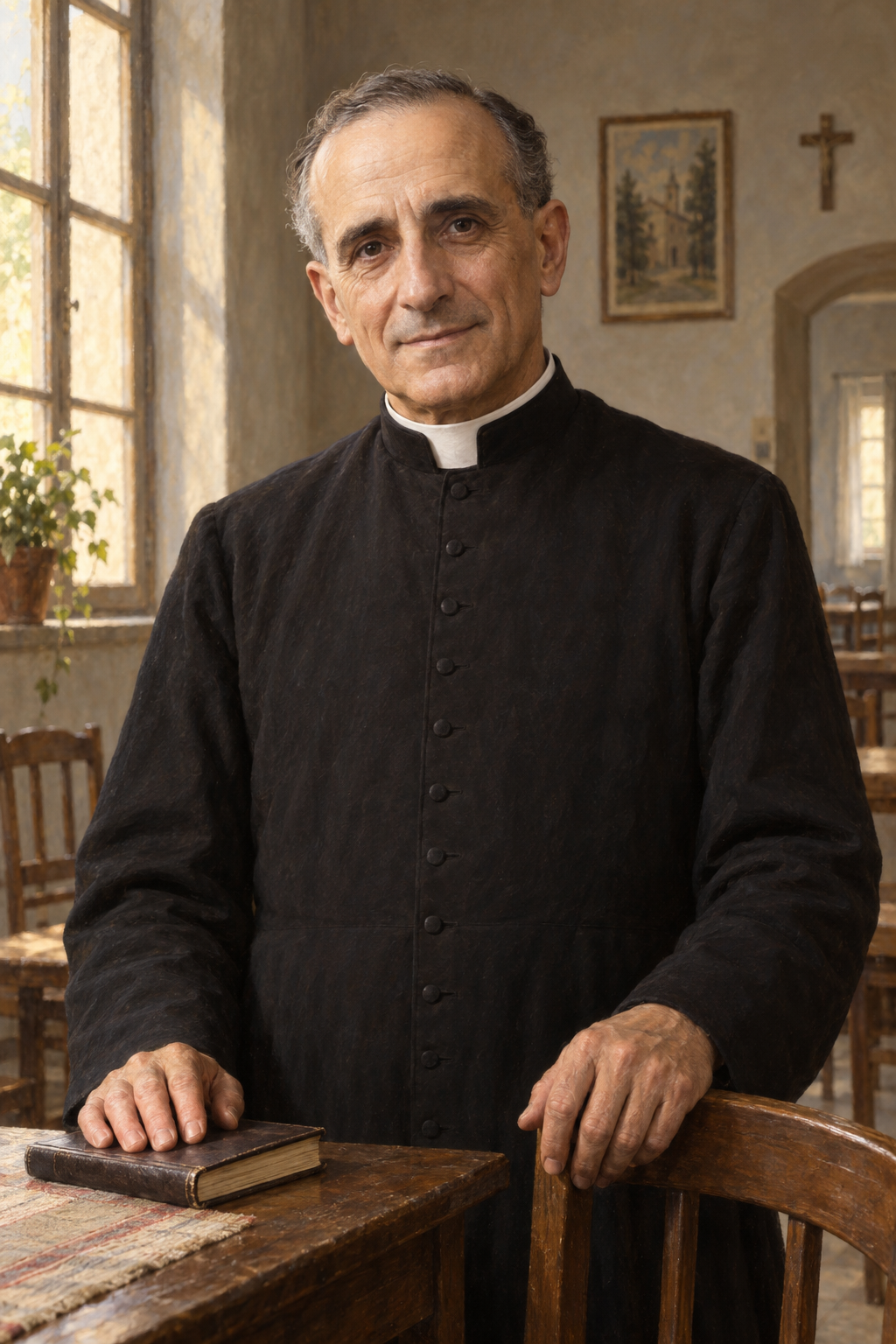
About Giovanni Calabria
Giovanni Calabria was born in Verona in 1873 to a family with little money. His father was a shoemaker and his mother worked in domestic service. After his father's death, Giovanni left school to earn money, interrupting his preparation for the priesthood.
A priest at San Lorenzo helped him prepare for admission to the seminary's secondary school. His studies were interrupted again by military service. The later account in the *New Catholic Encyclopedia* notes that this period brought him into care for sick and recovering soldiers. His concern for people without resources was therefore visible before he had an institution or a congregation to direct.
While still a theology student, Calabria gathered fellow students and lay supporters to assist sick people who could not pay for care. The congregation's later health-care study identifies Francesco Perez among the early collaborators. The effort joined visits to the sick with practical assistance and foreshadowed the larger works that would later grow from Verona.
In November 1897, according to the Holy See biography, Calabria encountered a boy without a safe place to stay and gave him shelter. This episode became part of the congregation's memory of its beginning. The boy’s background remains uncertain; this direct care for an abandoned young person preceded the formal opening of any home.
Calabria was ordained on 11 August 1901. The Diocese of Verona records six years of ministry at St Stephen's before his appointment to San Benedetto al Monte. During those years he also served as a seminary confessor. Parish work and the care of vulnerable people were not competing careers for him: he developed both while serving as a diocesan priest.
On 26 November 1907 he opened Casa Buoni Fanciulli in a small house in Verona's Vicolo Case Rotte. The congregation says the first group contained seven poor and abandoned children. The home moved the following year to San Zeno in Monte, which became the motherhouse. What began with one household became a continuing commitment to shelter and education.
Lay men joined him in service, forming the Poor Servants of Divine Providence. The Bishop of Verona approved the community in 1932; pontifical approval followed in 1949. A women's branch began in 1910.
The congregation's institutions served more than children. A study of its health-care tradition connects Calabria's attention to sick and older people with his early care for his father and military service. It also records his support for a medical missionary association. Health care became part of a broader response to poverty.
On 21 December 1933 Calabria received responsibility for a property at Negrar from the Verona diocesan curia. It was then a shelter for poor elderly people, rather than the large hospital later associated with his name. The community developed it over time into a center of care. This sequence matters: the modern hospital should not be projected back onto the small institution he first accepted.
The *New Catholic Encyclopedia* describes other practical forms of help, including provision for ill people, young workers and people with disabilities. It also traces lay associations that continued after Calabria's death. The range of these activities shows why his work cannot be reduced to one children's home, even though Casa Buoni Fanciulli remains the clearest starting point for the congregation's public history.
His interests reached beyond his own Catholic communities. The C. S. Lewis Institute documents a correspondence that began in 1947, when Calabria, having read Lewis's *Screwtape Letters* in Italian, wrote to the Anglican author in Latin. Their exchange continued until Calabria's death. It is evidence of personal contact across a confessional divide, without proving that every later claim about his role in Christian unity is equally secure.
His concern for cooperation appeared also in a family of lay external brothers. The congregation dates its formal beginning to 8 October 1944, although Calabria had considered the idea since 1932. Lay members sought to carry its spirit into family and working life and to serve the poor. This step shows that he did not confine his mission to people who entered his religious congregations.
Calabria died on 4 December 1954. John Paul II beatified him in Verona on 17 April 1988 and canonized him in Rome on 18 April 1999. The pope's canonization homily emphasized Calabria's charity toward poor people as an expression of faith. That is the Church's spiritual judgment of his life; the dates and places of the celebrations are matters of public record.
His remembrance takes more than one liturgical form. The Dicastery lists 4 December, the day of his death, while Verona celebrates him locally on 8 October, his birthday. The distinction prevents a local calendar from being mistaken for a universal observance. His congregations, lay partners and care institutions remain a visible continuation of the choices he made for people who had little support.
Wondering how to weigh the stories and sources? Learn how to read a saint biography.