Biography
Giuseppe Allamano
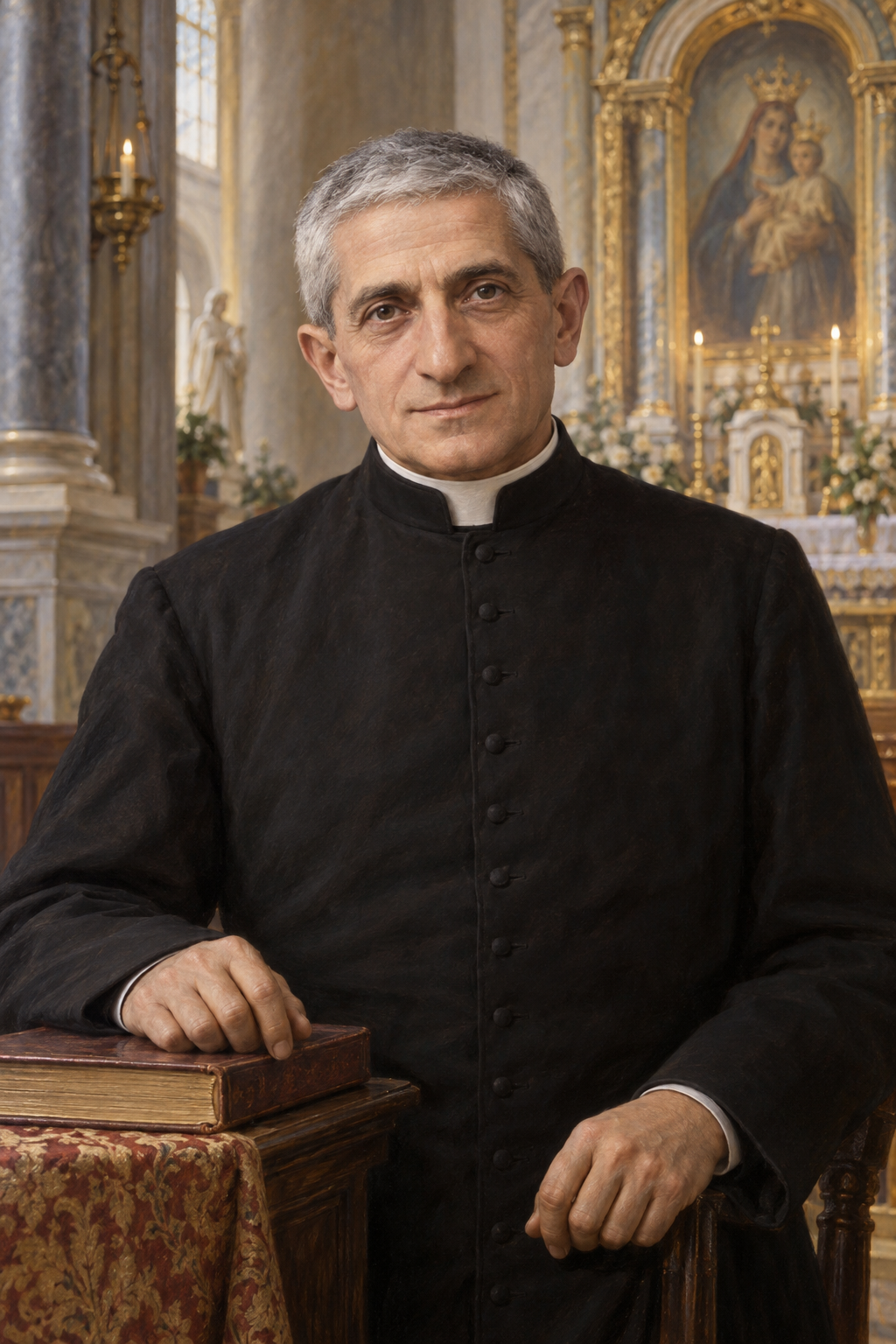
About Giuseppe Allamano
Giuseppe Allamano was born on 21 January 1851 in Castelnuovo d'Asti, now called Castelnuovo Don Bosco, in Piedmont. Giuseppe Cafasso was his uncle. His later work remained tied to Turin, even while the missionary institutes he founded reached Africa.
After elementary school he studied at the Salesian Oratory of Valdocco in Turin, where John Bosco guided him. Allamano then entered the diocesan seminary and was ordained a priest in 1873. His early appointments kept him within pastoral ministry and the formation of other priests rather than sending him overseas as a missionary.
Allamano served in the seminary as spiritual director before becoming rector of Turin's shrine of Our Lady of Consolation in 1880. The associated Convitto Ecclesiastico was a house for further formation of recently ordained clergy. Historian Arthur Lenti places these appointments amid institutional disputes in the archdiocese. The shrine and the Convitto shaped the remainder of Allamano's life.
The shrine needed repair and the Convitto had suffered from a dispute over the teaching of moral theology. Historian Arthur Lenti describes Allamano as someone the archbishop trusted to address the problem. The house resumed its program in 1882. The academic quarrel should not be flattened into a simple story of one heroic rector: clergy, teachers and diocesan authorities were all part of its resolution.
Allamano renewed the shrine's building and devotional life. The *New Catholic Encyclopedia* describes his work to make the Consolata a center for confessions and spiritual guidance. It also notes his support for the Catholic press and social initiatives. The shrine's influence extended beyond the people who could come through its doors.
The *New Catholic Encyclopedia* notes his attention to Catholic publications, labor concerns and other charitable initiatives. It also names Giacomo Camisassa, the shrine's vice-rector, as a close collaborator in both the shrine and the later missionary institute. Allamano's decisions were therefore carried out through a durable partnership, not by a founder acting alone.
Allamano believed that priests in Turin could share in the wider mission of the Church even if they did not already belong to an overseas order. After years of planning, he founded the Consolata Missionaries on 29 January 1901 with approval from Archbishop Agostino Richelmy and other Piedmontese bishops. He remained a diocesan priest; the institute opened a path for others to travel where his own ministry did not.
On 8 May 1902 the first four members, two priests and two brothers, departed Turin for Kenya. The mission's early history included cooperation with women religious from Cottolengo's institute. The departure was a distinct event from the 1901 foundation: a planned community had begun to send people, form local relationships and confront conditions far removed from the shrine's familiar setting.
The *Biographical Dictionary of Christian Missions* emphasizes that Allamano wanted his missionaries to attend to education and human development alongside preaching. Its account stresses respect for local customs and preparation of local leaders. These are the dictionary author's judgments about the institute's approach, rather than proof that every mission practice always achieved those ideals.
By 1910 Allamano saw a continuing need for a women's missionary institute. He founded the Consolata Missionary Sisters, giving the work a second organized community. The *Biographical Dictionary of Christian Missions* emphasizes the place of women and brothers in its account of the institute's development in Kenya. Their formation and responsibilities became part of its lasting reach.
Allamano remained a diocesan priest in Turin while directing the Consolata shrine and the Convitto, where priests received formation. Some became the first Consolata missionaries in Kenya. The missionary fathers began in 1901, and he later founded a community of missionary sisters. He led both institutes from Turin until his death. Their members combined evangelization with education, training local leaders and attending to social needs. His work thus depended on formation and sustained direction across distance.
Lenti's study places Allamano in a longer history of priestly formation at the Convitto, which existed before he became rector. His appointment followed a period of institutional conflict, and the renewed house prepared clergy within the Diocese of Turin. That local work and the overseas institutes were related but distinct parts of his vocation. One did not erase the obligations of the other.
Allamano died in Turin on 16 February 1926. His remains were first buried in the city cemetery and were later moved to the missionary motherhouse in 1938. John Paul II beatified him on 7 October 1990, and Pope Francis canonized him on 20 October 2024. These later decisions belong to the Church's public recognition of his life, separate from the chronology of the work he carried out.
His feast is observed on 16 February, the date of his death. The institutes he founded continued after him, but their history should remain connected to the people and places where they served rather than be reduced to the founder's intentions alone. Allamano's documented legacy joins a renewed Turin shrine and priest-formation house to missionary communities whose members crossed borders he himself never crossed.
Wondering how to weigh the stories and sources? Learn how to read a saint biography.