Biography
Giuseppe Benedetto Cottolengo
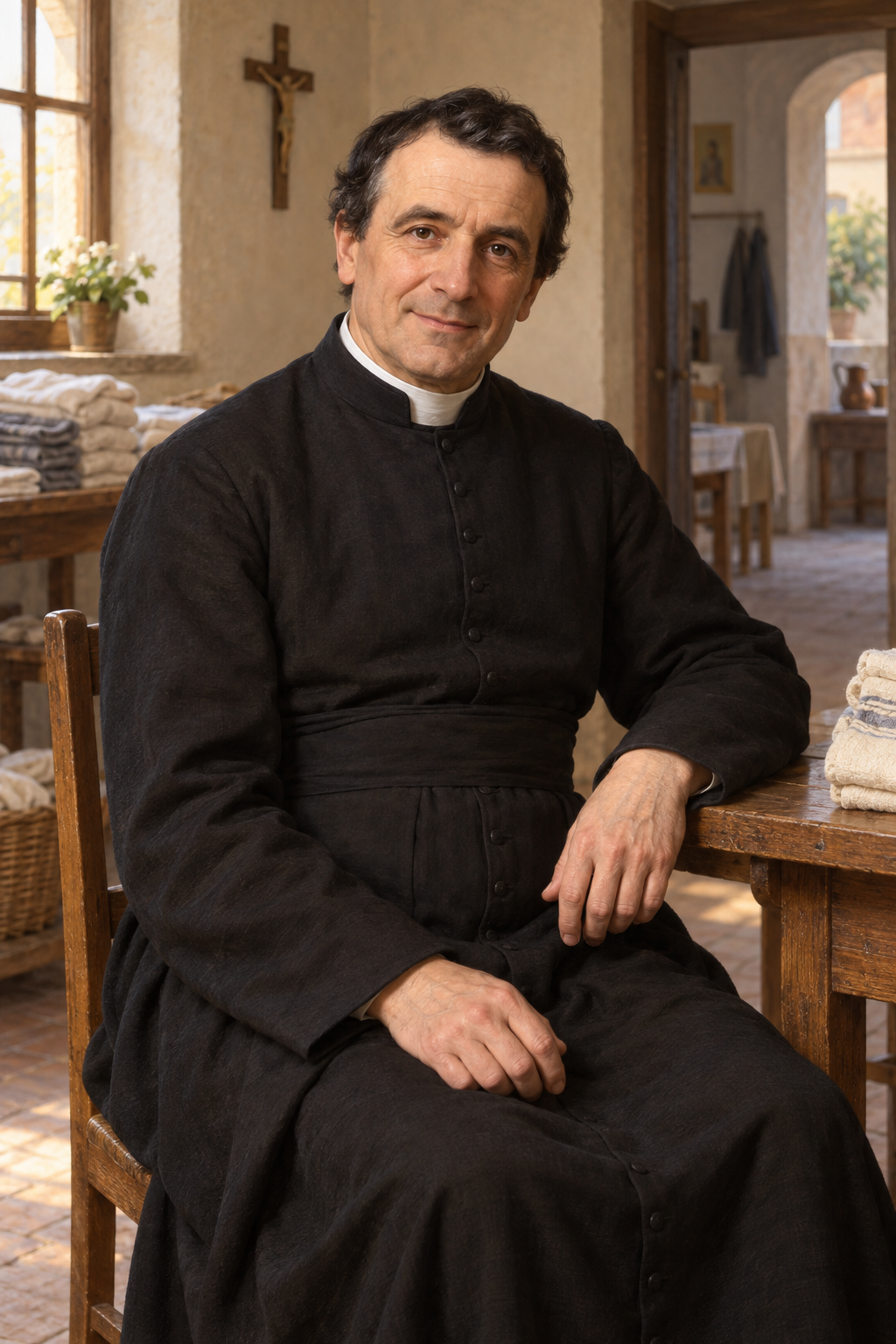
About Giuseppe Benedetto Cottolengo
Giuseppe Benedetto Cottolengo was born in Bra, in Piedmont, on 3 May 1786. He was the eldest of twelve children in a prosperous family. His father expected him to learn commercial work, but Giuseppe chose to prepare for the priesthood. That decision brought him into a church and a region disrupted by the French occupation, when ordinary routes through seminary study were not always available.
He studied philosophy and theology partly outside the usual seminary arrangements and then entered the seminary at Asti. Ordained on 8 June 1811, he worked first in Bra and later as an assistant priest at Corneliano d'Alba. The municipal biography also records his help with a school for poor girls and his visits to older and sick people there. These were early pastoral assignments, years before the institution for which he became known.
Cottolengo earned a doctorate in theology at Turin in 1816. Two years later he joined the priests serving the church of Corpus Domini. Historian Giuseppe Tuninetti describes him as a canon in a congregation of priests. His ministry included preaching. The appointment gave him a settled place in Turin, but it did not yet answer the needs that would occupy his final decade.
Turin after the Napoleonic period had charitable agencies and unmet need. Tuninetti describes migration from the countryside, poverty, disease and high infant mortality in the city. Cottolengo's later work developed within this setting. Its patients and residents were not an abstract group of unfortunate people: they faced specific barriers to admission, treatment, housing and daily support.
On 2 September 1827 he was called to a young mother who had been refused admission to Turin hospitals. She died, and the encounter became a turning point in accounts of his life. John Paul II described it as the beginning of his work for people outside care. Sources disagree about how many children the woman had, so the number does not belong in this account.
In 1828 Cottolengo opened a small infirmary in rented rooms near Corpus Domini. It became known as the Volta Rossa. The city's museum records that two patients were admitted at its beginning. His aim was practical: people whom the larger hospitals would not receive needed a place to be seen, cared for and sheltered. Small as it was, the infirmary marked a new form of his priestly work.
The work depended on others from the start. The *New Catholic Encyclopedia* names Marianna Nasi as a collaborator in founding the sisters' community in 1830. Women who had volunteered in the infirmary gained a stable form of service. Cottolengo remained the founder, but the daily work of nursing, organizing and living with those received could not be carried by one priest.
The first infirmary closed in September 1831 by government order, amid concern about cholera. The city museum's building record gives 19 September as the date of the order. Closure did not show that the infirmary had spread disease; it left its people and supporters needing a new place. Cottolengo moved the work beyond the cramped rooms near Corpus Domini.
On 27 April 1832 the Little House of Divine Providence opened in Turin's Borgo Dora district. John Paul II's later anniversary message treats this opening as a second beginning after the encounter in 1827. The house received people who had few alternatives for care or shelter. As the work expanded, its name remained deliberately modest, even while the number of residents and the forms of service grew.
The house served people with illnesses and disabilities, as well as others living in poverty. John Paul II described its purpose as offering care, work and religious formation to people otherwise neglected. This is a later church reading of the foundation, not a measure of each resident's own experience. The institution's history should keep the residents visible alongside its founder and the communities that served them.
The house required food, buildings, medicine and dependable organization. In 1833 King Carlo Alberto granted it legal recognition, allowing it to receive benefactions more securely. Its founder spoke of relying on divine providence, while the surviving record also shows the human means: gifts, volunteers and public support. The institution's own account says plainly that providence often works through donors. Those material arrangements were part of its ability to keep admitting people.
Cottolengo organized communities for different kinds of service. The sisters began in 1830, a community of religious lay brothers followed in 1833, and a priestly community developed later. He also established contemplative houses near the end of his life. The communities shared one institution but had distinct responsibilities. Their formation made the work less dependent on his presence and gave it a way to continue.
Tuninetti emphasizes Cottolengo's effort to make care more personal than was common in the period. The Little House arranged groups as “families” and combined medical attention, food, shelter and instruction. Its medical staff and sisters needed training and resources; goodwill alone did not constitute treatment. The historian also identifies important work with people who had intellectual or sensory disabilities. Such details show an institution built through sustained daily practice, beyond the dramatic story of its founding.
Cottolengo died at Chieri on 30 April 1842. The Little House had grown far beyond the rented rooms opened fourteen years earlier. Its size and later reach must be credited to the people who lived and worked there as well as to the founder. The institution continued after his death.
The Catholic Church beatified him in 1917 and canonized him in 1934. It commemorates him on 30 April. His significance rests in the lasting form he gave to care for people who had been excluded from other institutions, supported by religious communities and lay collaborators. The Little House remains a witness to both his initiative and the collective work required to turn a small infirmary into a continuing home.
Wondering how to weigh the stories and sources? Learn how to read a saint biography.