Biography
Giuseppe Maria Tomasi
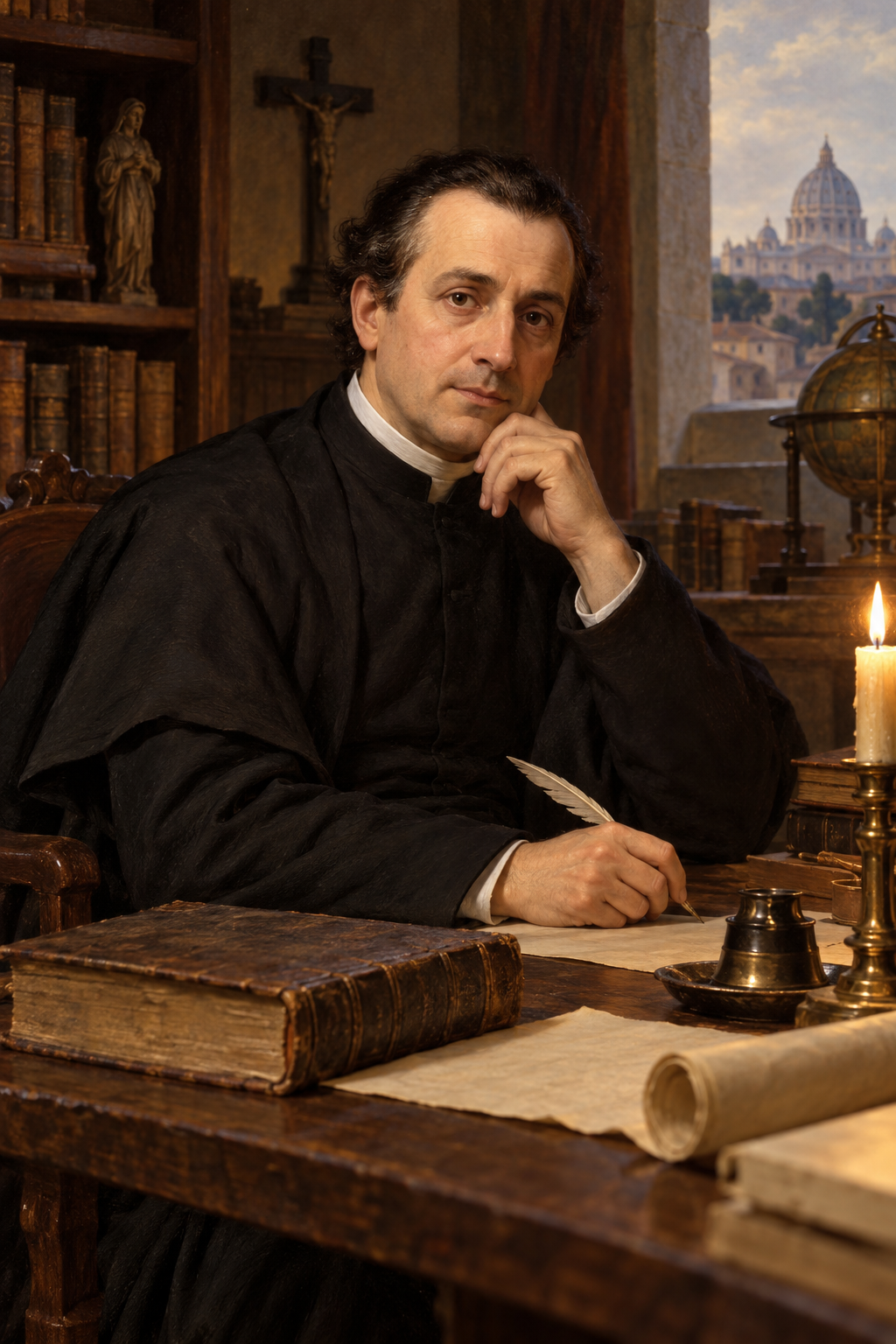
About Giuseppe Maria Tomasi
Giuseppe Maria Tomasi belonged to a noble Sicilian family whose plans for him included service to the Spanish king. John Paul II recalled that Tomasi chose religious life instead. The decision redirected his education and abilities toward study and ministry, though the demands of family and society did not disappear at once.
John Paul II later described the family's hope that Giuseppe would serve the Spanish king. This was a plausible course for a son of Sicilian nobility, but he chose religious life. His parents eventually consented. That choice changed where his abilities would be used: the languages and discipline expected in a public career became resources for study and church service.
He entered the Theatines, an order of priests committed to religious discipline and ministry. In the canonization homily, John Paul II linked Tomasi's study to his identity as a priest and religious. This is a later church interpretation of his vocation. It helps frame his research as part of a larger life, without treating every edition he produced as a direct cause of later liturgical change.
Tomasi relinquished hereditary rights and professed with the Theatines at Palermo on 25 March 1666. He studied philosophy and theology in Italy while managing poor health.
After the deaths of his brother and sister-in-law, he returned to Sicily in 1672 to address the future of a young heir. He went back to Rome, where he was ordained a priest on 23 December 1673. Busolini's account shows how study, family obligations and religious life remained entangled rather than unfolding as a smooth sequence of promotions.
In Rome he found scholars and collections that could sustain long research. Ward identifies contacts among church historians, librarians and learned clergy who shared texts and questions. They also place his publications within an active scholarly network: discoveries, collation and interpretation were rarely solitary achievements.
One important collection belonged to Christina of Sweden. Ward traces its manuscript history and notes Tomasi's work with early Latin liturgical books now associated with the Vatican Library. He compared witnesses and prepared material that other scholars could inspect and discuss. His effort was to recover the variety of older practice, not to pretend that one surviving manuscript spoke for the whole ancient Church.
His 1680 *Codices Sacramentorum* presented early sacramentaries, including a Gelasian text and several books from the Gallican tradition. The *New Catholic Encyclopedia* also lists subsequent editions of psalms, chants and biblical material. The point of publishing them was access: texts once confined to particular libraries could become evidence for a wider discussion of the Church's worship.
Busolini describes Tomasi's Roman and Gallican Psalter of 1683, his edition of antiphons and responsories in 1686, and later work on the Roman Mass books. These volumes did more than reproduce old pages. They placed sources side by side and helped readers compare their contents. Some editions had limits by later scholarly standards, but they made earlier forms of prayer newly visible.
John Paul II's canonization homily described Tomasi as a priest who joined learning to pastoral teaching. His work included catechesis for children and help for people who were sick or poor. That church assessment should be read alongside the publication record: research and service were connected in his own vocation, but neither should erase the other.
Tomasi also wrote shorter works intended to help ordinary readers pray and understand the Mass. His proposals for lay prayer in Italian concerned devotions outside the liturgy; Busolini cautions that he did not advocate replacing Latin in the Mass. His wish to make texts understandable and his care with historical sources belonged together, without making him the sole author of much later reforms.
In 1701 Tomasi published a short plan for theology teaching grounded in early Christian writers. Ward explains that he wanted students to read the Fathers with attention to their own intellectual setting, rather than forcing them into later categories. Three larger volumes followed in 1709, 1710 and 1712. The project joined historical reading to the training of clergy, widening the reach of his earlier liturgical research.
Clement XI appointed Tomasi a cardinal on 18 May 1712, near the end of his life. The British Museum's biographical catalog confirms the date; he died the following January. His elevation followed decades of liturgical scholarship and pastoral work, rather than beginning either of them.
Addressing pilgrims after the canonization, John Paul II recalled Tomasi's continuing connection to Sicily and the attention he gave to people with limited education, illness or material needs. This retrospective is a church judgment, not a detailed ledger of every act of service. It guards against portraying him only as an editor of difficult books.
Tomasi died in Rome on 1 January 1713. The Catholic Church beatified him in 1803 and canonized him in 1986. His scholarly editions survived through later editorial work, and his attention to liturgical sources remains the specific contribution for which he is remembered.
Wondering how to weigh the stories and sources? Learn how to read a saint biography.