Biography
Henry Budd
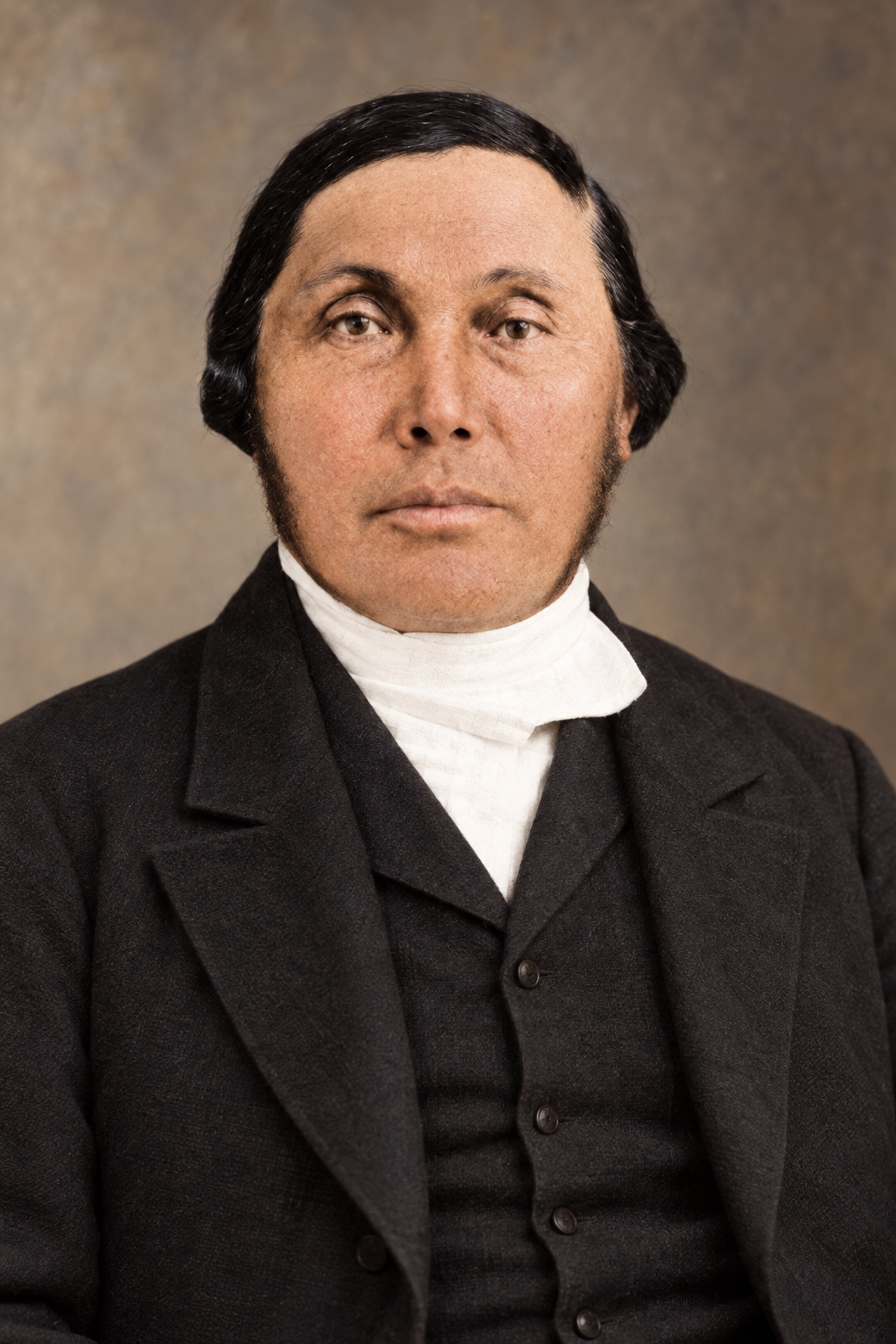
About Henry Budd
Henry Budd was born about 1812. Educated at the Red River mission school, he was baptized by John West in 1822 and later became a teacher himself. Budd’s Cree name was Sakachuwescam.
Historian Katherine Pettipas describes the schooling that sought to reshape his life around English language, Christian instruction, and settled agriculture. Religious education and pressure to abandon Indigenous customs were intertwined. The school curriculum included mathematics, reading, writing, and religious instruction.
The Hudson’s Bay Company Archives records a period of employment before his teaching ministry. He entered company service on March 6, 1832, and worked as a labourer in the Lac La Pluie district. He returned to Red River in 1835. The archival summary identifies his wife as Betsey Work and records their marriage in 1836. It describes him as a schoolmaster in 1837 and a settler in 1839. The cited registers also record the baptisms of two children, Henry in September 1837 and Sarah in October 1839. These are baptism records, not evidence for exact birth dates.
In 1840 he began work in the Cumberland district, establishing a mission at The Pas. His wife and mother accompanied him when he set out for the Cumberland district in June 1840. After a short stay at Cumberland House, he moved to The Pas and built a house that served for both teaching and worship. The mission thus began with a shared building, before the later church and parsonage.
Mackay’s description also explains why The Pas became a center for the mission. Budd initially worked at Cumberland, but chose a place between the company’s Cumberland House and Moose Lake posts for a permanent station. The site was already a favored camping ground. In this account, the mission entered an existing network of travel, trade, and gathering.
Bishop David Anderson ordained him deacon on December 22, 1850, and priest in 1853. Budd’s ministry was closely connected with Cree-speaking communities along the Saskatchewan River. Archdeacon John Mackay remembered Budd as an effective preacher in Cree and a capable writer in English. His account describes cooperation with James Hunter: Budd helped Hunter learn Cree and assisted with translations, while Hunter helped prepare him for ordination. Teaching, interpretation, travel, and the practical work of building a mission all belonged to Budd’s responsibilities.
Pettipas also describes literacy spreading within families: children took books home and taught older converts to read Cree syllabics. This exchange extended learning beyond the classroom and the minister’s own instruction.
His later career also reveals unequal conditions within the missionary organization. Indigenous workers received lower pay than European colleagues. A proposed increase for Budd was justified partly by his adoption of English habits. Even when he returned to The Pas as its pastor in 1867, European supervision and committee control of expenditure restricted his authority. Pettipas’s account therefore places his work within a church that relied on Indigenous knowledge and leadership while withholding equality. His considerable responsibilities should not obscure those limits.
Budd’s own diary offers a closer view of daily life. In January 1870 he described teaching, pastoral visits, and the difficulty of finding uninterrupted time for correspondence. Charles Buck helped teach children in Cree syllabics while receiving English lessons from Budd. When Budd returned from a lengthy journey that July, he found that others had sustained the work. Robert Lathlin had cared for property, Buck had continued the school, and the congregation had arranged and paid for a sexton to maintain services. Budd recorded his gratitude. These entries show a community with its own initiative, rather than a mission dependent on one person’s presence. They also reveal how religious work shared each day with farming, repairs, travel, and the care of families. His August entries make that practical work specific: after the haymaking, he helped replace the mission house’s cellar lining. On August 11, Buck taught Cree syllabics while Budd taught the older pupils in English.
Budd died at The Pas on April 2, 1875. His work there had spanned much of his adult life.
Mackay also recalled the affection expressed by a member of the congregation after Budd’s death. The memoir preserves personal testimony, but its praise is repeatedly framed through racial assumptions about Indigenous ability and European standards of achievement. Those judgments belong to the author’s period and should not be mistaken for a measure of Budd’s worth or his community’s capabilities.
A Manitoba commemorative plaque identifies his birthplace as near Norway House and remembers his ministry across several northern communities. It also records the lasting use of his Cree translations and locates his grave in the churchyard at The Pas. The places named include Cedar Lake, Moose Lake, The Pas Mountain, Cumberland House, and Nepowewin. The inscription places his work across these communities over thirty-five years.
The Anglican Church of Canada commemorates Henry Budd on April 2.
Wondering how to weigh the stories and sources? Learn how to read a saint biography.