Biography
Iakovos Tsalikis
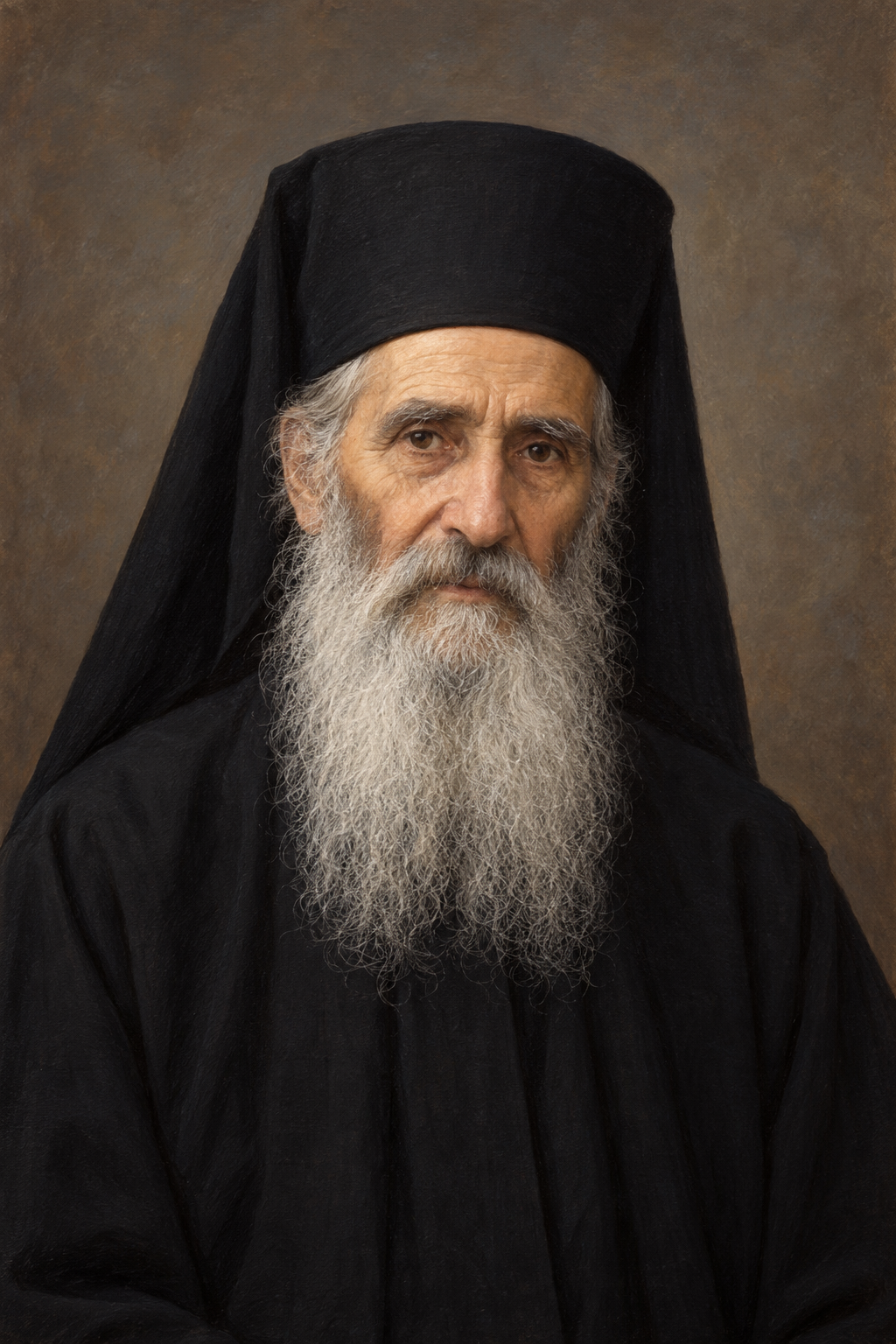
About Iakovos Tsalikis
Iakovos Tsalikis was born in Asia Minor on November 5, 1920. His family reached Greece as refugees. He grew up close to the worship of the Church, attended elementary school, and later served in the army. After his father’s death, he helped care for his sister until her marriage.
His family settled at Farakla in northern Evia. Neophytos of Morphou remembered Iakovos speaking about his mother, Theodora, whose prayers and religious practices shaped his childhood. Poverty ended his formal education after elementary school, and his father took him along to help with building work. The young man’s later vocation grew within this working household and its experience of displacement.
In 1952, he entered the monastery of Saint David on Evia and was ordained a priest. He became its abbot in 1975. The community had been in poor condition when he arrived. Alongside the demands of monastic life, he gave time to visitors seeking counsel and support.
According to his biographer Stylianos Papadopoulos, Iakovos sought out the cave associated with Saint David early in 1953, after the snow had melted. He wanted to follow the older saint’s example of prayer and solitude. Monastery responsibilities nevertheless filled his days: caring for the garden and animals, cleaning, gathering wood, and receiving visitors. The account places these ordinary tasks alongside his attendance at services and the long hours he devoted to prayer at night.
Papadopoulos also describes the books that nourished him. Iakovos had borrowed small religious books in his village, but his principal study became the Church’s service books. He paid particular attention to their words, despite having no formal training in ancient Greek. The Pentecostarion, with its hymns celebrating the Resurrection, especially delighted him. In his cell he read prayers and the Psalter by whatever light was available, sometimes using a burning piece of resinous wood when he lacked candles.
Other monks gradually joined the work of renewal, including Kyrillos in 1962 and, later, Seraphim. The monastery gained guest accommodation, a refectory for pilgrims, and a bell tower. Neophytos recalled Iakovos meeting people in the kitchen, dining room, and courtyard, often teaching through stories from his mother’s life or his own experience. He remembered the expressive gestures and changes of voice that made these conversations vivid. The same recollection describes money passing through Iakovos’s hands to people in need, rather than accumulating for his personal use.
Neophytos also remembered hearing him sing Christmas hymns among trees near the monastery, extending the celebration beyond the church to the surrounding woodland itself. Dimitrios Tzoumas, a judge who became a priest, visited with small groups of fellow judges, relatives, and friends. He remembered confession after Friday vespers and conversations around the monastery table afterward. In his own confession, Iakovos knelt nearby despite his poor health. Tzoumas describes a calm manner, without intrusive questioning or unnecessary detail. Visitors found a listener who took their failings seriously while treating them gently.
A letter to Tzoumas dated February 12, 1986, preserves Iakovos’s thanks for letters and a parcel of gifts. He assured his correspondent that he remembered the family in prayer during the liturgy, naming them individually. Another letter, reproduced in the same memoir, urged a troubled correspondent not to despair over his sins. Iakovos encouraged patience, humility, prayer, and restraint from wrongdoing. The memoir also records his insistence that money was not given solely for its recipient’s private enjoyment. Such correspondence and recollections show how his spiritual guidance extended beyond the hours visitors spent at the monastery.
Illness increasingly affected his later years. On November 21, 1991, he attended the liturgy, received Communion, and heard confessions. He died later that day. Papadopoulos gathered his biography from conversations with Iakovos and interviews with relatives, neighbors, clergy, and monks who knew him.
The Ecumenical Patriarchate approved his canonization in November 2017. It established November 22 as his annual commemoration, the day after the anniversary of his death. The announcement identified him as the abbot of Saint David’s monastery and recognized the place of his life within the Church’s calendar.
The public celebration of that recognition followed at Saint David’s monastery on June 2–3, 2018. Patriarch Bartholomew attended the services, and the patriarchal and synodal act was read at vespers. Pilgrims came from Greece and other countries. In his homily, the patriarch recalled Iakovos’s refugee experience and his concern for young people and the poor. The ceremony connected the formal decision made in Constantinople with the monastery where Iakovos had spent his adult religious life.
His memory subsequently acquired a formal place in the Greek Orthodox Metropolis of New Jersey. In September 2024, Metropolitan Apostolos announced Iakovos as its new patron saint. The letter invited the clergy and faithful to share his biography and celebrate together. It scheduled the first patronal services for November at the metropolitan headquarters in Westfield.
Wondering how to weigh the stories and sources? Learn how to read a saint biography.