Biography
James DeKoven
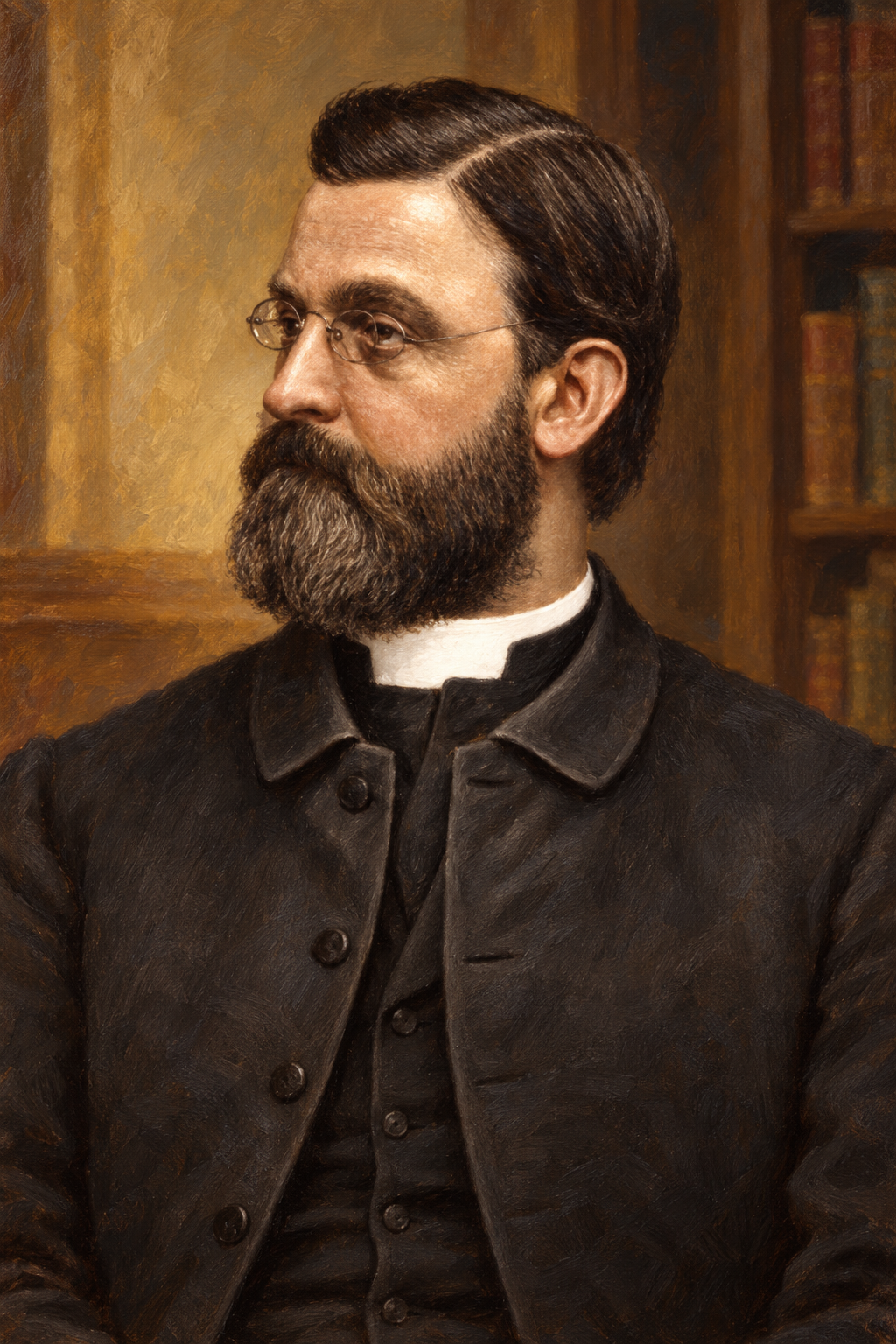
About James DeKoven
James DeKoven was an Episcopal priest whose work joined teaching with a strong commitment to sacramental worship. Born in Middletown, Connecticut, in 1831, he studied at Columbia College and the General Theological Seminary. He became a deacon in 1854 and a priest the following year. His early ministry included parish work at Delafield, Wisconsin, and teaching at Nashotah.
In 1859 he became warden of Racine College when St. John’s Hall merged with it. The faculty came with him from Delafield. At Racine, his educational vision shaped the physical arrangement and daily life of the college. Faculty and students lived on campus and shared meals in a common refectory, while the buildings formed a quadrangle modeled on English colleges. The college became a significant center of learning under his leadership, and his reputation grew as a preacher and writer.
At the General Convention in October 1874, DeKoven addressed a proposed rule restricting ritual practices in Holy Communion. The proposal named incense, crucifixes, elevation of the consecrated elements, and certain gestures of adoration. He objected to treating these outward practices as evidence of false teaching. He distinguished the church’s authority to regulate ceremonies from a declaration that the ceremonies necessarily conveyed error. Although he preferred no new rule, he accepted temporary oversight by a bishop and standing committee while the church clarified its worship regulations. He also warned that calling a doctrine doubtful could leave clergy subject to changing judgments as committees changed. His argument was therefore concerned with the consistency and fairness of church government as well as the meaning of worship. He wanted room for simple services and elaborate ceremonial within a clearer common framework. He also asked the proposed commission to consider protection for clergy whose conscientious scruples differed from his own convictions about baptism. Near the heart of his speech, he distinguished inward devotion from outward ceremony: he would submit to restrictions on ritual, but defended adoration of Christ in the sacrament.
The dispute also involved competing understandings of who could judge a bishop-elect’s qualifications. In a February 1875 letter, the Philadelphia priest William Rudder rejected the suggestion that DeKoven’s earlier explanation had satisfied him. Rudder believed it modified an earlier position, but said he still could not accept it. He also defended the right of the wider church to examine an elected candidate rather than merely certify that the local election followed the rules. In his reading of the canons, standing committees exercised that responsibility when the General Convention was not meeting. A bishop, he argued, belonged to the whole church even while governing a particular diocese. These were an opponent’s arguments, not an impartial ruling on DeKoven’s teaching. They show why the conflict cannot be reduced to a disagreement about ceremonial taste: it also concerned the relationship between a diocese’s choice and the wider church’s responsibility.
His churchmanship also brought conflict. In 1875 the Diocese of Illinois elected him bishop, but the election did not receive the necessary consent from standing committees elsewhere in the church. Writing to the Illinois convention that August, DeKoven argued that his Eucharistic views had been misrepresented. He affirmed Christ’s real and spiritual presence in the sacrament while declining to define how that presence occurred. He rejected both a merely symbolic understanding and explanations that he believed went beyond the church’s teaching. For him, devotion in Communion was directed toward Christ. The letter also weighed the cost of prolonging the dispute. Although he protested the refusal of consent, he recognized the diocese’s need for a bishop and withdrew his acceptance of the election. He asked its clergy and laity to choose another priest for the office. The convention responded by reaffirming its confidence in him.
DeKoven continued his work at Racine. Pope’s later biography records that he declined calls elsewhere because of the responsibilities that bound him to the college. He died there on March 19, 1879, and his funeral followed on March 22. His grave was placed beside the college chapel.
The institution survived him, although its collegiate department later closed and the campus passed through other educational uses. The property eventually became a place for retreats and church gatherings under the Community of St. Mary. Its continuing association with education, worship, and hospitality preserves part of the setting in which he worked. The Episcopal Church commemorates him on March 22.
A century after his death, clergy, seminarians, and laypeople gathered at Racine for a Eucharist and procession to his grave. The 1979 observances remembered him as pastor, preacher, and educator as well as a controversial advocate of the church’s Catholic heritage.
The centenary celebrations extended across several months. Episcopal News Service reported a March observance sponsored by nearby churches, the April gathering for priests, and plans for a May festival remembering DeKoven together with Jackson Kemper and James Lloyd Breck.
Wondering how to weigh the stories and sources? Learn how to read a saint biography.