Biography
James Solomon Russell
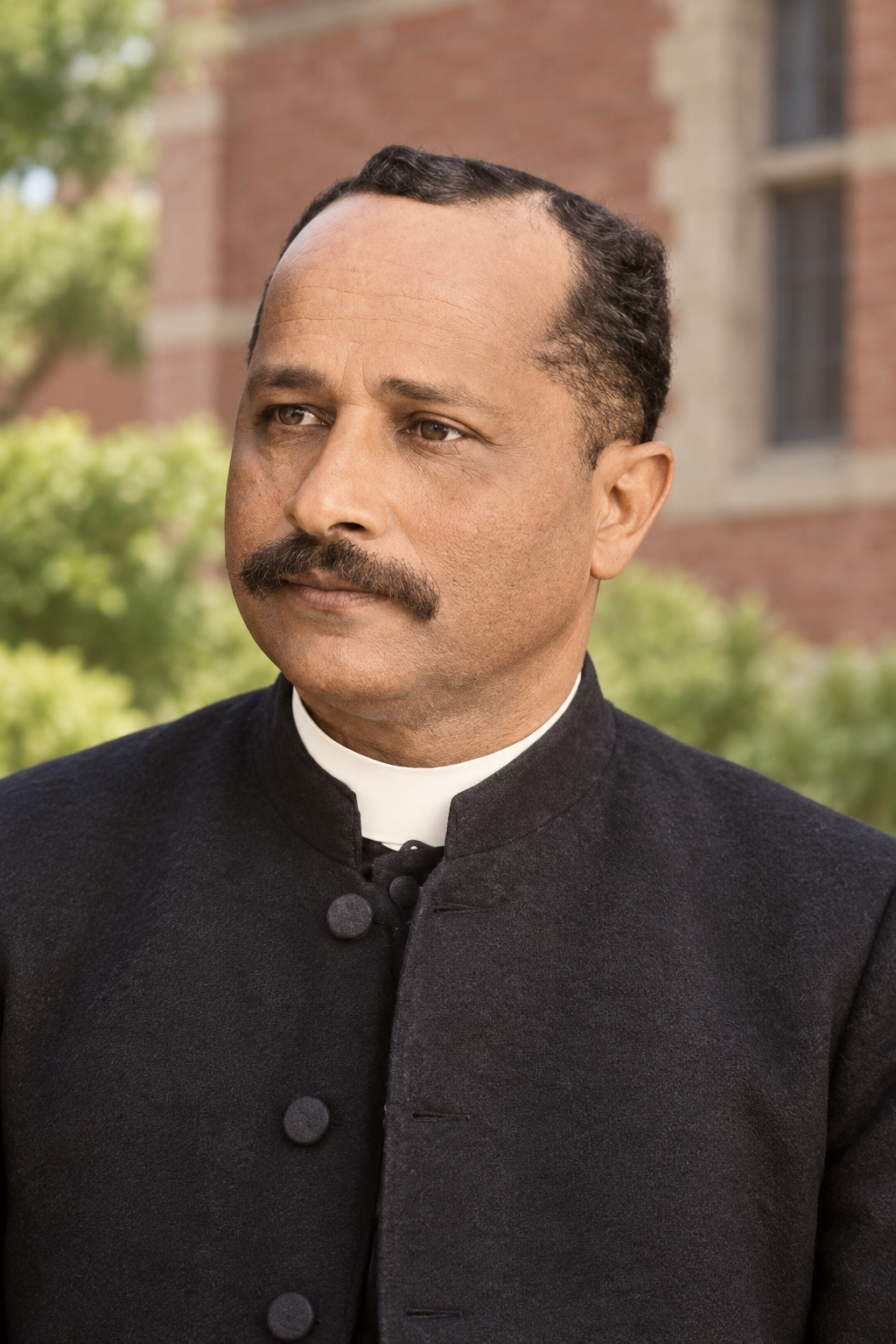
About James Solomon Russell
James Solomon Russell was an Episcopal priest who built a school and challenged restrictions on Black participation in his church.
Born enslaved, Russell spent his earliest years with his mother while his father lived on a plantation in North Carolina. The family reunited after the Civil War. Their efforts to support a small farm made schooling difficult, linking his own education to the household’s need for work and income.
His family’s support was essential. His mother kept encouraging him to return to school, and the family paid for some of his early tuition with food and labor. While teaching, he became interested in the Episcopal Church after receiving a copy of the Book of Common Prayer. Pattie Buford helped bring his wish to study for the ministry to the bishop’s attention. He became the first student at the institution later known as Bishop Payne Divinity School. He married Virginia Michigan Morgan in 1882, and the couple began a parish school in Lawrenceville.
Russell was ordained deacon in 1882 and priest in 1887. The parish school began in 1883; the distinct Saint Paul Normal and Industrial School opened in 1888. Its courses combined academic subjects with training in practical trades. Russell worked continually to raise money, while enrollment increased and the school acquired land and buildings.
A contemporary account by G. F. Richings describes a school dependent on voluntary contributions. Students paid part of their expenses through money and labor, while donors were asked to provide scholarships for the balance. The trades offered included carpentry, blacksmithing, printing, and farming for boys, and sewing, tailoring, and cooking for girls. This was a gendered program of vocational education, not an identical curriculum for every pupil. Richings also reported that students were admitted without discrimination on account of their religious beliefs, although all had to follow the school’s rules. The account praised Russell’s work and appealed for equipment and support, giving it the character of advocacy as well as description.
Richings reported more than three hundred students in the 1895–1896 session, drawn from sixteen states. He also described a graduating class representing nine states. These figures show the reach claimed for the school in a contemporary account; they are not enrollment totals for Russell’s entire career.
The school’s expansion brought disputes over management. Samuel H. Bishop, executive director of the American Church Institute for Negroes, criticized its finances and Russell’s practices. As historian Worth Norman recounts, Bishop objected to the school’s profits from students’ contract work for local businesses and farmers, charging that the arrangement exploited them. The disagreement became a struggle over control of the institution. Norman’s account favors Russell and draws on earlier scholarship; the criticism remains part of the school’s history, rather than disappearing behind its achievements.
The campus gave visible form to the relationship between study, work, and worship. The 1979 historic nomination identifies the Memorial Chapel, the Saul Building, and the former president’s house as its early architectural core. The chapel, built in 1904, was erected largely through student labor. Its brick walls, bell tower, stained glass, and exposed roof timbers made it a substantial place of worship within the school. The same nomination describes later alterations to the interior, including changed seating and a modernized sanctuary. Its account therefore records a building that continued to change, rather than an untouched setting from Russell’s years. The nomination documents the institution’s development through its buildings, recording the practical work of students alongside the leadership of the principal.
Russell also faced racial restrictions within the church itself. In 1889 he joined other Black ministers in protesting limits on their participation in the diocesan council. Appointed archdeacon in 1893, he supported congregations across Southern Virginia. A later effort to remove racial language from diocesan rules failed. He declined opportunities to become a bishop, choosing to remain at Saint Paul’s. He retired in 1929 and died in Lawrenceville on March 28, 1935.
Norman’s account gives the dispute a wider institutional setting. The funding agency affiliated several schools with different needs and programs, while struggling to secure enough financial support itself. Bishop’s objections included unpaid debts, the need for workshop equipment and buildings, and Russell’s practice of deciding whether to retain teachers only at the start of a term. These concerns involved the daily administration of education as well as competing claims to authority. The local trustees supported Russell’s management. Norman’s sympathetic interpretation should not obscure the questions raised about staffing, finances, and the conditions under which students worked.
The institution continued developing after his retirement. A teacher-training department established in 1922 had received state accreditation in 1926. Its later four-year degree programs and the name Saint Paul’s College belonged to changes made after Russell’s death. Those later achievements grew out of the school he had founded, but were the work of subsequent leaders, teachers, and students.
The Episcopal Church commemorates Russell on March 28.
Wondering how to weigh the stories and sources? Learn how to read a saint biography.