Biography
Jan Sarkander
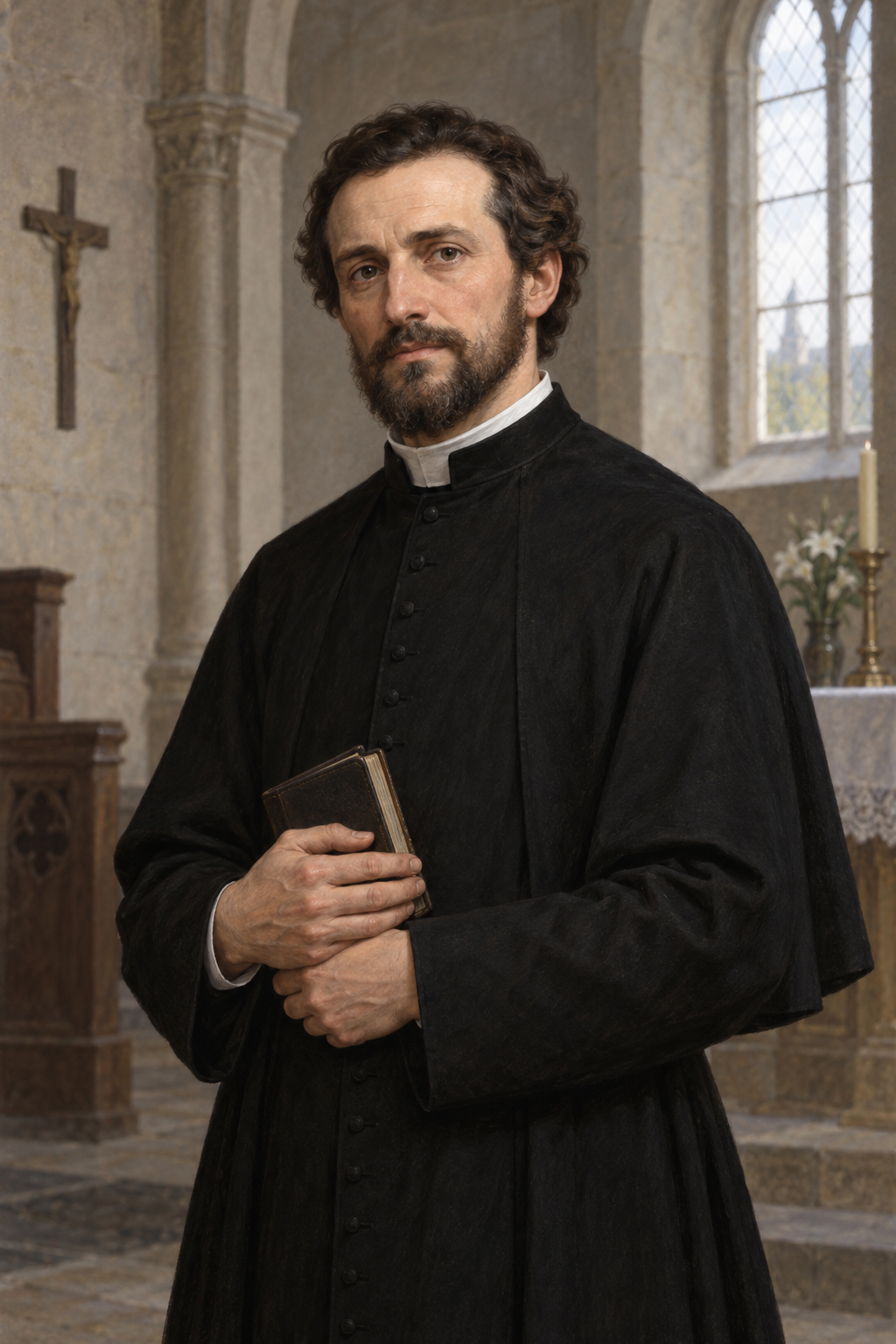
About Jan Sarkander
Jan Sarkander was born on 20 December 1576 in Skoczów, then in Silesia and now in Poland. After his father died, his mother moved the family to Příbor in Moravia. The town of Skoczów describes his education at a parish school and then at Jesuit schools in Olomouc and Prague. This movement across places that now lie in different countries belongs to the history of the region, not to a modern nationality that the sources assign him.
His studies in philosophy led to degrees at Prague in 1602 and 1603. He began theological study in Graz in 1604, interrupted it, and later returned. A Czech church account notes a surviving marriage agreement and calls him probably a widower when he was ordained. That is a qualified conclusion, not a secure account of his wife's life or death, and this biography does not build a story around it. His formation was less direct than a simple childhood-to-priesthood narrative would suggest.
Sarkander was ordained a priest in Brno in March 1609. He served several communities of the Olomouc diocese before being appointed parish priest of Holešov. The town lay on the estate of Ladislav Popel of Lobkowicz, an important Catholic governor in Moravia. Sarkander also served as his confessor. That pastoral relationship acquired political importance during the rising against Habsburg rule, but its existence alone cannot establish what either man knew of military plans.
The early seventeenth century brought religious disagreement into the contest for power in Moravia. The Olomouc Museum of Art places Sarkander's last years within the Estates' uprising and the opening of the Thirty Years' War. Protestant estates, Catholic officials and outside armed forces all had interests at stake. Parish life in Holešov could not be sealed off from those conflicts. A priest connected to a Catholic governor was especially exposed to suspicion when control of the region changed.
In 1619 Sarkander traveled to the Marian shrine at Częstochowa in Poland. The journey was a pilgrimage in the town of Skoczów's account, yet critics later gave it a second, political interpretation. They suspected that he had carried or negotiated a request for Polish armed support of the Habsburg side. The distinction matters: a journey that actually happened is evidence of travel, while an allegation about its secret purpose requires separate proof. The consulted sources do not establish such a mission.
Polish Lisowczycy troops entered Moravia in 1620. The events of that campaign and Sarkander's earlier journey exposed him to a charge of helping to arrange the invasion. Olomouc's biographical account states the accusation but offers no evidence that he had directed the troops. The allegation arose in a war in which armed forces could devastate settlements, and it carried serious danger for a priest associated with a Catholic governor. No consulted source establishes that he had foreknowledge of the troops' route.
As Protestant estates gained power, Sarkander hid, was captured and was taken to Olomouc. His judges wanted an account of the invasion and of his connection to Lobkowicz. The former prison stood where a chapel dedicated to him stands today. That surviving place ties his final weeks to a specific urban setting, even though its present devotional form was built after his death. The city describes the site as a former prison in which he was interrogated and tortured.
The Holy See account singles out a fourth interrogation on 18 February 1620. One judge pressed the suggestion that Lobkowicz had disclosed an invasion plan to Sarkander in confession. According to that account, Sarkander said he had learned no such thing and would not reveal what he had heard in the sacrament. The two statements should be kept together. Refusal to disclose confession was an act of priestly duty; it does not itself prove that the purported military secret existed.
The interrogations used torture, a severe assault on the prisoner. Sarkander survived the questioning for several weeks and died in custody on 17 March 1620 from its injuries. Olomouc preserves the former prison site as a chapel associated with his death. Its present building is a place of devotion, not the room exactly as he would have seen it. Later accounts add vivid details of his injured body and prayer, but the heritage site by itself cannot authenticate every scene.
Catholics soon honored Sarkander as a martyr for fidelity to the confessional seal. The Moravian Museum explains that interrogation notes fed later texts in Czech, Latin, Polish and German, shaping a legendary portrait that circulated in popular religious culture. His memory was also linked to John of Nepomuk, another saint associated with a refusal to divulge confession. The resemblance in later devotion does not make their lives or the evidence for each death interchangeable.
That devotional history developed over centuries. An effort toward beatification began in the eighteenth century, while a formal church decision came only in the nineteenth. The Holy See dates the beatification decree to 11 September 1859 and the ceremony in St Peter's to 6 May 1860. Both dates describe parts of one recognition process. Calling the ceremony the 1859 decree, or treating them as competing birth-like dates, would misstate the record.
John Paul II canonized Sarkander at Olomouc on 21 May 1995. In the homily he praised the priest's constancy under torture and also asked forgiveness, in the name of Catholics, for wrongs inflicted on non-Catholics in the region's troubled history. That acknowledgment belongs in a truthful account of a saint whose memory arose from confessional violence. The pope's words were a church act of remembrance and reconciliation, not a new trial record from 1620.
His commemorations also reflect place and tradition. Vatican News lists Sarkander on 17 March, the date of his death. The Church in the Czech lands commemorates him on 6 May, the anniversary of the public beatification ceremony. Recording both dates identifies their sources and scope; it does not turn either into a claim about every Catholic calendar. The former prison chapel in Olomouc and remembrance in his birthplace of Skoczów show how local communities have kept his memory in different places.
Sarkander's life joins ordinary study and parish ministry to an extraordinary death under interrogation. His judges' allegation about Polish troops remains an allegation in this review, while the injury and death caused by torture are central historical facts. The Catholic judgment of martyrdom honors his fidelity to the seal of confession. Holding those distinctions together allows respect for his witness without repeating political suspicion as proof or letting later legend replace the more limited surviving evidence.
Wondering how to weigh the stories and sources? Learn how to read a saint biography.