Biography
Jerome
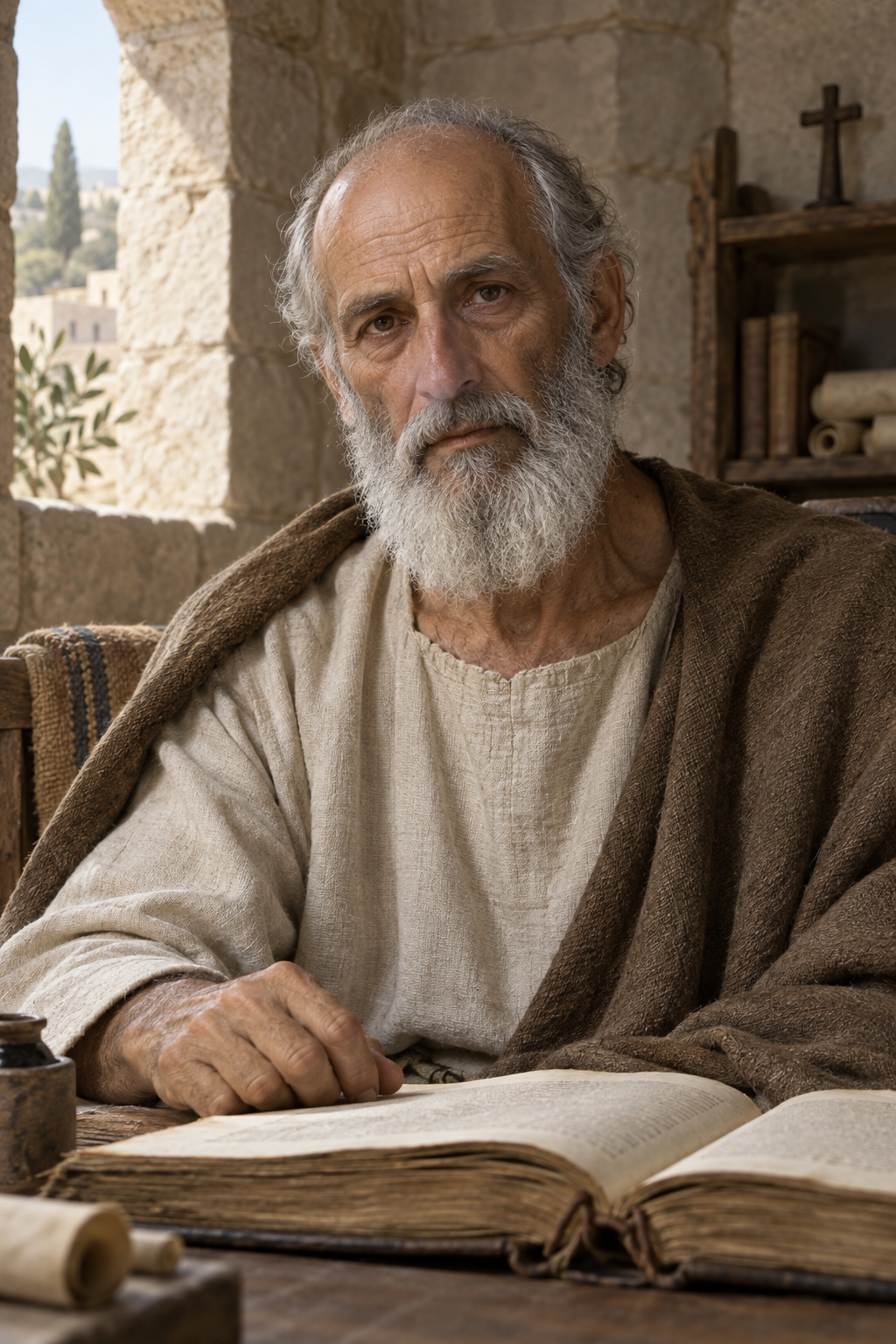
About Jerome
Jerome devoted much of his life to helping Latin-speaking Christians read and understand Scripture. His work involved translation, the comparison of texts, and the patient demands of learning languages. It also depended on relationships with teachers, patrons, and students, rather than on solitary scholarship alone. Born at Stridon in the middle of the fourth century, he received part of his education in Rome before journeys took him eastward and eventually to Bethlehem.
The chronology of his youth is not settled to an exact year. Benedict XVI's account places his birth around 347 and baptism around 366; Francis's later account gives birth around 345 and baptism between 358 and 364. Both place his education and baptism in Rome before his commitment to an ascetic life. These differences call for approximate dates, not a manufactured birthday or a confident reconstruction of each stage of his youth.
In a letter to Rusticus, Jerome recalls the difficulty of learning Hebrew while living in the desert. He sought instruction from a man who had been Jewish before becoming a Christian. Accustomed to polished Latin literature, he found himself learning unfamiliar letters and sounds. He admits repeatedly losing heart, giving up, and returning to the task, and says that the effort later bore fruit. The account makes his learning a matter of persistence rather than effortless ability.
His attachment to classical writing also troubled him. Writing to Eustochium, he describes carrying his Roman library with him and returning to Cicero and Plautus even while pursuing an austere religious life. He then recounts a frightening experience during a fever, in which a heavenly judge accused him of following Cicero rather than Christ. This is Jerome's own account of a religious experience, not independent evidence that the judgment scene occurred as he describes it.
Jerome returned to Rome in 382 and worked with Pope Damasus, who encouraged his biblical scholarship. He also taught women including Marcella and Paula, whose interest in Scripture formed an important part of his work there. After Damasus died, Jerome left Rome in 385. His subsequent travels included the Holy Land and Egypt, and in 386 he settled in Bethlehem, where he continued studying and writing.
Paula was more than a name among his students. In the letter written after her death, Jerome credits her with providing monastic buildings and accommodation for travelers at Bethlehem. He describes her and her daughter Eustochium asking to study the biblical books with him. When he admitted uncertainty, Paula pressed him to compare possible explanations. His account shows a teacher being challenged by a student's questions, not simply passing knowledge in one direction.
Translation brought arguments about what faithfulness to a text required. In Letter 57, Jerome defends a translation of another churchman's letter after critics accused him of altering it. He explains his preference for conveying meaning rather than mechanically replacing one word with another, while making a special qualification for Scripture. His discussion acknowledges the problems of idiom, word order, and style when moving between languages. It presents translation as a series of accountable choices, not an automatic exercise.
His biblical work included revising the Latin Gospels and translating Old Testament books from Hebrew. These labors helped shape the Latin Bible known as the Vulgate, alongside the work of others who continued the undertaking. It is therefore misleading to describe the whole received Latin Bible as a single translation made entirely by Jerome. The work's later importance does not erase the earlier texts, collaborators, or revisions involved in its transmission.
His advice about learning extended beyond specialist translators. In a letter to Laeta about her young daughter Paula, he recommends letters that the child can handle and recognize through play. He suggests guiding her hand as she learns to write and encouraging her with praise rather than scolding her for learning slowly. The advice belongs to a demanding program of religious upbringing, but its practical attention to a child's first lessons is clear.
Jerome could also be a harsh opponent. The same Letter 57 that explains his translation methods attacks his critics' motives and conduct. His defense must be read as one participant's argument, not a neutral account of everyone involved. His letters preserve intellectual care alongside cutting speech; their value does not require treating every insult as justified or every disagreement as proof of another person's bad faith.
Writing to Paulinus, Jerome praised eagerness to learn even when a teacher was not readily available. He connected Christian ministry with serious study and the ability to answer questions about Scripture. His letter reflects the conviction that good intentions alone do not supply all the knowledge a teacher needs. The emphasis complements his own account of returning to difficult language lessons and his recollection of Paula pressing him for better explanations.
Jerome died at Bethlehem, traditionally dated to 30 September 420, although Benedict XVI's account allows 419 or 420. His surviving letters preserve the practical work behind his reputation: learning unfamiliar sounds, answering questions, explaining translation choices, and encouraging study. They also preserve his disputes and limitations. His lasting significance lies in the access his scholarship gave Latin readers to Scripture, and in the record it leaves of the effort and judgment that such work demands.
Wondering how to weigh the stories and sources? Learn how to read a saint biography.
Explore similar vocations
Prayers for Jerome
Prayer excerpt from Letter 22
Have mercy upon me, O Lord: have mercy upon me.